
实验山羊模型中的主动脉弓压力感受器刺激:一种降低血压的新方法。
Aortic Arch Baroreceptor Stimulation in an Experimental Goat Model: A Novel Method to Lower Blood Pressure.
作者信息
Benson Jacobus F, Schoeman Johan P, Venter Frans J, Ker James A, Zeiler Gareth E, Bester Lynette, van Niekerk Janet, Tintinger Gregory R
机构信息
Faculty of Health Sciences, University of Pretoria, Pretoria, South Africa.
Faculty of Veterinary Science, University of Pretoria, Pretoria, South Africa.
出版信息
Front Cardiovasc Med. 2019 Jan 15;5:193. doi: 10.3389/fcvm.2018.00193. eCollection 2018.
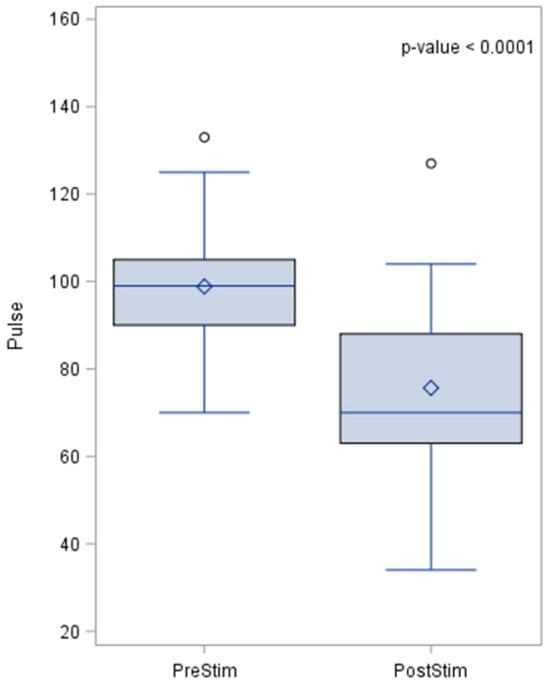
The effect of aortic baroreceptor stimulation on blood pressure manipulation was assessed using the goat species . The aim of this study was to manipulate blood pressure with future intention to treat high blood pressure in humans. The ages of the animals ranged from 6 months to 2 years. A standard anesthesia protocol was used. A lateral thoracotomy was performed to gain access to the aortic arch. Data was collected with the Vigileo system. Pre stimulation blood pressure was compared with maximum post stimulation blood pressure values. Results were analyzed with the Wilcoxon signed rank test. In the study 38 animals were enrolled. Baroreceptor stimulation was performed for each animal using 3 different electrodes each of which emits an electrical impulse. In the pilot phase of the study, the median baseline blood pressure prior to stimulation of the baroreceptors was 110.8 mmHg. After stimulation the median blood pressure decreased to 88 mmHg. The average decrease in blood pressure was 22.8 mmHg. This decrease of blood pressure after stimulation of the baroreceptors is statistically significant ( < 0.0001) and the proof of concept was shown. During the extended phase all three probes had a significant effect on blood pressure lowering ( < 0.0001). The study confirmed that aortic baroreceptor stimulation has an effect on blood pressure lowering. This is a novel field of blood pressure manipulation. The hemodynamic effects of long-term aortic baroreceptor stimulation are unknown. Further investigations need to be done to determine whether a similar effect can be induced in different species such as primates and humans.
使用山羊评估主动脉压力感受器刺激对血压调控的影响。本研究的目的是调控血压,以期未来治疗人类高血压。动物年龄在6个月至2岁之间。采用标准麻醉方案。通过侧胸切开术暴露主动脉弓。使用Vigileo系统收集数据。将刺激前血压与刺激后最高血压值进行比较。结果采用Wilcoxon符号秩检验进行分析。本研究纳入了38只动物。对每只动物使用3种不同电极进行压力感受器刺激,每种电极都会发出电脉冲。在研究的试点阶段,刺激压力感受器之前的基线血压中位数为110.8 mmHg。刺激后血压中位数降至88 mmHg。血压平均下降22.8 mmHg。压力感受器刺激后血压的下降具有统计学意义(<0.0001),证明了概念验证。在扩展阶段,所有三种探头对降低血压均有显著效果(<0.0001)。该研究证实主动脉压力感受器刺激对降低血压有作用。这是血压调控的一个新领域。长期主动脉压力感受器刺激的血流动力学效应尚不清楚。需要进一步研究以确定在灵长类和人类等不同物种中是否能诱导出类似效果。



 Zotero 插件