National Center for Advancing Translational Sciences , National Institutes of Health , Rockville , Maryland 20850 , United States.
ACS Chem Biol. 2019 Mar 15;14(3):497-505. doi: 10.1021/acschembio.9b00001. Epub 2019 Feb 14.
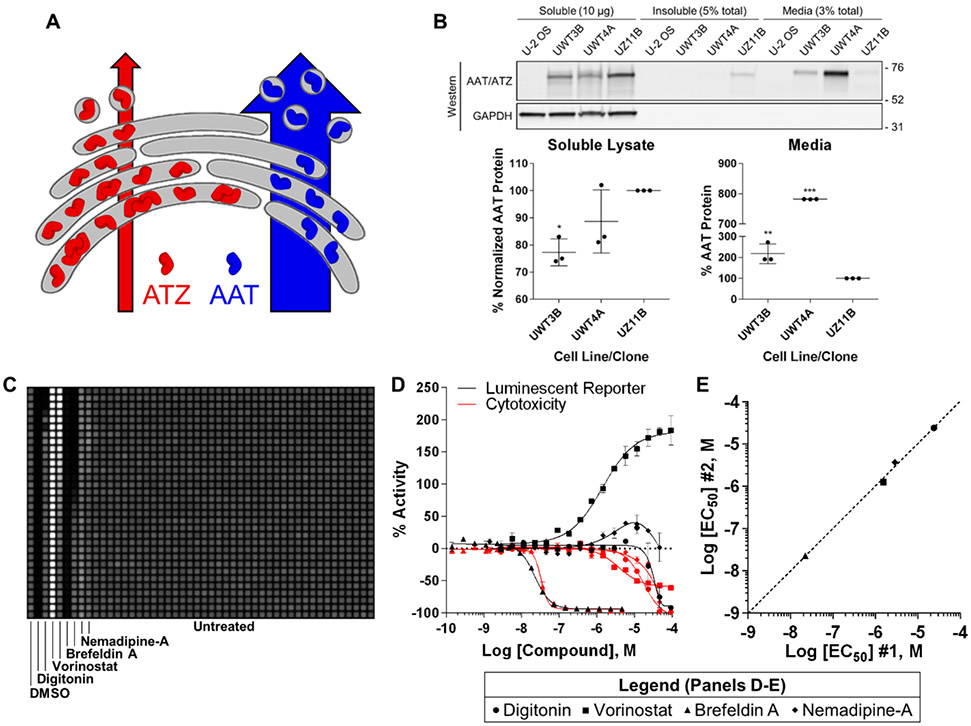
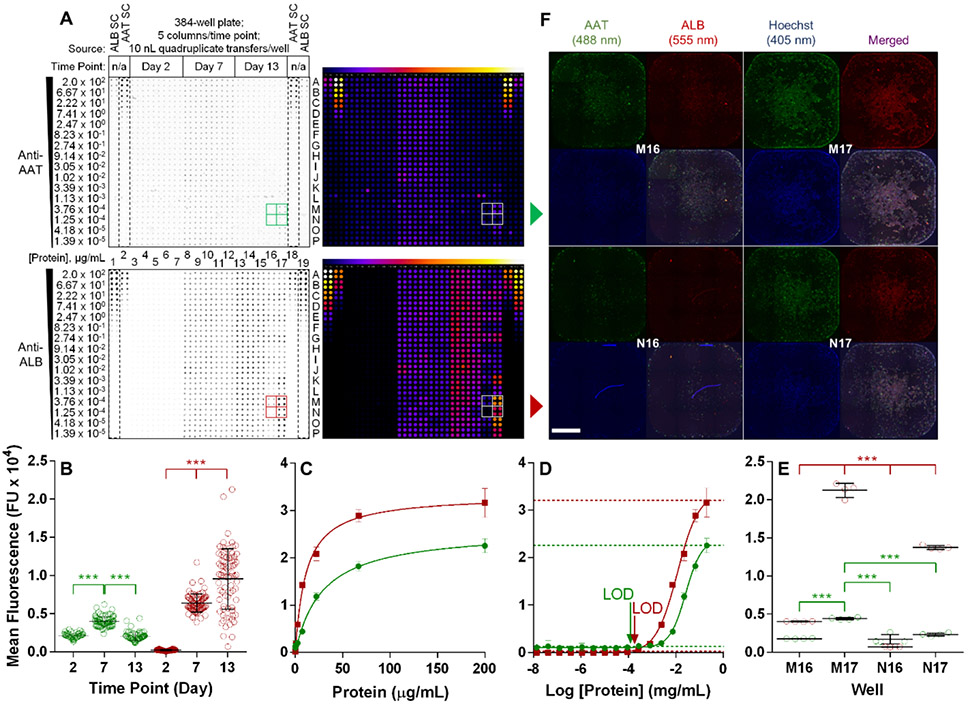
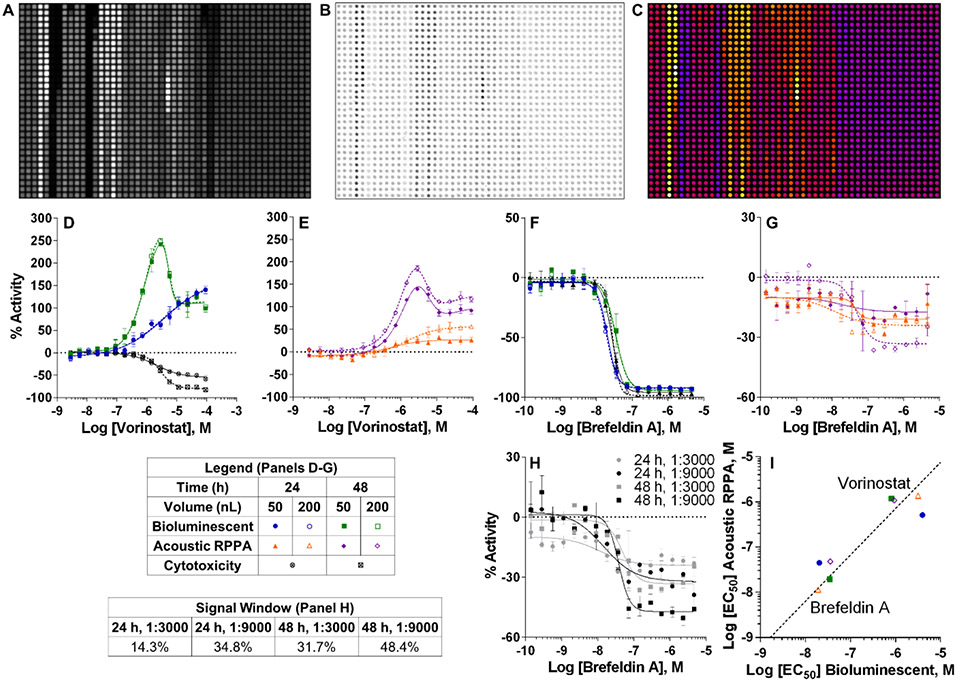
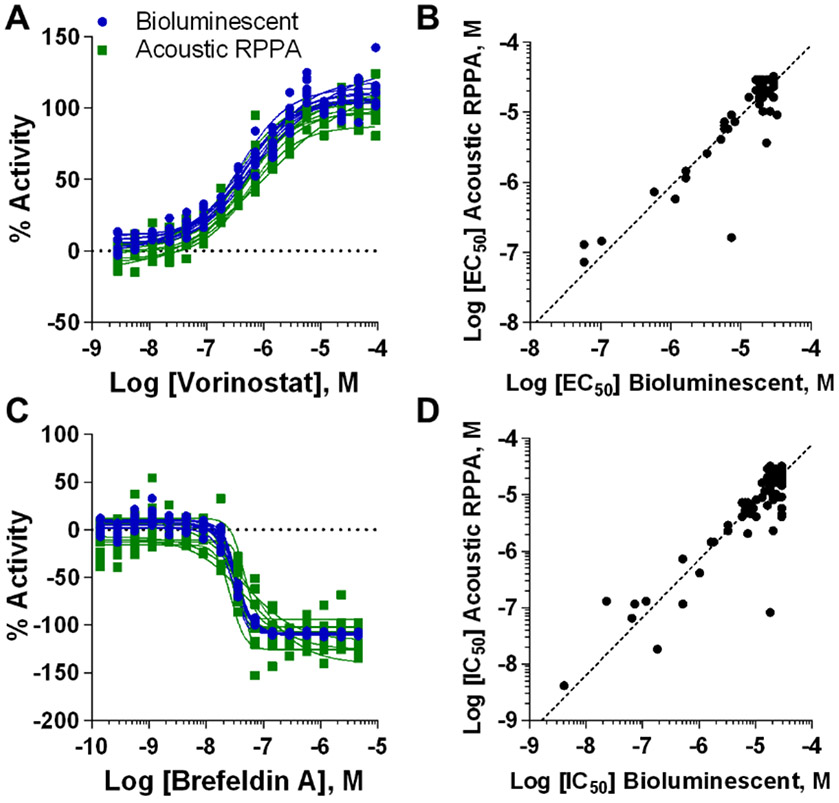
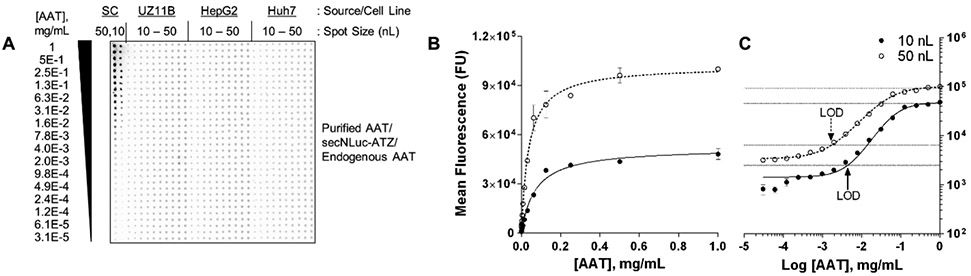
Nearly one-third of the encoded proteome is comprised of secretory proteins that enable communication between cells and organ systems, playing a ubiquitous role in human health and disease. High-throughput detection of secreted proteins would enhance efforts to identify therapies for secretion-related diseases. Using the Z mutant of alpha-1 antitrypsin as a human secretory model, we have developed 1536-well high-throughput screening assays that utilize acoustic droplet ejection to transfer nanoliter volumes of sample for protein quantification. Among them, the acoustic reverse phase protein array (acoustic RPPA) is a multiplexable, low-cost immunodetection technology for native, endogenously secreted proteins from physiologically relevant model systems like stem cells that is compatible with plate-based instrumentation. Parallel assay profiling with the LOPAC chemical library validated performance and orthogonality between a secreted bioluminescent reporter and acoustic RPPA method by consistently identifying secretory modulators with comparable concentration response relationships. Here, we introduce a robust, multiplexed drug discovery platform coupling extracellular protein quantification by acoustic RPPA with intracellular and cytotoxicity analyses from single wells, demonstrating proof-of-principle applications for human induced pluripotent stem cell-derived hepatocytes.
近三分之一的编码蛋白质组由分泌蛋白组成,这些蛋白可在细胞和器官系统之间进行通讯,在人类健康和疾病中发挥着普遍的作用。高通量检测分泌蛋白将有助于寻找与分泌相关的疾病的治疗方法。我们使用 alpha-1 抗胰蛋白酶的 Z 突变体作为人类分泌模型,开发了 1536 孔高通量筛选测定法,该方法利用声滴喷射将纳升体积的样品转移到用于蛋白质定量的孔中。其中,声反向蛋白阵列(acoustic RPPA)是一种可进行多重检测的、低成本的免疫检测技术,用于检测来自生理相关模型系统(如干细胞)中天然的、内源性分泌蛋白,与基于板的仪器兼容。与 LOPAC 化学文库的平行测定分析验证了分泌生物发光报告基因和 acoustic RPPA 方法之间的性能和正交性,一致地识别出具有可比浓度反应关系的分泌调节剂。在这里,我们介绍了一个强大的、多重的药物发现平台,该平台将声 RPPA 对细胞外蛋白质的定量与单个孔中的细胞内和细胞毒性分析相结合,证明了其在人诱导多能干细胞衍生的肝细胞中的应用原理。