Center for Innovation to Implementation (Ci2i), VA Palo Alto Health Care System, Stanford University, 795 Willow Rd, Menlo Park, CA, 94025, USA.
Veterans Health Administration, Pharmacy Benefits Management, Academic Detailing Service, Seattle, WA, USA.
Implement Sci. 2019 Feb 1;14(1):11. doi: 10.1186/s13012-019-0853-y.
It is challenging to conduct and quickly disseminate findings from in-depth qualitative analyses, which can impede timely implementation of interventions because of its time-consuming methods. To better understand tradeoffs between the need for actionable results and scientific rigor, we present our method for conducting a framework-guided rapid analysis (RA) and a comparison of these findings to an in-depth analysis of interview transcripts.
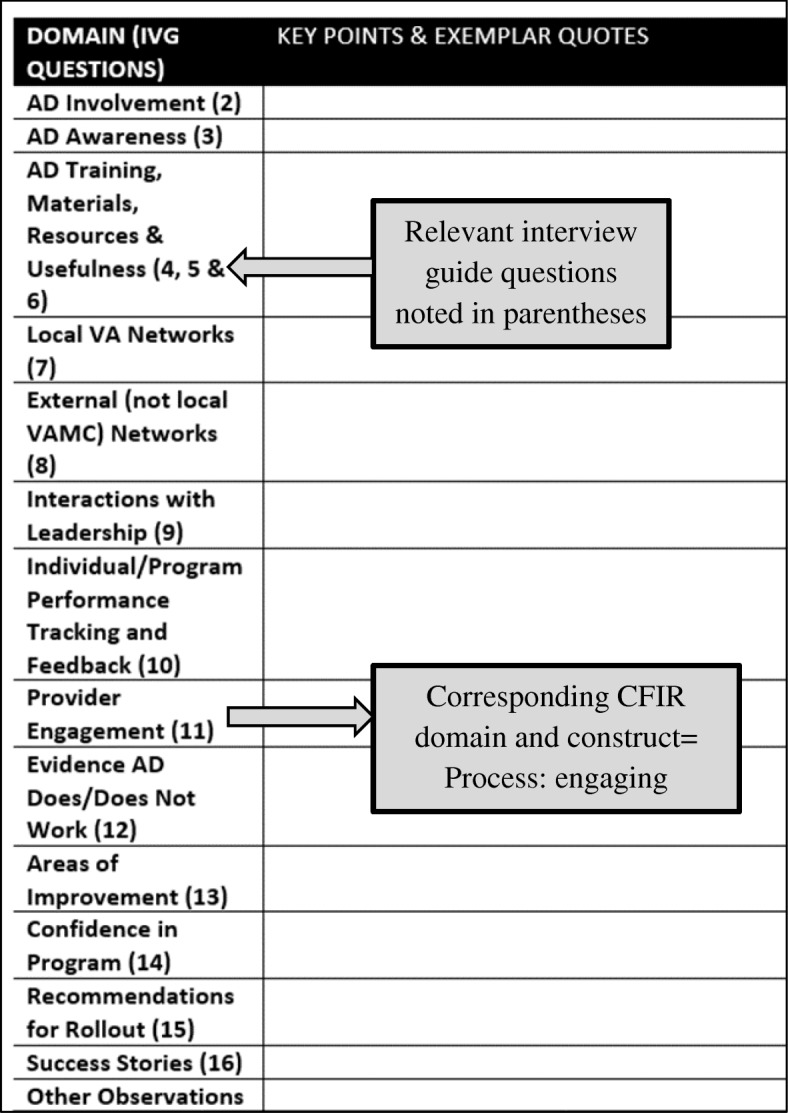
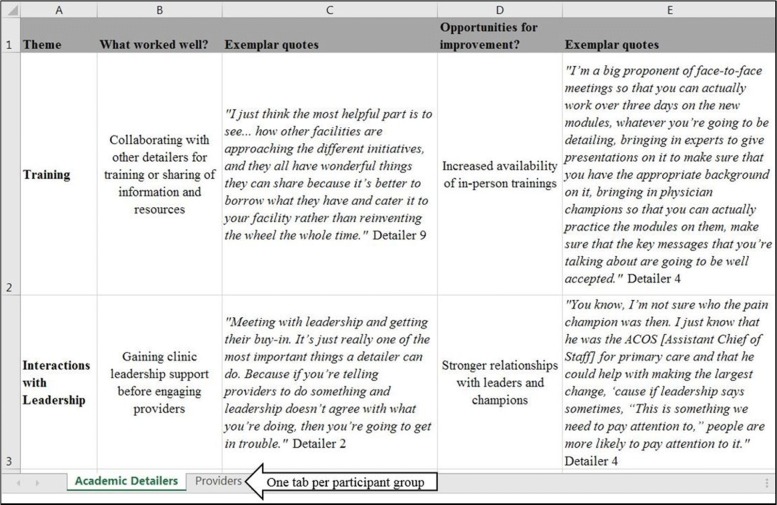
Set within the context of an evaluation of a successful academic detailing (AD) program for opioid prescribing in the Veterans Health Administration, we developed interview guides informed by the Consolidated Framework for Implementation Research (CFIR) and interviewed 10 academic detailers (clinical pharmacists) and 20 primary care providers to elicit detail about successful features of the program. For the RA, verbatim transcripts were summarized using a structured template (based on CFIR); summaries were subsequently consolidated into matrices by participant type to identify aspects of the program that worked well and ways to facilitate implementation elsewhere. For comparison purposes, we later conducted an in-depth analysis of the transcripts. We described our RA approach and qualitatively compared the RA and deductive in-depth analysis with respect to consistency of themes and resource intensity.
Integrating the CFIR throughout the RA and in-depth analysis was helpful for providing structure and consistency across both analyses. Findings from the two analyses were consistent. The most frequently coded constructs from the in-depth analysis aligned well with themes from the RA, and the latter methods were sufficient and appropriate for addressing the primary evaluation goals. Our approach to RA was less resource-intensive than the in-depth analysis, allowing for timely dissemination of findings to our operations partner that could be integrated into ongoing implementation.
In-depth analyses can be resource-intensive. If consistent with project needs (e.g., to quickly produce information to inform ongoing implementation or to comply with a policy mandate), it is reasonable to consider using RA, especially when faced with resource constraints. Our RA provided valid findings in a short timeframe, enabling identification of actionable suggestions for our operations partner.
深入的定性分析很难进行,且传播速度较慢,这可能会因为耗时的方法而阻碍干预措施的及时实施。为了更好地理解在需要可操作的结果和科学严谨性之间进行权衡,我们提出了一种进行框架引导快速分析(RA)的方法,并将这些发现与对访谈记录的深入分析进行了比较。
在评估退伍军人事务部(VA)中成功的阿片类药物处方学术细化(AD)计划的背景下,我们根据综合实施研究框架(CFIR)制定了访谈指南,并采访了 10 名学术细化员(临床药师)和 20 名初级保健提供者,以详细了解该计划成功的特征。对于 RA,使用结构化模板(基于 CFIR)对逐字记录进行总结;随后根据参与者类型将摘要合并到矩阵中,以确定该计划运行良好的方面以及在其他地方促进实施的方法。出于比较目的,我们后来对记录进行了深入分析。我们描述了我们的 RA 方法,并就主题的一致性和资源强度方面对 RA 和演绎性深入分析进行了定性比较。
在 RA 和深入分析中贯穿使用 CFIR 有助于为两种分析提供结构和一致性。两种分析的结果是一致的。从深入分析中最常编码的结构与 RA 中的主题很好地吻合,后者方法足以且适合解决主要的评估目标。我们的 RA 方法比深入分析的资源密集度低,允许及时向我们的运营伙伴传播结果,以便将其纳入正在进行的实施中。
深入分析可能会耗费大量资源。如果与项目需求一致(例如,快速生成信息以告知正在进行的实施或遵守政策要求),则考虑使用 RA 是合理的,尤其是在面临资源限制的情况下。我们的 RA 在短时间内提供了有效发现,为我们的运营伙伴确定了可操作的建议。