BC Children's Hospital Research Institute, Vancouver, Canada; Pediatrics, University of British Columbia, Vancouver, Canada.
Neurology, The Hospital for Sick Children, Toronto, Canada; Paediatrics, University of Toronto, Toronto, Canada.
EBioMedicine. 2019 Feb;40:655-662. doi: 10.1016/j.ebiom.2019.01.042. Epub 2019 Jan 30.
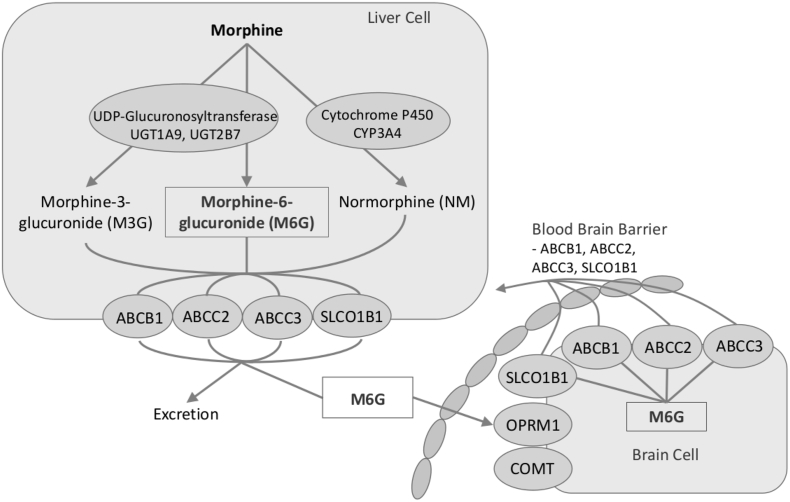
Behaviour problems are prevalent among children born very preterm (≤ 32 weeks gestation), and have been associated with morphine exposure. Morphine accumulation in the brain is determined by genetic variations related to morphine biotransformation. The objective of the study was to investigate whether morphine-biotransformation genotypes contribute to individual differences in long-term effects of morphine on behaviour at 18 months corrected age (CA).
198 children born very preterm (24-32 weeks gestation) were followed from birth and seen at 18 months CA. Relationships between child behavior (Internalizing, Externalizing on the Child Behavior Checklist), morphine exposure, neonatal clinical variables, and morphine biotransformation gene variants in ABCB1, UGT1A9, UGT 2B7*2, ABCC2, ABCC3, SLCO1B1, CYP3A4, COMT were examined.
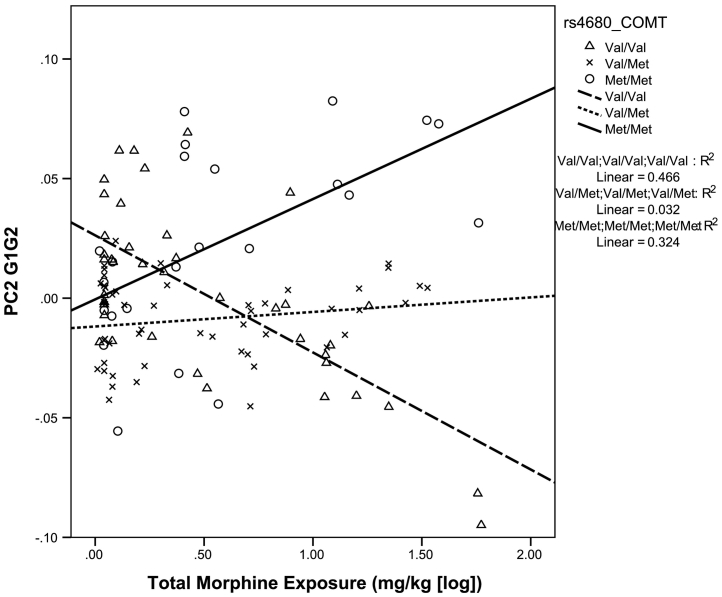
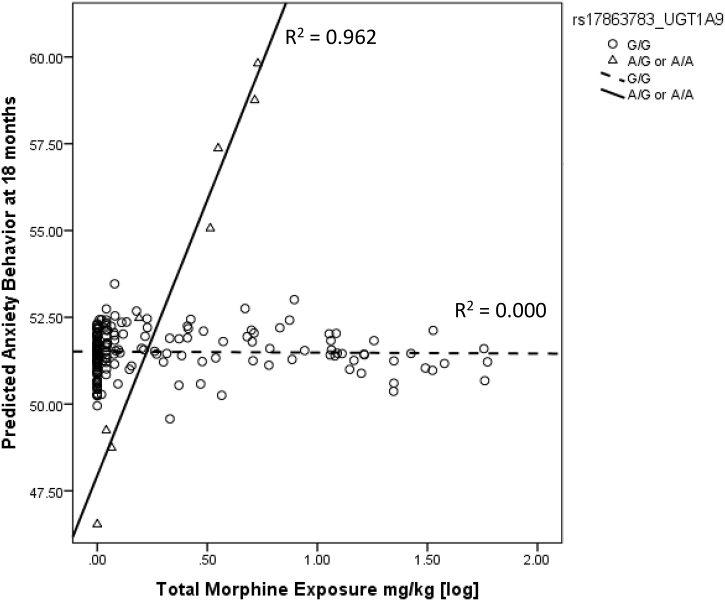
Neonatal clinical predictors and genotypes accounted for 39% of the overall variance in behaviour. In children with the minor allele of UGT1A9 rs17863783 (marker of UGT1A6*4, UDP-glucuronosyltransferase), greater morphine exposure (p = ·0011) was associated with more Internalizing behaviour. More Externalizing behaviour was predicted by greater morphine exposure in children with the COMT rs4680 Met/Met genotype (p = ·0006).
Genetic variations that affect relative accumulation of morphine in the brain, together with neonatal clinical factors, are differentially related to anxiety and depressive symptoms (internalizing) and to acting out (externalizing) behaviours at 18 months CA in children born very preterm. FUND: NIH/NICHD HD039783 (REG); CIHR MOP86489 (REG), MOP68898 (SPM), MOP79262 (SPM, REG).
行为问题在极早产儿(≤32 周妊娠)中很常见,且与吗啡暴露有关。吗啡在大脑中的积累取决于与吗啡生物转化相关的遗传变异。本研究的目的是探讨吗啡生物转化基因型是否有助于在 18 个月校正年龄(CA)时吗啡对行为的长期影响的个体差异。
198 名极早产儿(24-32 周妊娠)从出生开始随访,在 18 个月 CA 时进行检查。研究了儿童行为(儿童行为检查表的内化、外化)、吗啡暴露、新生儿临床变量以及 ABCB1、UGT1A9、UGT2B7*2、ABCC2、ABCC3、SLCO1B1、CYP3A4、COMT 等吗啡生物转化基因变异之间的关系。
新生儿临床预测因子和基因型解释了行为总变异的 39%。在 UGT1A9 rs17863783(UGT1A6*4、UDP-葡萄糖醛酸基转移酶的标记物)的次要等位基因的儿童中,更大的吗啡暴露量(p=·0011)与更多的内化行为相关。在 COMT rs4680 Met/Met 基因型的儿童中,更大的吗啡暴露量预测了更多的外化行为(p=·0006)。
影响吗啡在大脑中相对积累的遗传变异,以及新生儿临床因素,与极早产儿 18 个月 CA 时的焦虑和抑郁症状(内化)和行为问题(外化)相关。资助:NIH/NICHD HD039783(REG);CIHR MOP86489(REG)、MOP68898(SPM)、MOP79262(SPM、REG)。