Department of Neurology, The First Affiliated Hospital of Zhengzhou University, Zhengzhou, Henan, China.
The Departments of Radiology and Neurology, Massachusetts General Hospital and Harvard Medical School, Boston, MA, USA.
Sci Rep. 2019 Feb 4;9(1):1173. doi: 10.1038/s41598-018-36986-w.
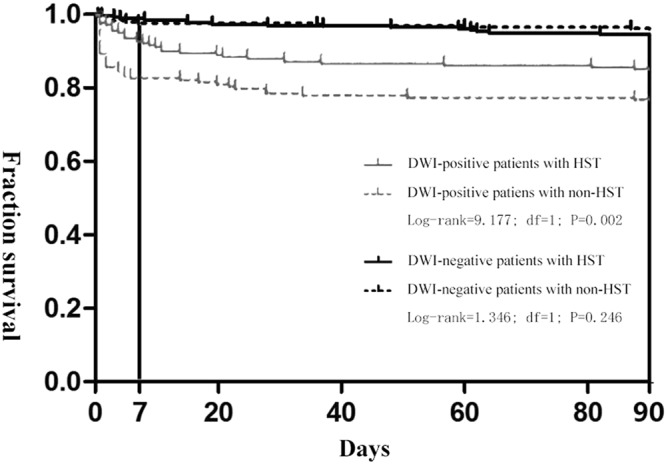
To determine whether positive or negative DWI TIA patients could get benefits from HST we conducted a cohort study which data from the prospective, hospital-based, TIA database of the First Affiliated Hospital of Zhengzhou University. The end-point was 7-day and 90-day incidence of stroke. Cox proportional hazard regression models were used to analyze the association between end-points and high-intensity statin treatment in TIA patients with positive and negative DWI. A total of 987 eligible TIA patients were analyzed. The stroke risk of patients with positive DWI was about a four-fold increase compared to that with negative DWI (7 d, 10.9 versus 1.8, p < 0.001 and 90 d, 18.3 versus 4.2, p < 0.001). After adjusting confounding factors, HST significantly improved both 7-day (HR 0.331, 95% CI 0.165-0.663; p = 0.002) and 90-day (HR 0.480, 95% CI 0.288-0.799; p = 0.005) outcomes in positive DWI patients. As a conclusion, high-intensity statin use reduces the 90 days' recurrent stroke risk in DWI-positive TIA patients but not in DWI-negative patients.
为了确定 DWI 阳性或阴性 TIA 患者是否能从 HST 中获益,我们进行了一项队列研究,该研究的数据来自郑州大学第一附属医院前瞻性、基于医院的 TIA 数据库。终点是 7 天和 90 天的卒中发生率。Cox 比例风险回归模型用于分析 TIA 患者阳性和阴性 DWI 与终点之间的关联。共分析了 987 例符合条件的 TIA 患者。与 DWI 阴性患者相比,DWI 阳性患者的卒中风险增加了约四倍(7 天,10.9 比 1.8,p<0.001;90 天,18.3 比 4.2,p<0.001)。调整混杂因素后,HST 显著改善了 DWI 阳性患者的 7 天(HR 0.331,95%CI 0.165-0.663;p=0.002)和 90 天(HR 0.480,95%CI 0.288-0.799;p=0.005)结局。总之,高强度他汀类药物的使用降低了 DWI 阳性 TIA 患者 90 天内复发卒中的风险,但对 DWI 阴性患者没有影响。