IFOM, The FIRC Institute of Molecular Oncology, via Adamello 16, 20139, Milan, Italy.
University of Milan, Department of Biosciences, Via Celoria 26, 20133, Milan, Italy.
Sci Rep. 2019 Feb 4;9(1):1211. doi: 10.1038/s41598-018-37780-4.
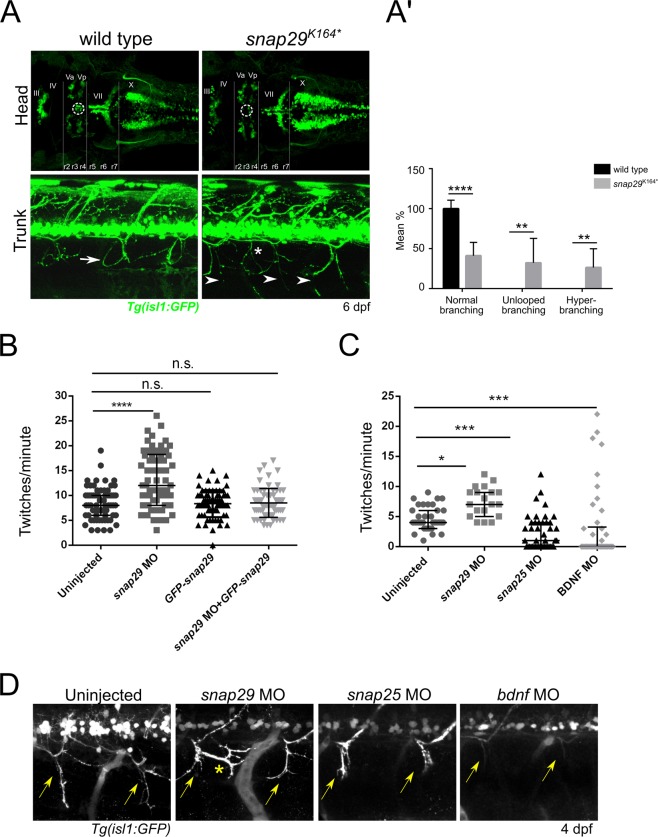
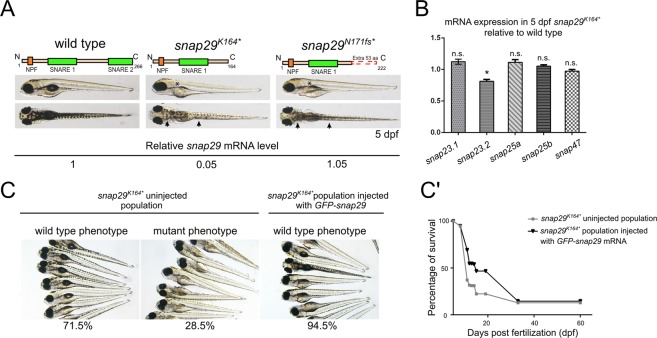
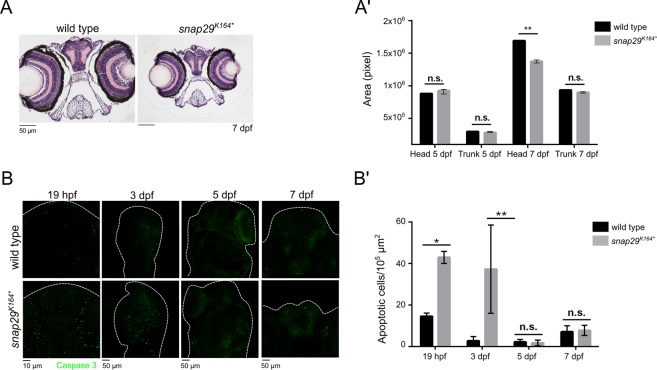
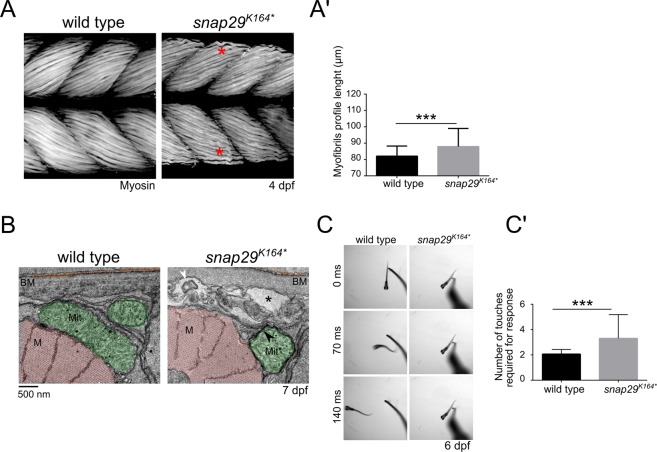
Homozygous mutations in SNAP29, encoding a SNARE protein mainly involved in membrane fusion, cause CEDNIK (Cerebral Dysgenesis, Neuropathy, Ichthyosis and Keratoderma), a rare congenital neurocutaneous syndrome associated with short life expectancy, whose pathogenesis is unclear. Here, we report the analysis of the first genetic model of CEDNIK in zebrafish. Strikingly, homozygous snap29 mutant larvae display CEDNIK-like features, such as microcephaly and skin defects. Consistent with Snap29 role in membrane fusion during autophagy, we observe accumulation of the autophagy markers p62 and LC3, and formation of aberrant multilamellar organelles and mitochondria. Importantly, we find high levels of apoptotic cell death during early development that might play a yet uncharacterized role in CEDNIK pathogenesis. Mutant larvae also display mouth opening problems, feeding impairment and swimming difficulties. These alterations correlate with defective trigeminal nerve formation and excess axonal branching. Since the paralog Snap25 is known to promote axonal branching, Snap29 might act in opposition with, or modulate Snap25 activity during neurodevelopment. Our vertebrate genetic model of CEDNIK extends the description in vivo of the multisystem defects due to loss of Snap29 and could provide the base to test compounds that might ameliorate traits of the disease.
编码 SNARE 蛋白的 SNAP29 基因纯合突变主要参与膜融合,导致 CEDNIK(脑发育不良、神经病、鱼鳞病和角化过度),这是一种罕见的先天性神经皮肤综合征,与预期寿命短有关,其发病机制尚不清楚。在这里,我们报告了在斑马鱼中分析 CEDNIK 的第一个遗传模型。引人注目的是,纯合 snap29 突变体幼虫表现出 CEDNIK 样特征,如小头畸形和皮肤缺陷。与 Snap29 在自噬过程中的膜融合作用一致,我们观察到自噬标记物 p62 和 LC3 的积累,以及异常的多层细胞器和线粒体的形成。重要的是,我们发现在早期发育过程中存在高水平的细胞凋亡,这可能在 CEDNIK 的发病机制中发挥尚未确定的作用。突变体幼虫还表现出口张开问题、进食障碍和游泳困难。这些改变与三叉神经形成缺陷和轴突分支过多有关。由于已知 Snap25 的同源物可促进轴突分支,因此 Snap29 可能在神经发育过程中与 Snap25 活性相互作用或调节 Snap25 活性。我们的 CEDNIK 脊椎动物遗传模型扩展了体内描述 Snap29 缺失导致的多系统缺陷,并为测试可能改善疾病特征的化合物提供了基础。