Aspinall Sasha L, Leboeuf-Yde Charlotte, Etherington Sarah J, Walker Bruce F
1School of Health Professions, Murdoch University, Perth, WA Australia.
2Institute of Regional Health Research, University of Southern Denmark, Odense, Denmark.
Chiropr Man Therap. 2019 Jan 29;27:7. doi: 10.1186/s12998-018-0226-7. eCollection 2019.
Manipulation-induced hypoalgesia (MIH) represents reduced pain sensitivity following joint manipulation, and has been documented in various populations. It is unknown, however, whether MIH following high-velocity low-amplitude spinal manipulative therapy is a specific and clinically relevant treatment effect.
This systematic critical review with meta-analysis investigated changes in quantitative sensory testing measures following high-velocity low-amplitude spinal manipulative therapy in musculoskeletal pain populations, in randomised controlled trials. Our objectives were to compare changes in quantitative sensory testing outcomes after spinal manipulative therapy vs. sham, control and active interventions, to estimate the magnitude of change over time, and to determine whether changes are systemic or not.
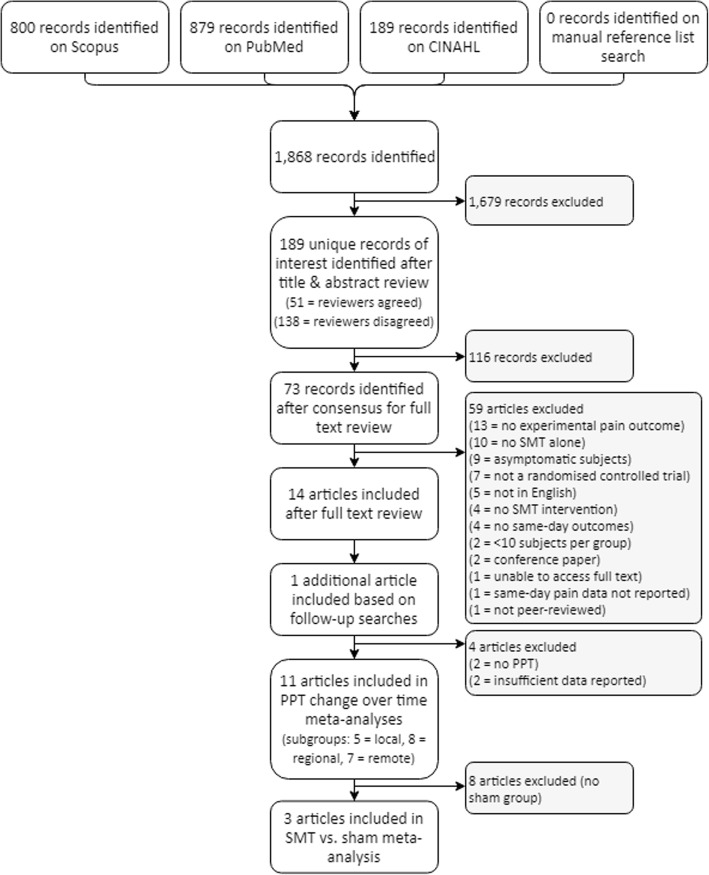
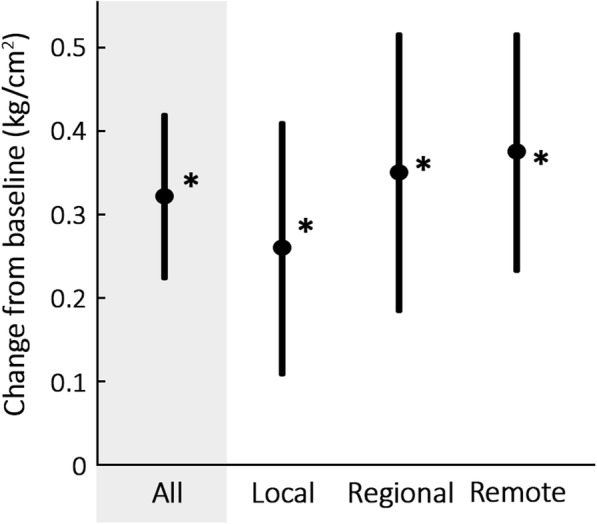
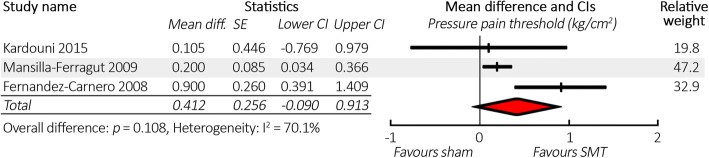
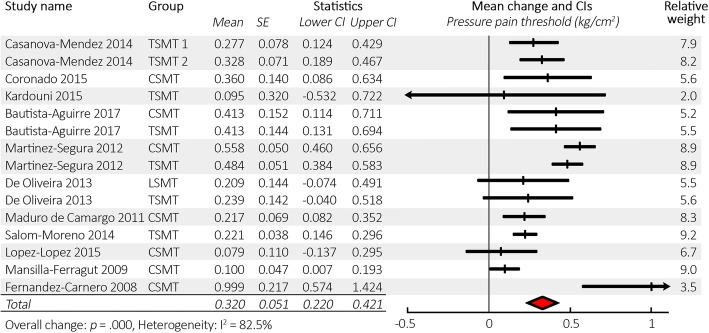
Fifteen studies were included. Thirteen measured pressure pain threshold, and four of these were sham-controlled. Change in pressure pain threshold after spinal manipulative therapy compared to sham revealed no significant difference. Pressure pain threshold increased significantly over time after spinal manipulative therapy (0.32 kg/cm, CI 0.22-0.42), which occurred systemically. There were too few studies comparing to other interventions or for other types of quantitative sensory testing to make robust conclusions about these.
We found that systemic MIH (for pressure pain threshold) does occur in musculoskeletal pain populations, though there was low quality evidence of no significant difference compared to sham manipulation. Future research should focus on the clinical relevance of MIH, and different types of quantitative sensory tests.
Prospectively registered with PROSPERO (registration CRD42016041963).
手法诱导性痛觉减退(MIH)是指关节手法治疗后疼痛敏感性降低,已在不同人群中得到证实。然而,高速低幅脊柱手法治疗后的MIH是否是一种特定的、具有临床相关性的治疗效果尚不清楚。
这项带有荟萃分析的系统批判性综述,研究了随机对照试验中,高速低幅脊柱手法治疗对肌肉骨骼疼痛人群定量感觉测试指标的影响。我们的目标是比较脊柱手法治疗与假治疗、对照治疗及主动干预后定量感觉测试结果的变化,评估随时间变化的幅度,并确定这些变化是否具有全身性。
纳入了15项研究。13项测量了压力痛阈,其中4项为假治疗对照研究。与假治疗相比,脊柱手法治疗后压力痛阈的变化无显著差异。脊柱手法治疗后压力痛阈随时间显著升高(0.32kg/cm,可信区间0.22 - 0.42),且这种变化具有全身性。与其他干预措施比较或进行其他类型定量感觉测试的研究过少,无法得出可靠结论。
我们发现,在肌肉骨骼疼痛人群中确实会出现全身性的MIH(针对压力痛阈),尽管与假手法治疗相比,证据质量较低且无显著差异。未来的研究应聚焦于MIH的临床相关性以及不同类型的定量感觉测试。
前瞻性注册于PROSPERO(注册号CRD42016041963)。