Division of Hematology/Oncology, Department of Medicine, Massachusetts General Hospital, Harvard Medical School, Boston, MA.
Broad Institute of MIT and Harvard, Boston, MA.
Blood Adv. 2019 Feb 12;3(3):375-383. doi: 10.1182/bloodadvances.2018027672.
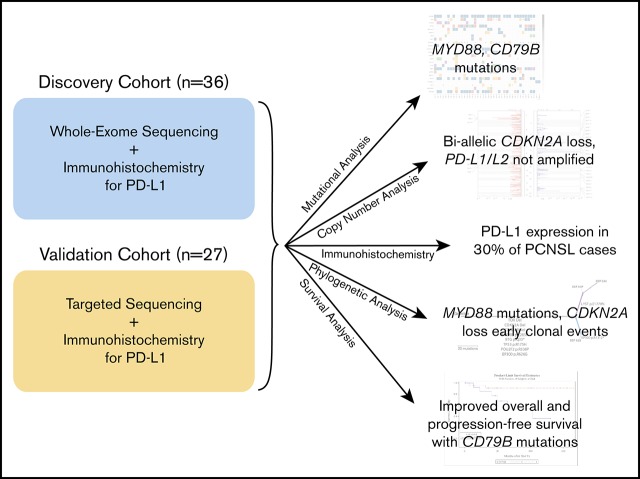
The genetic alterations that define primary central nervous system lymphoma (PCNSL) are incompletely elucidated, and the genomic evolution from diagnosis to relapse is poorly understood. We performed whole-exome sequencing (WES) on 36 PCNSL patients and targeted sequencing on a validation cohort of 27 PCNSL patients. We also performed WES and phylogenetic analysis of 3 matched newly diagnosed and relapsed tumor specimens and 1 synchronous intracranial and extracranial relapse. Immunohistochemistry (IHC) for programmed death-1 ligand (PD-L1) was performed on 43 patient specimens. Combined WES and targeted sequencing identified mutation in 67% (42 of 63) of patients, biallelic loss in 44% (16 of 36), and mutation in 61% (22 of 36). Copy-number analysis demonstrated frequent regions of copy loss (ie, ), with few areas of amplification. mutations were associated with improved progression-free and overall survival. We did not identify amplification at the / loci. IHC for PD-L1 revealed membranous expression in 30% (13 of 43) of specimens. Phylogenetic analysis of paired primary and relapsed specimens identified mutation and loss as early clonal events. PCNSL is characterized by frequent mutations within the B-cell receptor and NF-κB pathways. The lack of amplifications, along with membranous PD-L1 expression in 30% of our cohort, suggests that PD-1/PD-L1 inhibitors may be useful in a subset of PCNSL. WES of PCNSL provides insight into the genomic landscape and evolution of this rare lymphoma subtype and potentially informs more rational treatment decisions.
原发性中枢神经系统淋巴瘤(PCNSL)的基因改变尚未完全阐明,从诊断到复发的基因组进化也知之甚少。我们对 36 例 PCNSL 患者进行了全外显子组测序(WES),并对 27 例 PCNSL 患者的验证队列进行了靶向测序。我们还对 3 例新诊断和复发肿瘤标本和 1 例同步颅内和颅外复发的标本进行了 WES 和系统发育分析。对 43 例患者标本进行了程序性死亡配体 1(PD-L1)的免疫组织化学(IHC)检测。综合 WES 和靶向测序在 67%(42/63)的患者中发现了 突变,在 44%(16/36)的患者中发现了双等位基因缺失,在 61%(22/36)的患者中发现了 突变。拷贝数分析显示了频繁的拷贝缺失区域(即 ),而扩增区域较少。 突变与改善的无进展生存期和总生存期相关。我们未在 / 基因座发现扩增。IHC 检测 PD-L1 显示 30%(43 例标本中的 13 例)有膜表达。对配对的原发性和复发标本的系统发育分析确定了 突变和 缺失是早期克隆事件。PCNSL 的特征是 B 细胞受体和 NF-κB 途径的频繁突变。缺乏 扩增,以及我们队列中 30%的标本有膜 PD-L1 表达,提示 PD-1/PD-L1 抑制剂可能对 PCNSL 的一部分患者有效。PCNSL 的 WES 提供了对这种罕见淋巴瘤亚型基因组景观和进化的深入了解,并可能为更合理的治疗决策提供信息。