Yamasaki Masahiro, Daido Wakako, Saito Naomi, Funaishi Kunihiko, Okada Takenori, Kawamoto Kazuma, Matsumoto Yu, Matsumoto Naoko, Taniwaki Masaya, Ohashi Nobuyuki, Hattori Noboru
Department of Respiratory Disease, Hiroshima Red Cross Hospital & Atomic-bomb Survivors Hospital, Hiroshima, Japan.
Department of Molecular and Internal Medicine, Graduate School of Biomedical and Health Sciences, Hiroshima University, Hiroshima, Japan.
Front Oncol. 2019 Jan 22;9:4. doi: 10.3389/fonc.2019.00004. eCollection 2019.
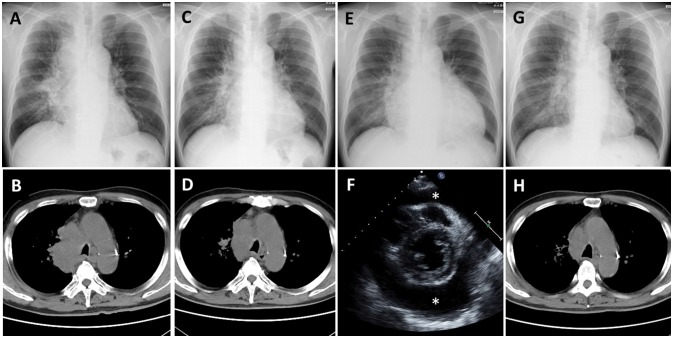
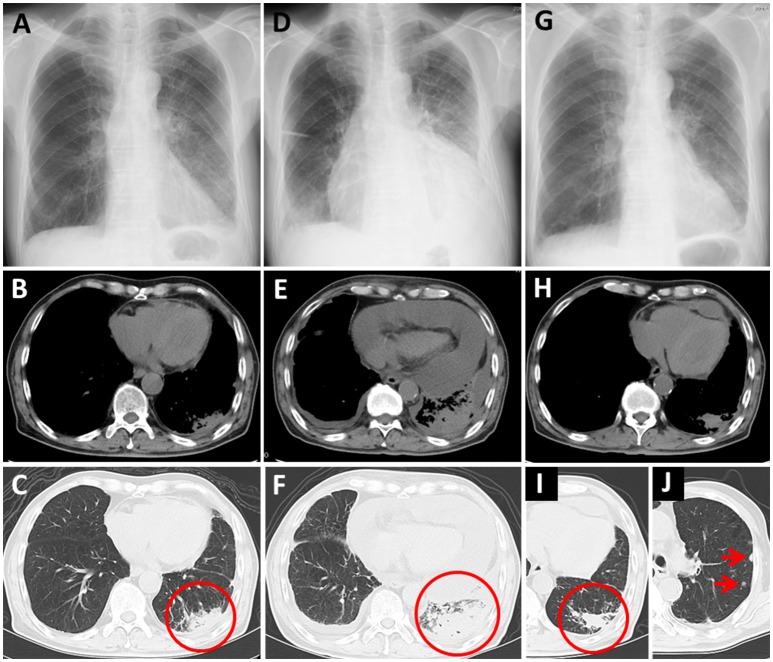
Nivolumab is an immune checkpoint inhibitor (ICI) that has shown efficacy for treating non-small cell lung cancer and has become a standard therapy for previously treated non-small cell lung cancer. Moreover, immune-related adverse events of ICI therapy are well-known. Malignant pericardial effusions occasionally arise in patients with lung cancer. There have been a few reports of pericardial effusion in non-small cell lung cancer after nivolumab administration. However, the cause of this condition is controversial; the possibilities include serositis as an immune-related adverse event or pseudo-progression. This report presents two cases of pericardial effusion with tamponade in lung cancer during treatment with nivolumab. Both patients experienced temporal increases in pericardial effusions followed by effusion regression. In one case, nivolumab administration was continued after performance of pericardiocentesis, without an increase in pericardial effusion. In the other case, temporal simultaneous increases in both the pericardial effusion and the primary tumor were detected, followed by simultaneous regression in both the effusion and the tumor. These findings support the fact that the pericardial effusions were caused by pseudo-progression. Pericardial effusion with tamponade can occur in lung cancer patients being treated with nivolumab; moreover, some of these effusions might be caused by pseudo-progression. In the case of putative pseudo-progression, continuation of nivolumab administration might be allowable with strict follow up.
纳武单抗是一种免疫检查点抑制剂(ICI),已显示出治疗非小细胞肺癌的疗效,并已成为先前接受过治疗的非小细胞肺癌的标准疗法。此外,ICI治疗的免疫相关不良事件是众所周知的。恶性心包积液偶尔会出现在肺癌患者中。有几篇关于纳武单抗给药后非小细胞肺癌患者心包积液的报道。然而,这种情况的原因存在争议;可能性包括作为免疫相关不良事件的浆膜炎或假性进展。本报告介绍了两例在使用纳武单抗治疗期间肺癌合并心包积液伴心脏压塞的病例。两名患者的心包积液均出现暂时增加,随后积液消退。在一例中,心包穿刺术后继续使用纳武单抗,心包积液未增加。在另一例中,检测到心包积液和原发肿瘤同时出现暂时增加,随后积液和肿瘤同时消退。这些发现支持心包积液是由假性进展引起的这一事实。接受纳武单抗治疗的肺癌患者可能会出现心包积液伴心脏压塞;此外,其中一些积液可能是由假性进展引起的。在疑似假性进展的情况下,在严格随访的情况下可以允许继续使用纳武单抗。