Biostatistics Center, The George Washington University, Rockville, MD
Division of Endocrinology, Diabetes and Metabolism, University of Tennessee Health Science Center, Memphis, TN.
Diabetes Care. 2019 Apr;42(4):657-664. doi: 10.2337/dc18-1574. Epub 2019 Feb 6.
The Diabetes Control and Complications Trial/Epidemiology of Diabetes Interventions and Complications (DCCT/EDIC) study demonstrated the beneficial effects of intensive therapy on atherosclerosis and clinical cardiovascular disease (CVD) outcomes. The current analyses evaluated the relationship between longitudinal changes in insulin dose and CVD risk factors and outcomes.
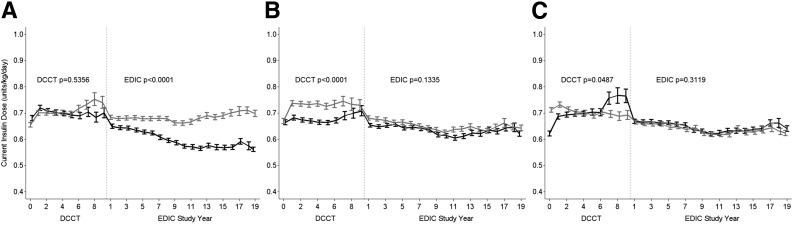
A total of 1,441 participants were randomly assigned to intensive or conventional diabetes therapy during the DCCT. After an average of 6.5 years of follow-up, 96% of the surviving cohort enrolled in the EDIC observational study, which included annual visits with detailed medical history, physical examination, and laboratory testing. CVD events were adjudicated by a review committee. Generalized linear mixed models and Cox proportional hazards regression models were used to assess the association between insulin dose and cardiometabolic risk factors and CVD risk, respectively, over a total of 30 years.
Higher insulin doses were significantly associated with a less favorable cardiometabolic risk profile (higher BMI, pulse rate, and triglycerides and lower HDL cholesterol) with the exception of lower diastolic blood pressure and lower LDL cholesterol. In a minimally adjusted model, a 0.1 unit/kg body wt/day increase in insulin dose was associated with a 6% increased risk of any CVD (95% CI 3, 9). However, the association with insulin dose was no longer significant after adjustment for other CVD risk factors.
During DCCT/EDIC, higher insulin doses were associated with adverse trends in several cardiometabolic risk factors, even after multivariable adjustment, but not with incident CVD outcomes.
糖尿病控制与并发症试验/糖尿病干预与并发症的流行病学(DCCT/EDIC)研究表明强化治疗对动脉粥样硬化和临床心血管疾病(CVD)结局有有益影响。目前的分析评估了胰岛素剂量的纵向变化与 CVD 危险因素和结局之间的关系。
共有 1441 名参与者在 DCCT 期间被随机分配到强化或常规糖尿病治疗组。经过平均 6.5 年的随访,幸存队列中有 96%的人参加了 EDIC 观察性研究,该研究包括每年进行详细的病史、体格检查和实验室检查。CVD 事件由审查委员会裁决。广义线性混合模型和 Cox 比例风险回归模型分别用于评估在总共 30 年的时间内,胰岛素剂量与心血管代谢危险因素和 CVD 风险之间的关系。
更高的胰岛素剂量与更不利的心血管代谢风险特征显著相关(更高的 BMI、脉搏率和甘油三酯,以及更低的 HDL 胆固醇),但舒张压和 LDL 胆固醇除外。在最小调整模型中,胰岛素剂量每增加 0.1 单位/公斤体重/天,CVD 任何事件的风险增加 6%(95%CI 3,9)。然而,在调整其他 CVD 危险因素后,与胰岛素剂量的关联不再显著。
在 DCCT/EDIC 期间,更高的胰岛素剂量与多种心血管代谢危险因素的不良趋势相关,即使在多变量调整后也是如此,但与 CVD 结局无关。