Fliefel Riham M, Entekhabi Saleh A, Ehrenfeld Michael, Otto Sven
Experimental Surgery and Regenerative Medicine (ExperiMed), Ludwig-Maximilians University, Munich 80336, Germany.
Department of Oral and Maxillofacial Surgery, Ludwig-Maximilians University, Munich 80337, Germany.
Stem Cells Int. 2019 Jan 9;2019:4351327. doi: 10.1155/2019/4351327. eCollection 2019.
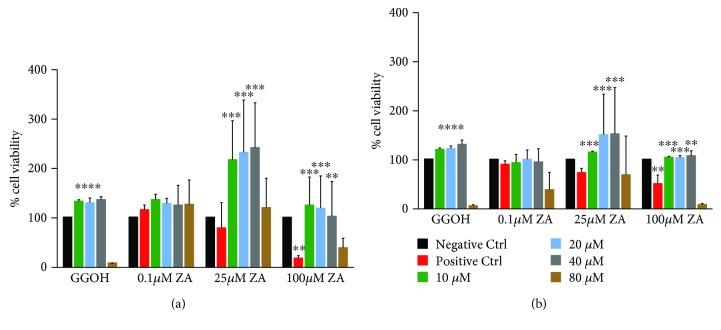
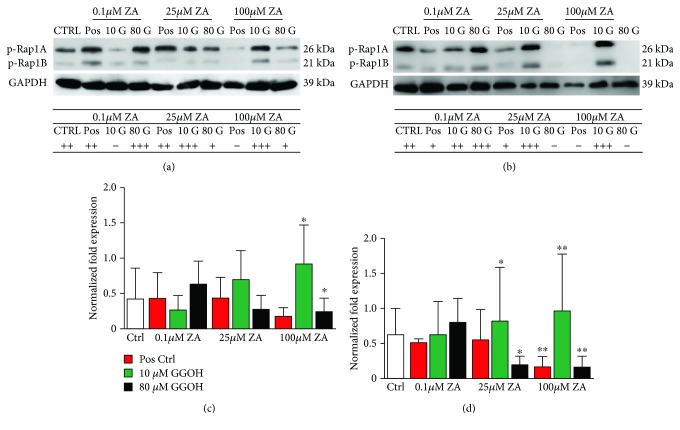
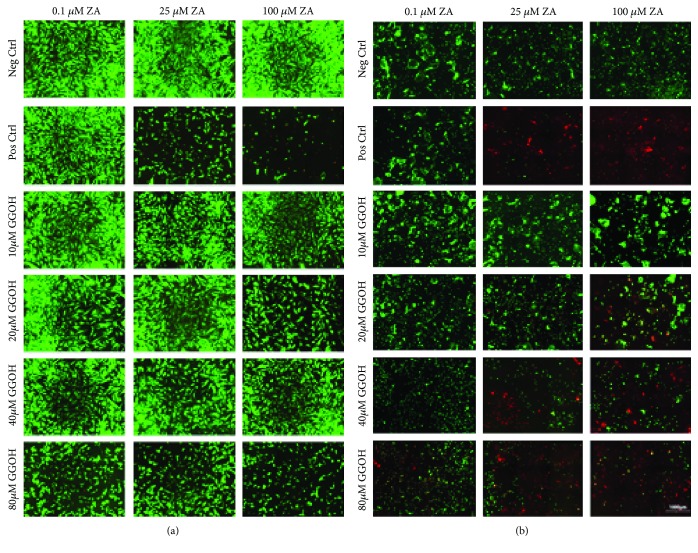
Bisphosphonates (BPs) are the keystone to treat bone disorders. Despite the great benefits of BPs, medication-related osteonecrosis of the jaw (MRONJ) arouse as a potential side effect. Nitrogen-containing BPs (N-BPs) as zoledronate (ZA) act by the inhibition of specific enzymes of the mevalonate pathway resulting in altering protein prenylation which is required for the posttranslational maturation of the small GTP-binding proteins. Geranylgeraniol (GGOH) is an intermediate product in the mevalonate pathway having positive effects on different cell types treated with BPs by salvaging protein prenylation improving cell viability and proliferation in tissue regeneration, thus overcoming N-BP-induced apoptosis. Here, the effect of different concentrations of zoledronate (ZA) on the bone cells has been investigated by cell viability assay, live/dead staining, and western blot to understand if GGOH was able to rescue bone cells and levels of statistical significance were indicated at < 0.05, < 0.01, < 0.001, and < 0.0001. Although the high concentration of ZA had significantly decreased the cell viability in the bone cells, GGOH reversed the action of ZA on the cells while at very high concentration; it caused severe reduction in the cell viability. Rap1A, a member of the GTPases family, was expressed in the negative controls but was absent in cells treated with high concentrations of ZA. The addition of GGOH had increased the expression of Rap1A up to a certain limit. The experiments proved that ZA acts directly on the mevalonate pathway and protein prenylation and that GGOH could be applied as a future local therapy to MRONJ.
双膦酸盐(BPs)是治疗骨疾病的关键药物。尽管双膦酸盐有诸多益处,但颌骨药物相关性骨坏死(MRONJ)作为一种潜在的副作用出现了。含氮双膦酸盐(N-BPs)如唑来膦酸(ZA)通过抑制甲羟戊酸途径的特定酶起作用,导致蛋白质异戊二烯化改变,而这是小GTP结合蛋白翻译后成熟所必需的。香叶基香叶醇(GGOH)是甲羟戊酸途径中的一种中间产物,通过挽救蛋白质异戊二烯化,对接受双膦酸盐治疗的不同细胞类型具有积极作用,可改善细胞活力和组织再生中的增殖,从而克服N-BP诱导的细胞凋亡。在此,通过细胞活力测定、活/死染色和蛋白质印迹法研究了不同浓度的唑来膦酸(ZA)对骨细胞的影响,以了解GGOH是否能够挽救骨细胞,统计学显著性水平分别为<0.05、<0.01、<0.001和<0.0001。尽管高浓度的ZA显著降低了骨细胞的活力,但GGOH逆转了ZA对细胞的作用,而在非常高的浓度下,它会导致细胞活力严重降低。Rap1A是GTP酶家族的成员,在阴性对照中表达,但在高浓度ZA处理的细胞中不存在。添加GGOH使Rap1A的表达增加到一定限度。实验证明ZA直接作用于甲羟戊酸途径和蛋白质异戊二烯化,并且GGOH可作为未来治疗MRONJ的局部疗法。