Department of Pathology, Icahn School of Medicine at Mount Sinai, New York, New York, United States of America.
Department of Pathology and Laboratory Medicine, University of Rochester Medical Center, Rochester, New York, United States of America.
PLoS One. 2019 Feb 7;14(2):e0212142. doi: 10.1371/journal.pone.0212142. eCollection 2019.
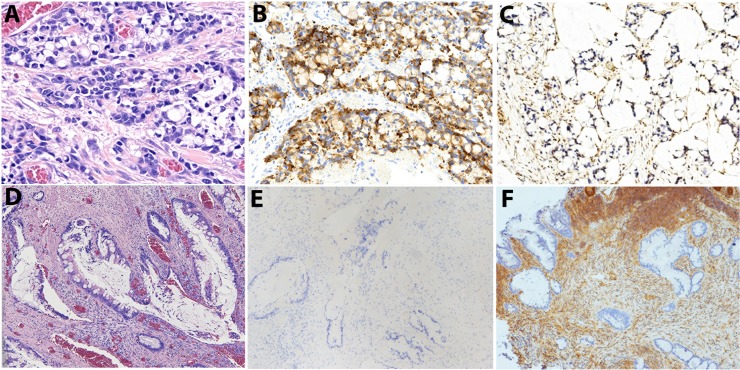
The SMAD4 tumor suppressor gene product inhibits transforming growth factor-β-mediated signaling and is mutated in ~10% of colorectal carcinomas. The prognostic significance of SMAD4 mutations has been controversial. We studied the pathological and clinical characteristics of SMAD4-mutated intestinal adenocarcinomas using a retrospective case-control study design. Cases and controls were identified among 443 primary adenocarcinomas that had undergone next generation DNA sequencing (NGS) with the Ion AmpliSeq Cancer Hotspot Panel v2, which evaluates 50 cancer-related genes. Twenty-eight SMAD4-mutated (SMAD4m) patients were matched 1:2 with 56 consecutive SMAD4 wild-type (SMAD4wt) control patients from the same analysis stream. Compared with the SMAD4wt controls, the SMAD4m tumors were of higher stage (P = 0.026) and were more likely to feature mucinous differentiation (P = 0.0000), to occur in the setting of Crohn's disease (P = 0.0041), and to harbor concurrent RAS mutations (P = 0.0178). Tumor mucin content was significantly correlated with mutations involving the MH2 domain of the SMAD4 protein (P = 0.0338). Correspondence between mutation sites and morphology was demonstrated directly in a mixed adenocarcinoma and neuroendocrine tumor where SMAD4 mutations involving different protein domains were found in histologically disparate tumor regions despite both containing identical KRAS and TP53 mutations.
SMAD4 肿瘤抑制基因产物抑制转化生长因子-β介导的信号转导,约 10%的结直肠癌存在 SMAD4 突变。SMAD4 突变的预后意义一直存在争议。我们采用回顾性病例对照研究设计,使用下一代 DNA 测序(NGS)分析研究 SMAD4 突变的肠腺癌的病理和临床特征。病例和对照是从 443 例接受 Ion AmpliSeq Cancer Hotspot Panel v2 (评估 50 个与癌症相关的基因)NGS 的原发性腺癌中确定的。28 例 SMAD4 突变(SMAD4m)患者与来自同一分析流的 56 例连续 SMAD4 野生型(SMAD4wt)对照患者 1:2 匹配。与 SMAD4wt 对照组相比,SMAD4m 肿瘤分期更高(P = 0.026),更有可能表现为黏液分化(P = 0.0000),发生在克罗恩病背景下(P = 0.0041),并同时存在 RAS 突变(P = 0.0178)。肿瘤黏蛋白含量与涉及 SMAD4 蛋白 MH2 结构域的突变显著相关(P = 0.0338)。在混合性腺癌和神经内分泌肿瘤中直接证明了突变部位与形态之间的对应关系,尽管这两种肿瘤都含有相同的 KRAS 和 TP53 突变,但不同蛋白结构域的 SMAD4 突变存在于组织学上不同的肿瘤区域。