Chen Ji-Ying, Fu Chun-Wei, Ho Hsu-Yu, Lu Yung-Chang
Department of Orthopedic Surgery, MacKay Memorial Hospital, No. 92, Sec. 2, Zhongshan N. Rd., Taipei City, Taiwan, ROC.
Medicine (Baltimore). 2019 Feb;98(6):e14403. doi: 10.1097/MD.0000000000014403.
Heterotopic ossification (HO), which is defined as the formation of new bone in tissues that do not normally ossify, is an infrequent yet debilitating complication of burns. Herein, we report three patients who suffered from elbow HO after burn injury due to a dust explosion event. This is a case report that includes the most cases involved in a single mass casualty incident in the presented literature.
Case 1: A 28-year-old man presented with second-to-third degree 88% total body surface area (TBSA) burns after the explosion event. He complained of decreased progressive bilateral elbow range of motion (ROM) for 1.5 months after the burn injury.Case 2: A 28-year-old woman presented with second-to-third degree 50% TBSA burns and complained of decreased progressive bilateral elbow ROM with intolerable pain on elbow extension for 1 month after the burn injury.Case 3: A 22-year-old man presented with second-to-third degree 90% TBSA burns and complained of significantly decreased left elbow ROM with intolerable pain 5 months after the burn injury.
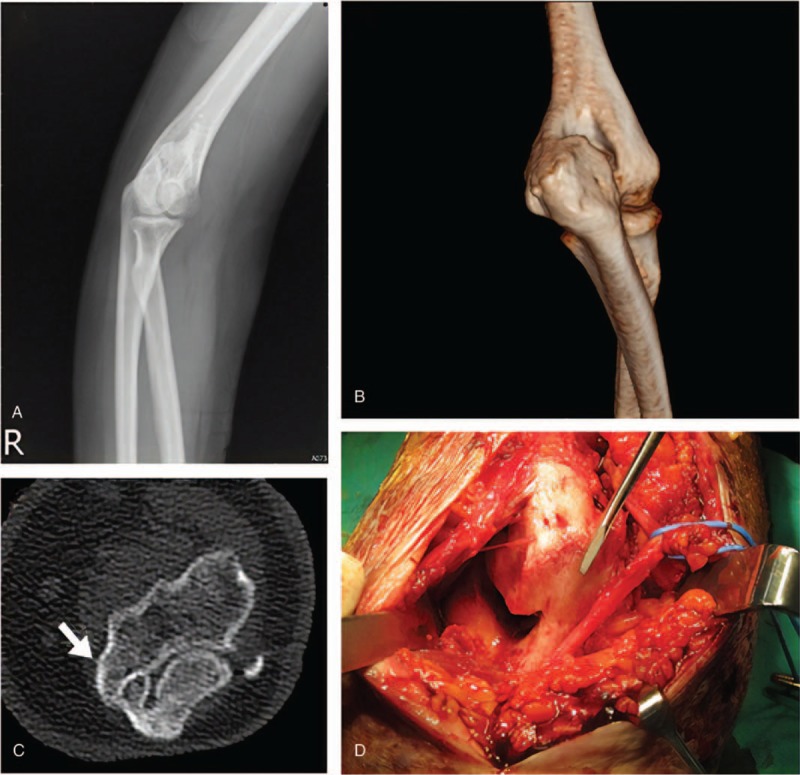
The follow-up radiograph of the symptomatic elbow of these three patients revealed heterotopic ossification formation. Three-dimensional reconstruction computed tomography performed preoperatively showed that HO mainly affected the humeroulnar joint.
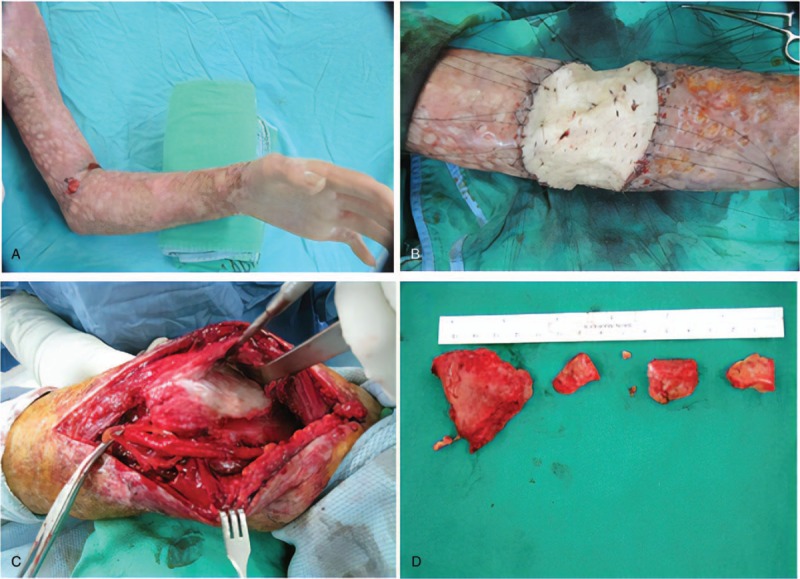
We treated all three patients with surgical elbow HO resection and ulnar nerve transposition, followed by immediate passive ROM exercise since postoperative day 1 and continuous physical therapy.
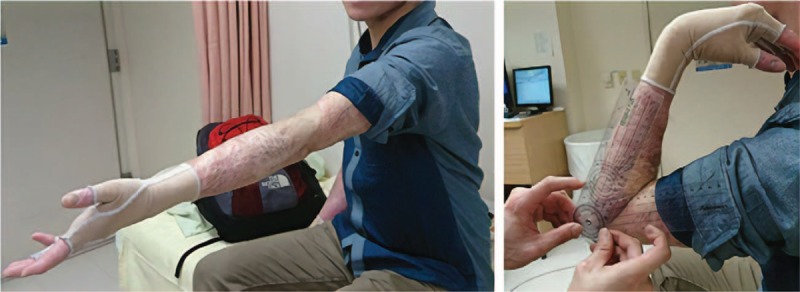
In case 1, the documented ROM gain on the last follow-up (18.5 months after surgery) was 30° in the right elbow and 118° in the left elbow. In case 2, the follow-up time was 21 months and the documented ROM gain on the last follow-up was 120° in the right elbow and 90° in the left elbow. In case 3, the follow-up time was 20 months and the documented left elbow ROM gain on the last follow-up was 40°.
We discuss our experience of treating postburn HO and review the recent literature. The postburn HO treatment results of early surgical excision combined with immediate postoperative physical therapy were satisfactory.
异位骨化(HO)是指在正常情况下不会发生骨化的组织中形成新骨,是烧伤后一种罕见但使人衰弱的并发症。在此,我们报告3例因粉尘爆炸事件烧伤后发生肘部HO的患者。这是一篇病例报告,在所呈现的文献中包含了单一群体伤亡事件中涉及病例最多的情况。
病例1:一名28岁男性在爆炸事件后出现全身88%体表面积的二度至三度烧伤。烧伤后1.5个月,他主诉双侧肘部渐进性活动范围(ROM)减小。病例2:一名28岁女性出现全身50%体表面积的二度至三度烧伤,烧伤后1个月,她主诉双侧肘部渐进性ROM减小,肘部伸展时疼痛难忍。病例3:一名22岁男性出现全身90%体表面积的二度至三度烧伤,烧伤后5个月,他主诉左肘部ROM显著减小,疼痛难忍。
这3例患者出现症状的肘部的随访X线片显示有异位骨化形成。术前进行的三维重建计算机断层扫描显示HO主要影响肱尺关节。
我们对所有3例患者均采用手术切除肘部HO并行尺神经转位术,术后第1天起立即进行被动ROM锻炼并持续进行物理治疗。
病例1,最后一次随访(术后18.5个月)记录的ROM增加情况为:右肘30°,左肘118°。病例2,随访时间为21个月,最后一次随访记录的ROM增加情况为:右肘120°,左肘90°。病例3,随访时间为20个月,最后一次随访记录的左肘ROM增加为40°。
我们讨论了治疗烧伤后HO的经验并回顾了近期文献。早期手术切除联合术后立即进行物理治疗的烧伤后HO治疗结果令人满意。