Department of Respiratory Internal Medicine, Hiroshima University Hospital, Hiroshima, Japan.
Department of Surgical Oncology, Research Institute for Radiation Biology and Medicine, Hiroshima University, Hiroshima, Japan.
J Cell Mol Med. 2019 Apr;23(4):2984-2994. doi: 10.1111/jcmm.14205. Epub 2019 Feb 7.
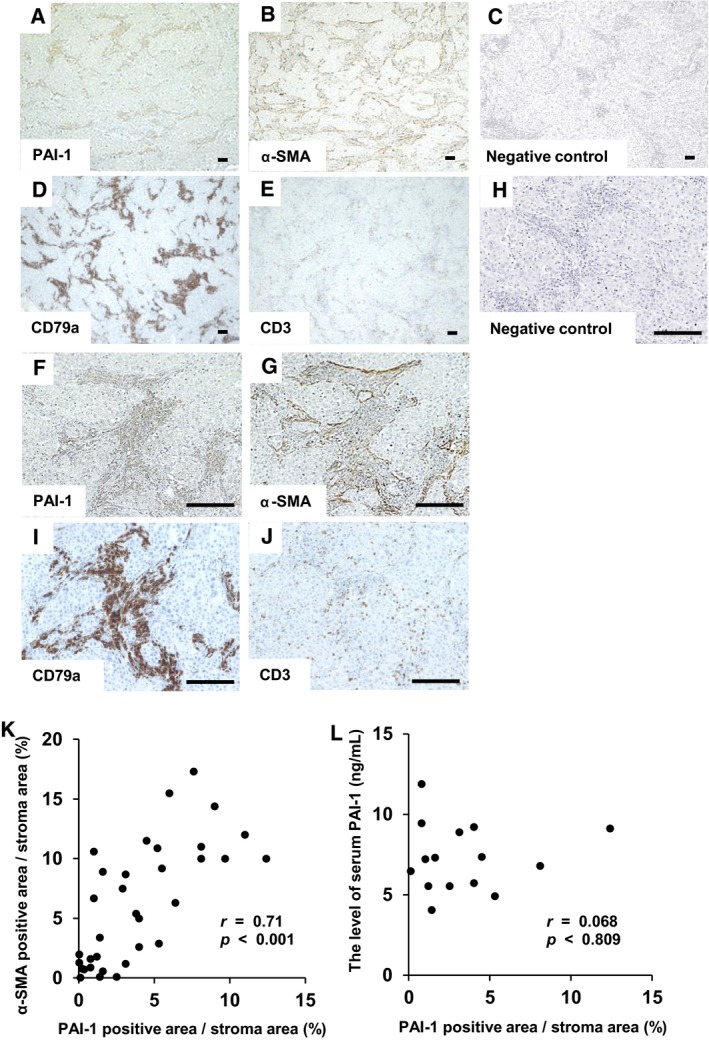
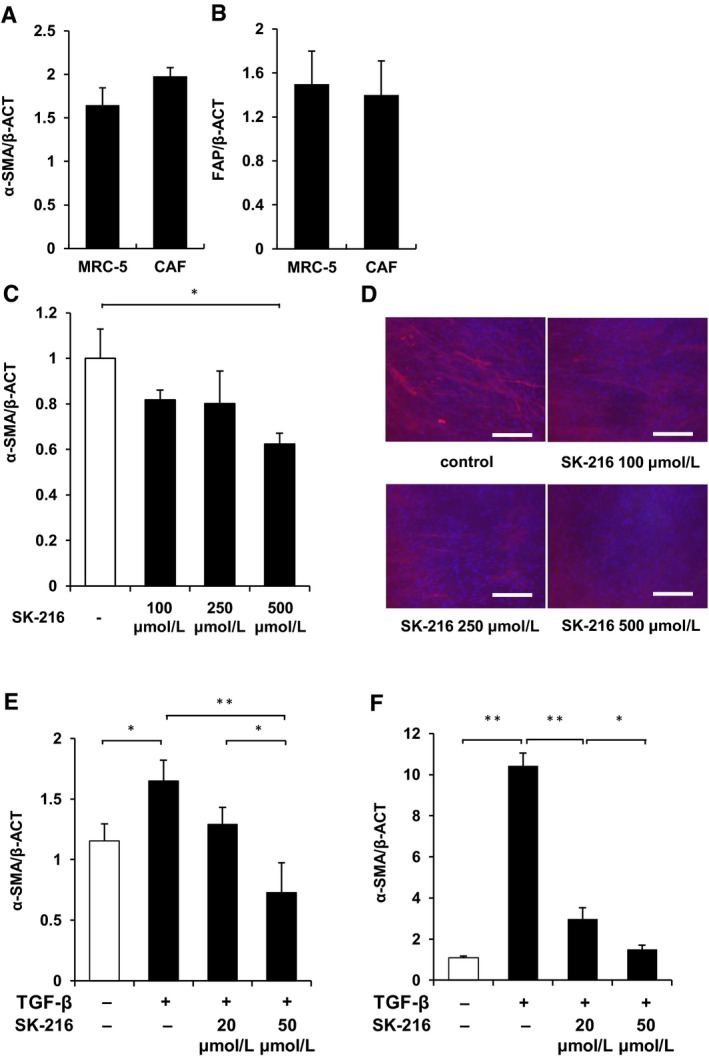
Plasminogen activator inhibitor-1 (PAI-1) promotes pulmonary fibrosis through increasing myofibroblast (MF) characteristics, expressing alpha-smooth muscle actin (α-SMA) in fibroblasts. Fibroblasts in the tumour stroma are called cancer-associated fibroblasts (CAFs). Some CAFs have MF characteristics and substantially promote tumour progression and chemotherapy resistance. This study determined whether inhibition of PAI-1 suppressed MF characteristics of CAFs and limited chemotherapy resistance in lung cancer. To investigate cellular PAI-1 expression and its correlation with α-SMA expression of CAFs, 34 patients' paraffin-embedded lung adenocarcinoma tissue sections were immunohistochemically stained for PAI-1 and α-SMA. Immunohistochemical analysis of lung adenocarcinoma tissues showed that PAI-1 expression was correlated with that of α-SMA (r = 0.71, p < 0.001). Furthermore, in vitro, α-SMA expression of CAFs was limited by PAI-1 inhibition, and apoptosis of CAFs was increased. In addition, the effectiveness of cisplatin on lung cancer cells co-cultured with CAFs was increased by suppressing α-SMA expression using PAI-1 inhibitor. In lung adenocarcinoma tissues, PAI-1 expression was associated with T factor and TNM stage. Our data suggest that inhibition of PAI-1 increased the chemotherapeutic effect on lung cancer through suppressing the MF characteristics of CAFs. Hence, PAI-1 might be a promising therapeutic target for patients with chemotherapeutic-resistant lung cancer with CAFs.
纤溶酶原激活物抑制剂-1(PAI-1)通过增加成肌纤维细胞(MF)特征,在成纤维细胞中表达α-平滑肌肌动蛋白(α-SMA),从而促进肺纤维化。肿瘤基质中的成纤维细胞称为癌相关成纤维细胞(CAFs)。一些 CAFs 具有 MF 特征,可显著促进肿瘤进展和化疗耐药性。本研究旨在确定抑制 PAI-1 是否能抑制 CAFs 的 MF 特征并限制肺癌的化疗耐药性。为了研究细胞 PAI-1 表达及其与 CAFs 中 α-SMA 表达的相关性,对 34 例石蜡包埋的肺腺癌组织切片进行了 PAI-1 和 α-SMA 的免疫组织化学染色。肺腺癌组织的免疫组织化学分析表明,PAI-1 的表达与 α-SMA 的表达相关(r=0.71,p<0.001)。此外,在体外,CAFs 的 α-SMA 表达受到 PAI-1 抑制的限制,并且 CAFs 的凋亡增加。此外,通过使用 PAI-1 抑制剂抑制 α-SMA 表达,增加了顺铂对与 CAFs 共培养的肺癌细胞的有效性。在肺腺癌组织中,PAI-1 的表达与 T 因子和 TNM 分期相关。我们的数据表明,通过抑制 CAFs 的 MF 特征,抑制 PAI-1 增加了对肺癌的化疗效果。因此,PAI-1 可能是一种有前途的治疗靶点,适用于具有 CAFs 的化疗耐药性肺癌患者。