a Immunochemistry Laboratory , Butantan Institute , São Paulo , SP , Brazil.
b Biosciences National Laboratory , National Centre for Research in Energy and Materials , Campinas , SP , Brazil.
J Enzyme Inhib Med Chem. 2019 Dec;34(1):310-321. doi: 10.1080/14756366.2018.1546698.
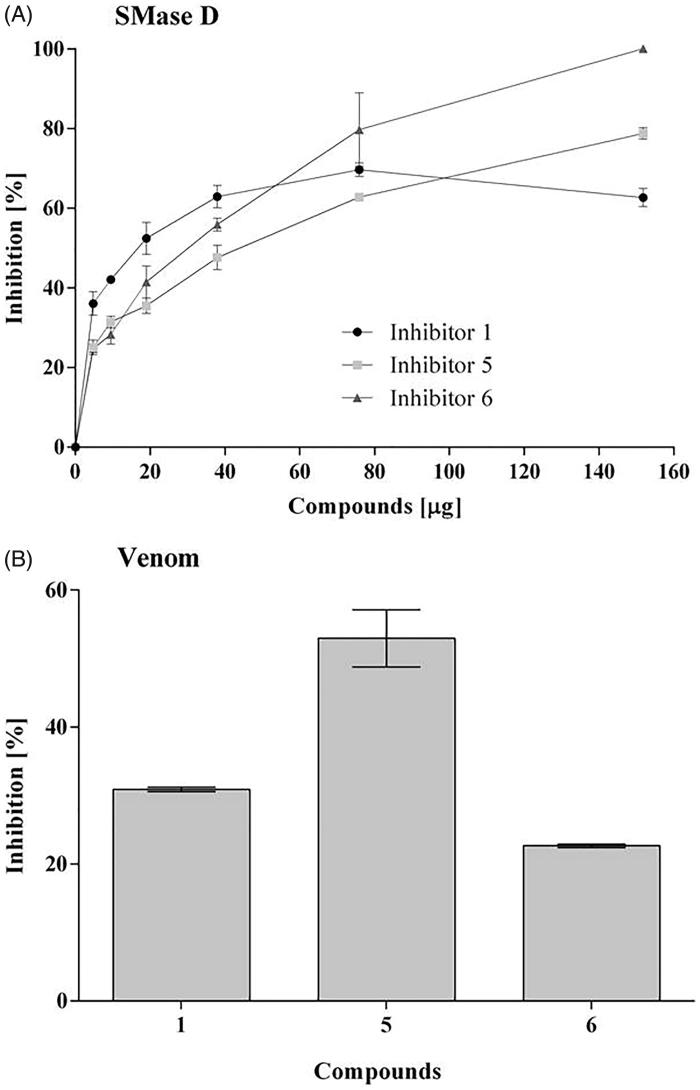
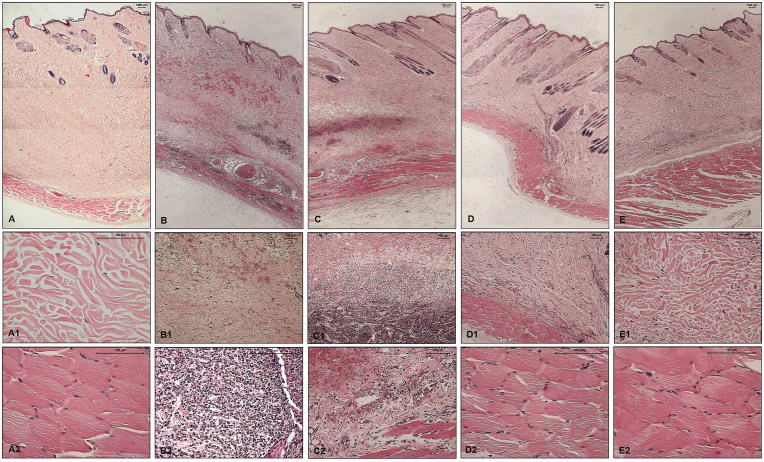
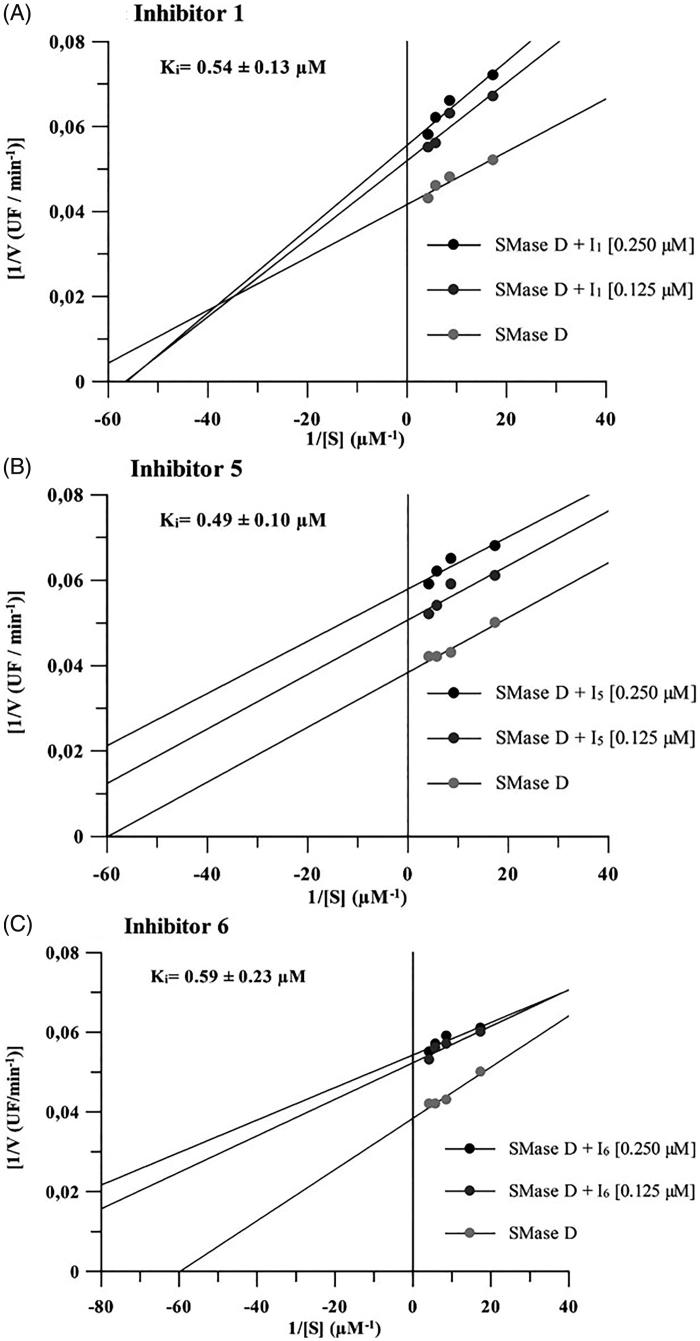
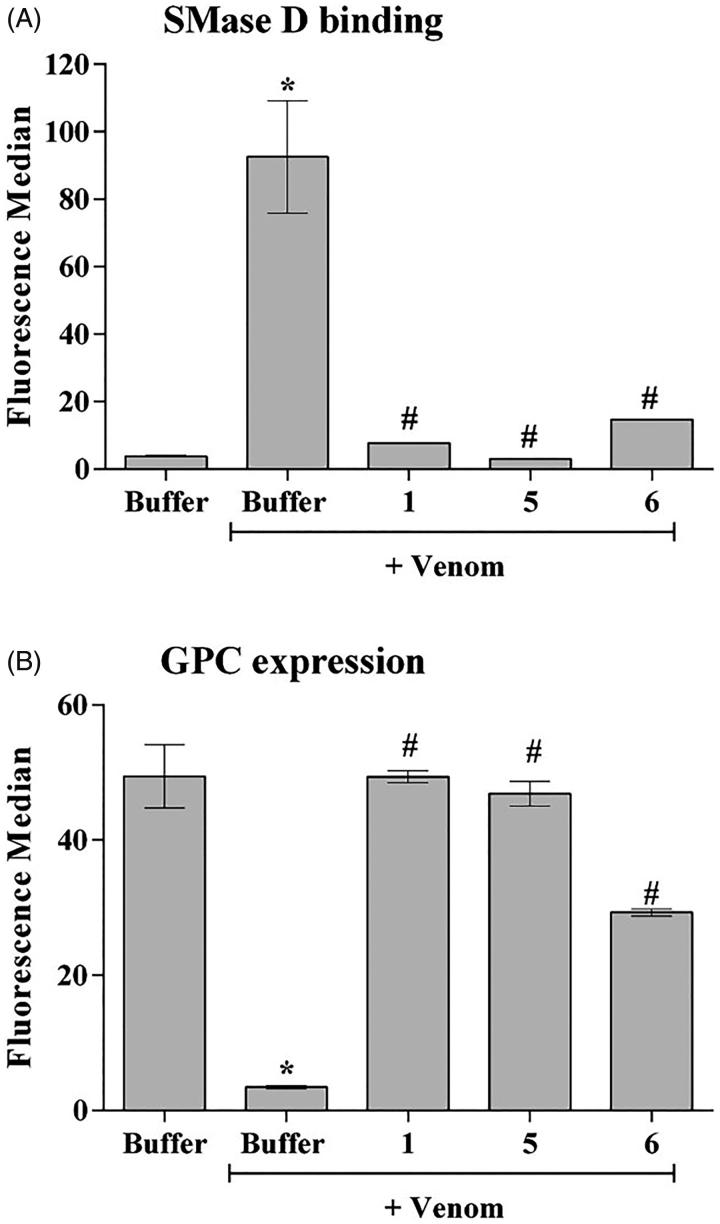
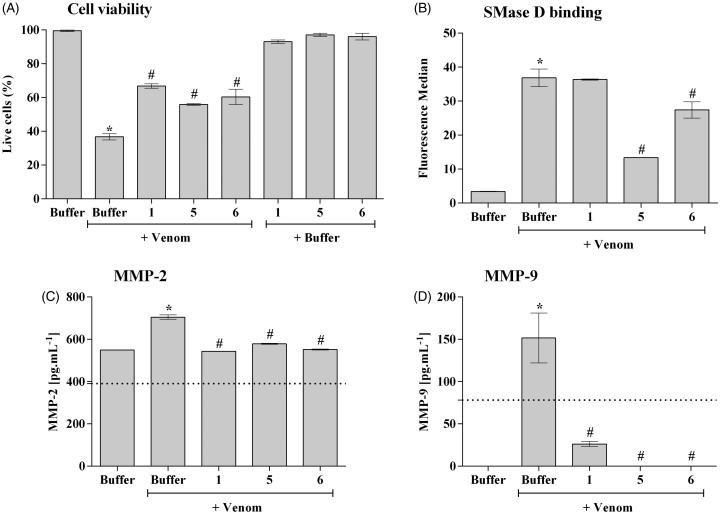
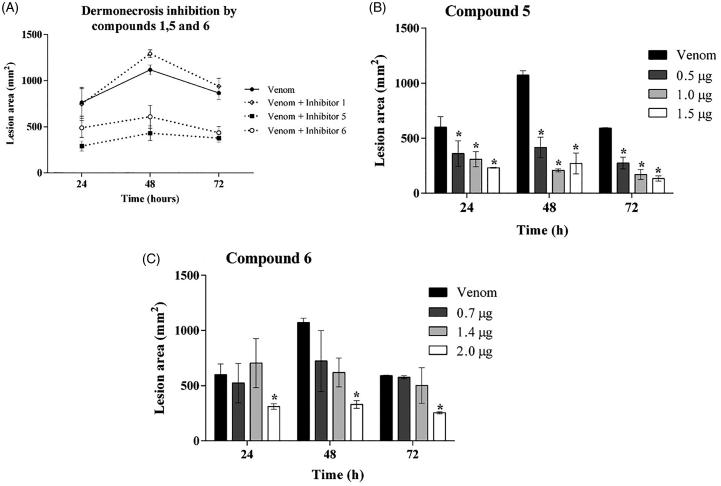
Loxosceles spiders' venoms consist of a mixture of proteins, including the sphingomyelinases D (SMases D), which are the main toxic components responsible for local and systemic effects in human envenomation. Herein, based on the structural information of SMase D from Loxosceles laeta spider venom and virtual docking-based screening approach, three benzene sulphonate compounds (named 1, 5 and 6) were identified as potential Loxosceles SMase D inhibitors. All compounds inhibited the hydrolysis of the sphingomyelin substrate by both recombinant and native SMases D. Compounds 5 and 6 acted as SMases D uncompetitive inhibitors with Ki values of 0.49 µM and 0.59 µM, respectively. Compound 1 is a mixed type inhibitor, and presented a Ki value of 0.54 µM. In addition, the three compounds inhibited the binding of SMases D to human erythrocytes and the removal of glycophorin C from the cell surface, which are important events in the complement-dependent haemolysis induced by Loxosceles venom. Moreover, compounds 5 and 6 reduced the binding of SMases to human keratinocytes membrane and the venom induced cell death. Importantly, compounds 5 and 6 also controlled the development of the necrotic lesion in an in vivo model of loxoscelism. Together, our findings indicate that the novel SMase D inhibitors presented here are able to suppress both local and systemic reactions induced by Loxosceles venoms. Since the number of Loxosceles envenomation accidents is currently growing worldwide, our results indicate that both inhibitors are promising scaffolds for the rational design of new drugs targeting SMases D from these spiders.
狼蛛毒液含有多种蛋白质,包括神经鞘磷脂酶 D(SMase D),它是导致人类被狼蛛咬伤后产生局部和全身反应的主要毒性成分。在此基础上,根据拉氏狼蛛毒液中 SMase D 的结构信息和基于虚拟对接的筛选方法,鉴定出三种苯磺酸盐化合物(命名为 1、5 和 6)为潜在的拉氏狼蛛 SMase D 抑制剂。所有化合物均抑制重组和天然 SMase D 对神经鞘磷脂底物的水解。化合物 5 和 6 为 SMase D 非竞争性抑制剂,Ki 值分别为 0.49µM 和 0.59µM。化合物 1 为混合型抑制剂,Ki 值为 0.54µM。此外,这三种化合物均抑制 SMase D 与人类红细胞的结合以及糖蛋白 C 从细胞表面的脱落,这是拉氏狼蛛毒液引起补体依赖性溶血的重要事件。此外,化合物 5 和 6 减少了 SMases 与人类角质形成细胞膜的结合以及毒液诱导的细胞死亡。重要的是,化合物 5 和 6 还控制了体内狼蛛咬伤模型中坏死损伤的发展。总之,我们的研究结果表明,本文所提出的新型 SMase D 抑制剂能够抑制拉氏狼蛛毒液引起的局部和全身反应。由于目前全球范围内狼蛛咬伤事故的数量正在增加,我们的研究结果表明,这两种抑制剂均为针对这些蜘蛛的 SMase D 合理设计新型药物的有前途的骨架。