Menzies Health Institute Queensland, School of Medical Science, Griffith University, Southport, Australia.
PLoS One. 2019 Feb 8;14(2):e0211954. doi: 10.1371/journal.pone.0211954. eCollection 2019.
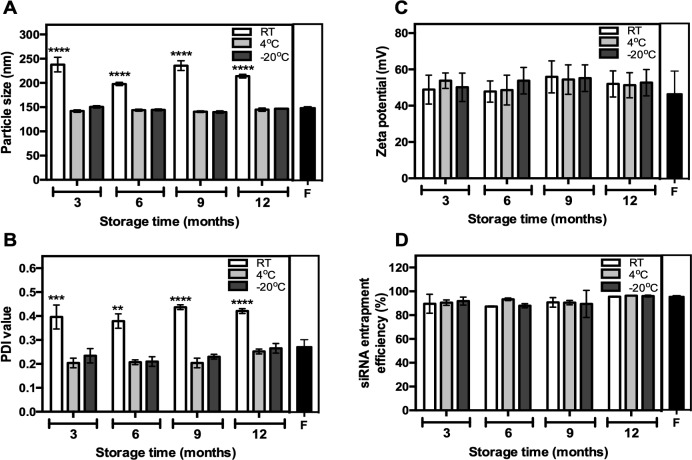
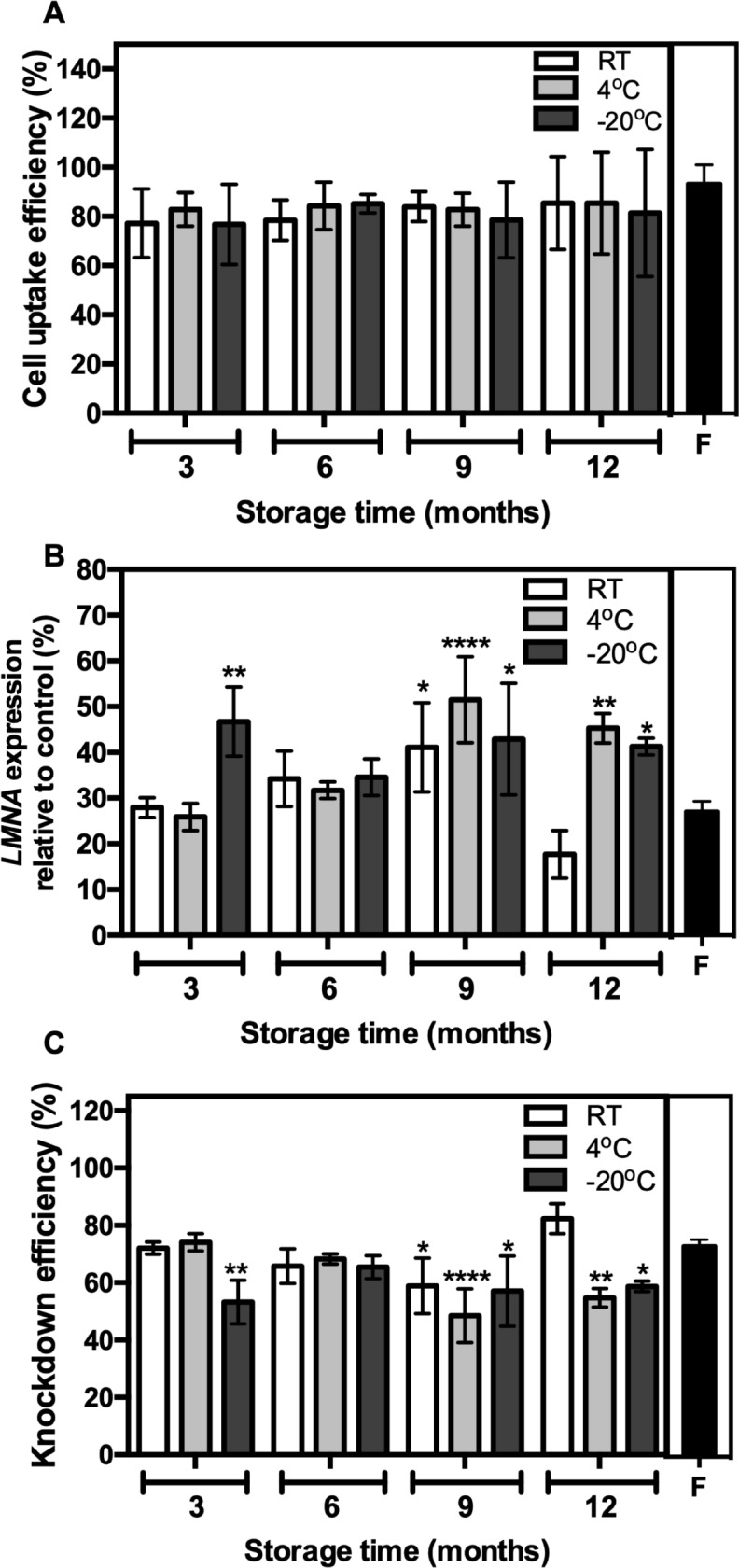
Liposomes are versatile and well-proven as a means to deliver nucleic acids into cells. Most of the formulation procedures used are labour intensive and result in unstable end products. We have previously reported on the development of a simple, yet efficient, hydration-of-freeze-dried-matrix (HFDM) method to entrap siRNA within lipid particles. Here we show that the particles are stable up to 12 months after storage at room temperature (RT), 4°C or -20°C. While RT storage results in changes in particle size and polydispersity, gene silencing of all particles was similar to freshly prepared particles following storage for 3, 6, 9 or 12 months at all temperatures. This is the first report of such long-term stability in siRNA-loaded liposomes.
脂质体作为一种将核酸递送入细胞的手段,具有多功能性和良好的效果。大多数使用的制剂程序都很繁琐,而且会导致不稳定的最终产物。我们之前已经报道了一种简单而有效的冷冻干燥基质水合(HFDM)方法的开发,用于将 siRNA 包封在脂质体中。在这里,我们表明这些颗粒在室温(RT)、4°C 或-20°C 下储存长达 12 个月仍然稳定。虽然 RT 储存会导致颗粒大小和多分散性的变化,但在所有温度下储存 3、6、9 或 12 个月后,所有颗粒的基因沉默效果都与新制备的颗粒相似。这是负载 siRNA 的脂质体具有如此长的稳定性的首次报道。