Department of Neurology, Erasmus University Medical Center, Rotterdam, The Netherlands.
Department of Child Neurology, VU University Medical center, Amsterdam, The Netherlands.
Orphanet J Rare Dis. 2019 Feb 8;14(1):33. doi: 10.1186/s13023-019-1016-6.
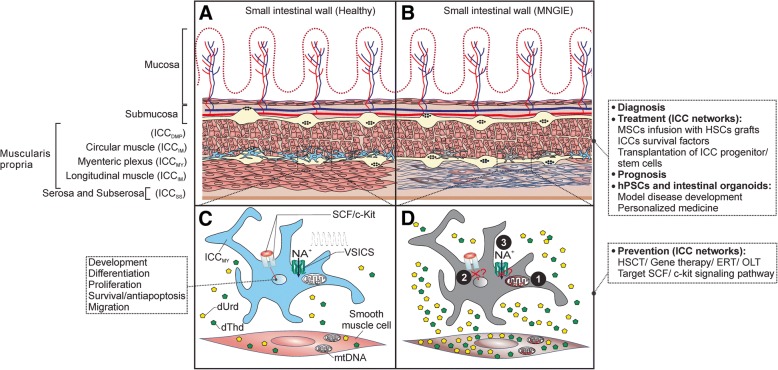
MNGIE is a rare and fatal disease in which absence of the enzyme thymidine phosphorylase induces systemic accumulation of thymidine and deoxyuridine and secondary mitochondrial DNA alterations. Gastrointestinal (GI) symptoms are frequently reported in MNGIE patients, however, they are not resolved with the current treatment interventions. Recently, our understanding of the GI pathology has increased, which rationalizes the pursuit of more targeted therapeutic strategies. In particular, interstitial cells of Cajal (ICC) play key roles in GI physiology and are involved in the pathogenesis of the GI dysmotility. However, understanding of the triggers of ICC deficits in MNGIE is lacking. Herein, we review the current knowledge about the pathology of GI dysmotility in MNGIE, discuss potential mechanisms in relation to ICC loss/dysfunction, remark on the limited contribution of the current treatments, and propose intervention strategies to overcome ICC deficits. Finally, we address the advances and new research avenues offered by organoids and tissue engineering technologies, and propose schemes to implement to further our understanding of the GI pathology and utility in regenerative and personalized medicine in MNGIE.
Interstitial cells of Cajal play key roles in the physiology of the gastrointestinal motility. Evaluation of their status in the GI dysmotility related to MNGIE would be valuable for diagnosis of MNGIE. Understanding the underlying pathological and molecular mechanisms affecting ICC is an asset for the development of targeted prevention and treatment strategies for the GI dysmotility related to MNGIE.
MNGIE 是一种罕见且致命的疾病,其特征为缺乏胸苷磷酸化酶会导致胸苷和脱氧尿苷在体内蓄积,并引发继发性线粒体 DNA 改变。胃肠道(GI)症状在 MNGIE 患者中经常被报道,但目前的治疗干预措施并不能解决这些问题。最近,我们对 GI 病理学的认识有所增加,这使得我们能够寻求更具针对性的治疗策略。特别是,Cajal 间质细胞(ICC)在 GI 生理学中发挥着关键作用,并且与 GI 动力障碍的发病机制有关。然而,目前对于 MNGIE 中 ICC 缺陷的触发因素还缺乏了解。本文综述了 MNGIE 中 GI 动力障碍的病理生理学知识,讨论了与 ICC 丧失/功能障碍相关的潜在机制,评价了目前治疗方法的局限性,并提出了干预策略以克服 ICC 缺陷。最后,我们讨论了类器官和组织工程技术带来的进展和新的研究方向,并提出了实施方案,以进一步了解 MNGIE 中 GI 病理学及其在再生医学和个性化医疗中的应用。
Cajal 间质细胞在胃肠道动力的生理学中发挥着关键作用。评估它们在与 MNGIE 相关的 GI 动力障碍中的状态对于 MNGIE 的诊断具有重要价值。了解影响 ICC 的潜在病理和分子机制对于开发针对与 MNGIE 相关的 GI 动力障碍的靶向预防和治疗策略具有重要意义。