Division of Renal Medicine, Brigham and Women's Hospital, Boston, Massachusetts;
Department of Nephrology.
J Am Soc Nephrol. 2019 Mar;30(3):493-504. doi: 10.1681/ASN.2018100979. Epub 2019 Feb 8.
Iron is a key mediator of AKI in animal models, but data on circulating iron parameters in human AKI are limited.
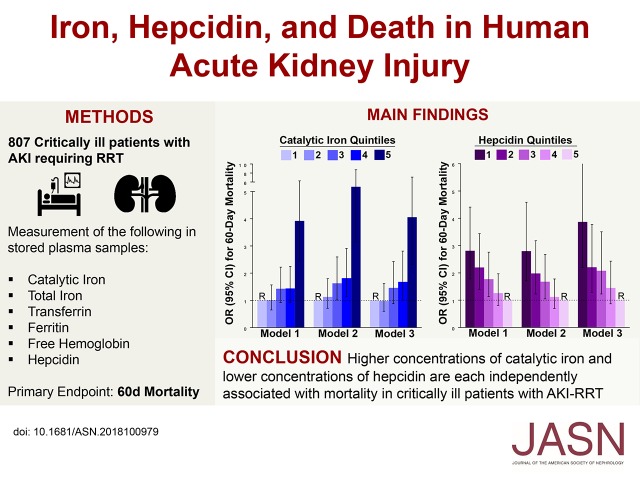
We examined results from the ARF Trial Network study to assess the association of plasma catalytic iron, total iron, transferrin, ferritin, free hemoglobin, and hepcidin with 60-day mortality. Participants included critically ill patients with AKI requiring RRT who were enrolled in the study.
Of the 807 study participants, 409 (51%) died by day 60. In both unadjusted and multivariable adjusted models, higher plasma concentrations of catalytic iron were associated with a significantly greater risk of death, as were lower concentrations of hepcidin. After adjusting for other factors, patients with catalytic iron levels in the highest quintile versus the lowest quintile had a 4.06-fold increased risk of death, and patients with hepcidin levels in the lowest quintile versus the highest quintile of hepcidin had a 3.87-fold increased risk of death. These findings were consistent across multiple subgroups. Other iron markers were also associated with death, but the magnitude of the association was greatest for catalytic iron and hepcidin. Higher plasma concentrations of catalytic iron and lower concentrations of hepcidin are each independently associated with mortality in critically ill patients with AKI requiring RRT.
These findings suggest that plasma concentrations of catalytic iron and hepcidin may be useful prognostic markers in patients with AKI. Studies are needed to determine whether strategies to reduce catalytic iron or increase hepcidin might be beneficial in this patient population.
铁是动物模型中急性肾损伤(AKI)的关键介质,但关于人类 AKI 中循环铁参数的数据有限。
我们检查了 ARF 试验网络研究的结果,以评估血浆催化铁、总铁、转铁蛋白、铁蛋白、游离血红蛋白和hepcidin 与 60 天死亡率的关系。研究纳入了需要肾脏替代治疗(RRT)的 AKI 重症患者。
在 807 名研究参与者中,有 409 名(51%)在第 60 天死亡。在未调整和多变量调整模型中,较高的血浆催化铁浓度与死亡风险显著增加相关,hepcidin 浓度较低也与死亡风险增加相关。在调整其他因素后,催化铁水平处于最高五分位组的患者死亡风险是处于最低五分位组的患者的 4.06 倍,hepcidin 水平处于最低五分位组的患者死亡风险是处于最高五分位组的患者的 3.87 倍。这些发现与多个亚组一致。其他铁标志物也与死亡相关,但与催化铁和 hepcidin 相比,其关联的程度最大。较高的血浆催化铁浓度和较低的 hepcidin 浓度均与需要 RRT 的 AKI 重症患者的死亡率独立相关。
这些发现表明,血浆催化铁和 hepcidin 浓度可能是 AKI 患者有用的预后标志物。需要研究确定降低催化铁或增加 hepcidin 的策略是否对这一患者群体有益。