School of Epidemiology and Public Health, Faculty of Medicine, University of Ottawa, Room 101, 600 Peter Morand Crescent, Ottawa, ON, K1G 5Z3, Canada.
Directorate of Environmental and Radiation Protection and Assessment (DERPA), Canadian Nuclear Safety Commission (CNSC), 280 Slater Street, Station B, P.O. Box 1046, Ottawa, ON, K1P 5S9, Canada.
Int Arch Occup Environ Health. 2019 Jul;92(5):747-762. doi: 10.1007/s00420-019-01411-w. Epub 2019 Feb 8.
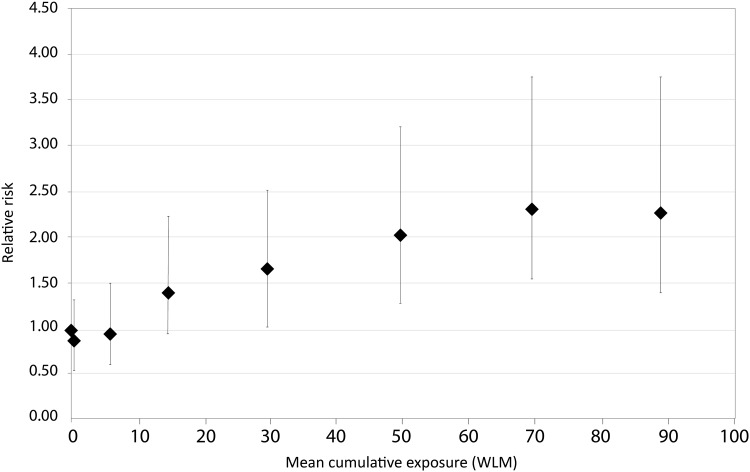
It is well established that high radon exposures increase the risk of lung cancer mortality. The effects of low occupational exposures and the factors that confound and modify this risk are not clear and are needed to inform current radiation protection of miners. The risk of lung cancer mortality at low radon exposures (< 100 working-level months) was assessed in the joint cohort analysis of Czech, French, and Canadian uranium miners, employed in 1953 or later. Statistical analysis was based on linear Poisson regression modeling with grouped cohort survival data. Two sensitivity analyses were used to assess potential confounding from tobacco smoking. A statistically significant linear relationship between radon exposure and lung cancer mortality was found. The excess relative risk per working-level month was 0.022 (95% confidence intervals: 0.013-0.034), based on 408 lung cancer deaths and 394,236 person-years of risk. Time since exposure was a statistically significant modifier; risk decreased with increasing time since exposure. A tendency for a decrease in risk with increasing attained age was observed, but this was not statistically significant. Exposure rate was not found to be a modifier of the excess relative risk. The potential confounding effect of tobacco smoking was estimated to be small and did not substantially change the radon-lung cancer mortality risk estimates. This joint cohort analysis provides strong evidence for an increased risk of lung cancer mortality from low occupational radon exposures. The results suggest that radiation protection measures continue to be important among current uranium miners.
已经证实,高氡暴露会增加肺癌死亡率。但是,对于低职业暴露的影响,以及混淆和改变这种风险的因素还不清楚,需要为当前的矿工辐射防护提供信息。在捷克、法国和加拿大铀矿工的联合队列分析中,评估了低氡暴露(<100 个工作水平月)对肺癌死亡率的影响,这些矿工在 1953 年或之后就业。统计分析基于线性泊松回归建模,使用分组队列生存数据。进行了两项敏感性分析,以评估烟草吸烟的潜在混杂因素。在基于 408 例肺癌死亡和 394236 人年风险的研究中,发现氡暴露与肺癌死亡率之间存在统计学显著的线性关系。每个工作水平月的超额相对风险为 0.022(95%置信区间:0.013-0.034)。暴露时间是一个统计学上显著的修饰因素;随着暴露时间的增加,风险降低。观察到随着年龄的增加风险呈下降趋势,但这并不具有统计学意义。暴露率不是超额相对风险的修饰因素。吸烟的潜在混杂效应估计较小,并未实质性改变氡-肺癌死亡率风险估计值。这项联合队列分析为低职业氡暴露导致肺癌死亡率增加提供了强有力的证据。结果表明,在当前的铀矿工中,辐射防护措施仍然很重要。