Channing Division of Network Medicine, Department of Medicine, Brigham and Women's Hospital, Harvard Medical School, Boston, Mass.
Division of Chronic Disease Research Across the Lifecourse, Department of Population Medicine, Harvard Medical School and Harvard Pilgrim Health Care Institute, Boston, Mass.
J Allergy Clin Immunol. 2019 Jun;143(6):2263-2270.e14. doi: 10.1016/j.jaci.2019.01.034. Epub 2019 Feb 6.
Epigenetic clocks have been suggested to capture one feature of the complexity between aging and the epigenome. However, little is known about the epigenetic clock in childhood allergy and asthma.
We sought to examine associations of DNA methylation age (DNAmAge) and epigenetic age acceleration with childhood allergy and asthma.
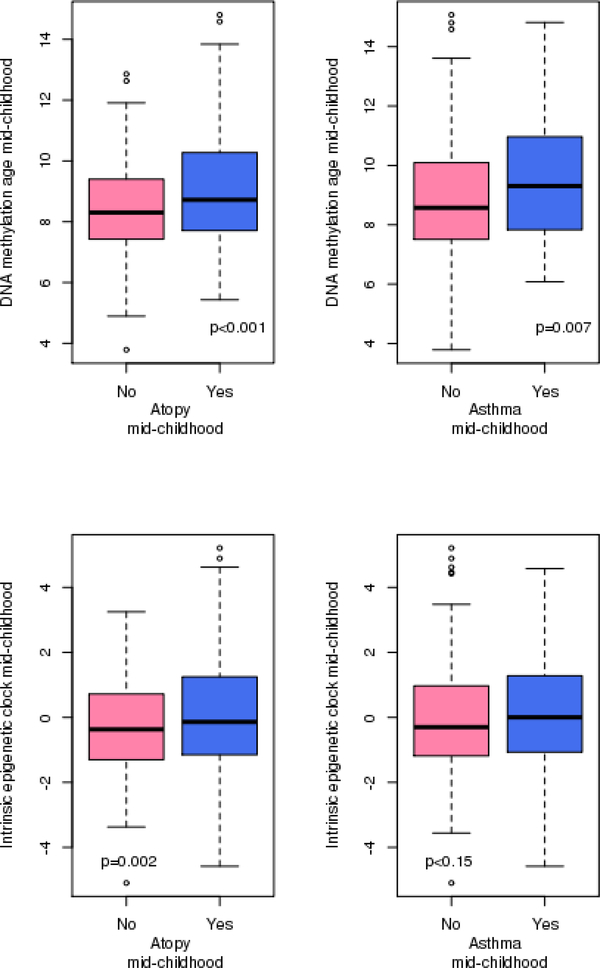
We calculated DNAmAge and age acceleration at birth, early childhood, and midchildhood based on the IlluminaHumanMethylation450BeadChip in Project Viva. We evaluated epigenetic clock associations with allergy and asthma using covariate-adjusted linear and logistic regressions. We attempted to replicate our findings in the Genetics of Asthma in Costa Rica Study.
At midchildhood (mean age, 7.8 years) in Project Viva, DNAmAge and age acceleration were cross-sectionally associated with greater total serum IgE levels and greater odds of atopic sensitization. Every 1-year increase in intrinsic epigenetic age acceleration was associated with a 1.22 (95% CI, 1.07-1.39), 1.17 (95% CI, 1.03-1.34), and 1.29 (95% CI, 1.12-1.49) greater odds of atopic sensitization and environmental and food allergen sensitization. DNAmAge and extrinsic epigenetic age acceleration were also cross-sectionally associated with current asthma at midchildhood. DNAmAge and age acceleration at birth and early childhood were not associated with midchildhood allergy or asthma. The midchildhood association between age acceleration and atopic sensitization were replicated in an independent data set.
Because the epigenetic clock might reflect immune and developmental components of biological aging, our study suggests pathways through which molecular epigenetic mechanisms of immunity, development, and maturation can interact along the age axis and associate with childhood allergy and asthma by midchildhood.
表观遗传时钟被认为可以捕捉衰老和表观基因组之间复杂性的一个特征。然而,儿童期过敏和哮喘的表观遗传时钟知之甚少。
我们旨在研究 DNA 甲基化年龄(DNAmAge)和表观遗传年龄加速与儿童期过敏和哮喘的相关性。
我们基于 Viva 项目中的 IlluminaHumanMethylation450BeadChip 计算了出生时、幼儿期和儿童中期的 DNAmAge 和年龄加速。我们使用协变量调整的线性和逻辑回归评估了表观遗传时钟与过敏和哮喘的相关性。我们试图在哥斯达黎加哮喘遗传学研究中复制我们的发现。
在 Viva 项目的儿童中期(平均年龄 7.8 岁),DNAmAge 和年龄加速与总血清 IgE 水平升高和特应性致敏的几率增加呈横断面相关。内在表观遗传年龄加速每增加 1 年,特应性致敏、环境和食物过敏原致敏的几率分别增加 1.22(95%CI,1.07-1.39)、1.17(95%CI,1.03-1.34)和 1.29(95%CI,1.12-1.49)。儿童中期的 DNAmAge 和外在表观遗传年龄加速也与当前哮喘呈横断面相关。出生时和幼儿期的 DNAmAge 和年龄加速与儿童中期的过敏或哮喘无关。年龄加速与特应性致敏之间的儿童中期相关性在一个独立的数据集中得到了复制。
由于表观遗传时钟可能反映了免疫和发育过程中的生物学衰老,我们的研究表明,免疫、发育和成熟的分子表观遗传机制可能沿着年龄轴相互作用,并通过儿童中期与儿童期过敏和哮喘相关。