Pacheco M Andreína, García-Amado M Alexandra, Manzano Jaime, Matta Nubia E, Escalante Ananias A
Department of Biology/Institute for Genomics and Evolutionary Medicine (iGEM), Temple University, Philadelphia, PA, United States of America.
Laboratorio de Fisiología Gastrointestinal, Centro de Biofísica y Bioquímica, Instituto Venezolano de Investigaciones Científicas (IVIC), Caracas, Miranda, Venezuela.
PeerJ. 2019 Feb 5;7:e6361. doi: 10.7717/peerj.6361. eCollection 2019.
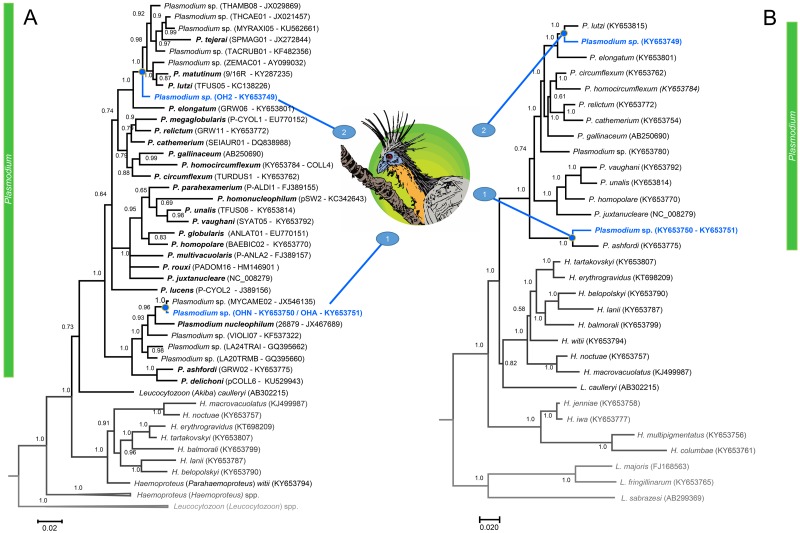
The Hoatzin () is the only extant member of the order Opisthocomiformes. This unique South American bird lives in the riparian lowland vegetation characteristic of the Amazon and Orinoco basins. Hoatzins nest in communal social units close to water bodies; they are strictly folivores being the only bird with pregastric fermentation in the crop. Because of the complex logistics involved in capturing this bird, there is a knowledge gap on its parasites. This study documents two distant lineages of haemosporidian parasites ( spp.) in a juvenile and two adults sampled in the Cojedes state, Venezuela. Although negative by microscopy, the parasite identification was possible by using molecular methods. We estimated the phylogenetic relationships on the parasite cytochrome b ( 480 bp) gene and the mitochondrial DNA. We found one of the parasites lineages in two individuals (nestling and adult), and the corresponding fragment of was identical to a one found in Wood Stork () from Brazil. The other lineage, found in an adult, has an identity of 469 out of 478 bp (98%) with sp. GAL-2012 (isolate THAMB08) from Brazil. Although a morphological description of these parasites was not possible, this is the first molecular study focusing on Hoatzin haemosporidian parasites and the first documentation of infections in the Hoatzin from Venezuela. Furthermore, we reported microfilaria in two adults as well as hematological parameters for six individuals. Information on hematological parameters could contribute to establishing the necessary baseline to detect underlying conditions, such as infections, in this bird species.
麝雉()是麝雉目现存的唯一成员。这种独特的南美鸟类生活在亚马逊河和奥里诺科河流域特有的河岸低地植被中。麝雉以群居社会单位在靠近水体的地方筑巢;它们是严格的食叶动物,是唯一在嗉囊中进行前胃发酵的鸟类。由于捕捉这种鸟类涉及复杂的后勤工作,关于其寄生虫的知识存在空白。本研究记录了在委内瑞拉科赫德斯州采集的一只幼鸟和两只成年麝雉体内的两种远缘血孢子虫寄生虫( spp.)谱系。尽管显微镜检查呈阴性,但通过分子方法可以鉴定寄生虫。我们估计了寄生虫细胞色素b(480 bp)基因和线粒体DNA的系统发育关系。我们在两个个体(雏鸟和成年鸟)中发现了其中一个寄生虫谱系,其 的相应片段与在巴西的林鹳()中发现的片段相同。在一只成年鸟中发现的另一个谱系,在478 bp中有469 bp(98%)与来自巴西的 sp. GAL - 2012(分离株THAMB08)相同。尽管无法对这些寄生虫进行形态学描述,但这是第一项专注于麝雉血孢子虫寄生虫的分子研究,也是委内瑞拉麝雉感染 的首次记录。此外,我们报告了两只成年麝雉体内的微丝蚴以及六只个体的血液学参数。血液学参数信息有助于建立检测该鸟类潜在疾病(如感染)的必要基线。