Xiang Lei, Li Yanmei, Sui Xiaolin, Li Airong
Yunnan Key Laboratory for Wild Plant Resources, Department of Economic Plants and Biotechnology, Kunming Institute of Botany, Chinese Academy of Sciences, Kunming 650201, China.
University of Chinese Academy of Sciences, 19A Yuquan Road, Beijing 100049, China.
Plant Divers. 2018 Jul 24;40(5):226-231. doi: 10.1016/j.pld.2018.07.005. eCollection 2018 Oct.
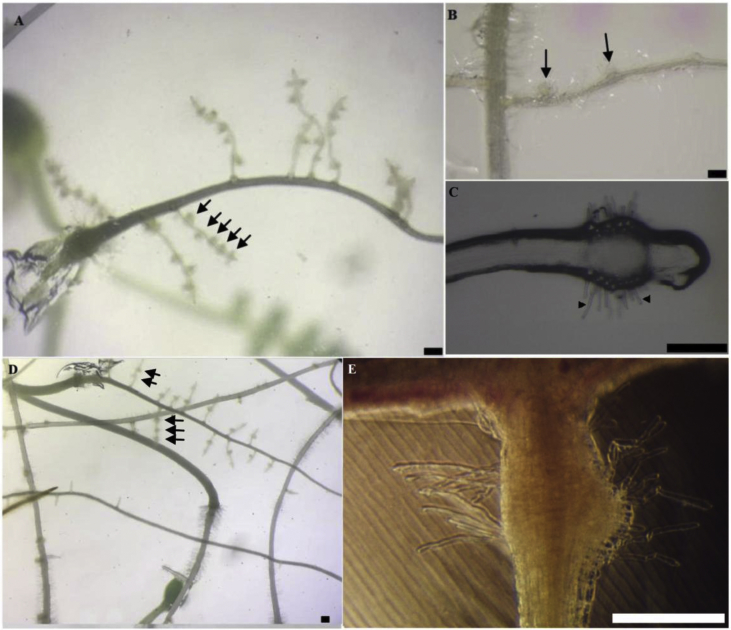
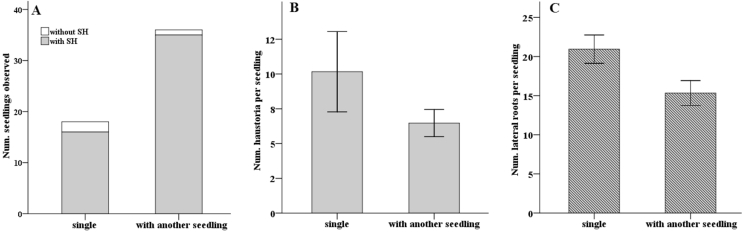
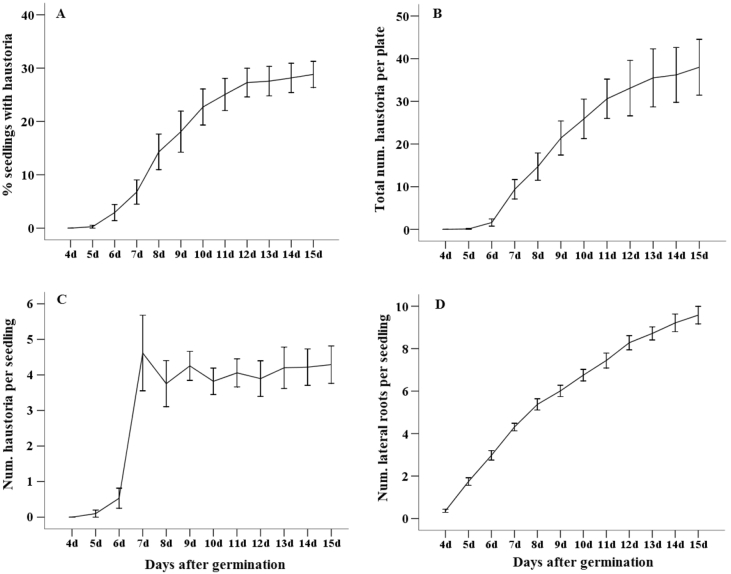
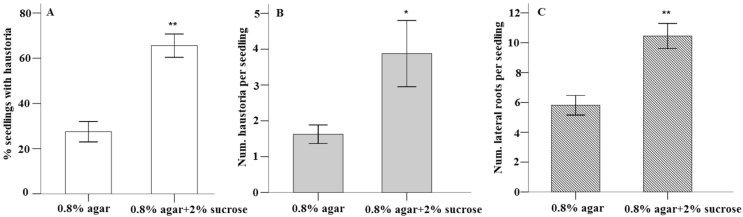
Haustorium formation is the characteristic feature of all parasitic plants and a vital process for successful parasitism. Previous investigations on haustorium initiation and development are constricted to induced processes by host-derived signals or synthetic analogs. Spontaneous haustorium formation in the absence of host signals, a process representing an early stage in the evolution of parasitic plants, remains largely unexplored. Lack of fast and frequent formation of spontaneous haustoria greatly hinders full understanding of haustorium formation in root hemiparasites. In this study, seedlings of Maxim., a facultative root hemiparasitic species in Orobanchaceae observed to produce many spontaneous haustoria, were grown in autoclaved water agar in the absence of any known haustorium-inducing stimulants. We aimed to test the temporal and developmental pattern of spontaneous haustorium formation. Also, effects of sucrose supply and root contact on spontaneous haustorium formation were tested. Spontaneous haustoria were observed starting from six days after germination, much earlier than previously reported root hemiparasites. A majority of the spontaneous haustoria formed on lateral roots. Percentage of seedlings with spontaneous haustoria was 28.8% when grown on water agar plates, with a mean of four haustoria per seedling two weeks after germination. Haustorium formation by seedlings grown in water agar amended with 2% sucrose was more than twice of those without sucrose amendment. Singly grown seedlings were able to develop spontaneous haustoria at similar levels as those grown with another conspecific seedling. In view of the fast and abundant formation of spontaneous haustoria, may be developed as an excellent experimental system in future investigations for unraveling endogenous regulation of haustorium initiation and development in root hemiparasitic plants.
吸器形成是所有寄生植物的特征性特性,也是成功寄生的关键过程。先前对吸器起始和发育的研究局限于宿主衍生信号或合成类似物诱导的过程。在没有宿主信号的情况下自发形成吸器,这一过程代表了寄生植物进化的早期阶段,在很大程度上仍未得到充分探索。缺乏快速且频繁的自发吸器形成极大地阻碍了对根半寄生植物吸器形成的全面理解。在本研究中,将玄参科兼性根半寄生植物小米草(Euphrasia nemorosa Maxim.)的幼苗,观察到其会产生许多自发吸器,在没有任何已知吸器诱导刺激物的情况下,种植于高压灭菌的水琼脂中。我们旨在测试自发吸器形成的时间和发育模式。此外,还测试了蔗糖供应和根部接触对自发吸器形成的影响。从发芽后六天开始观察到自发吸器,比先前报道的根半寄生植物要早得多。大多数自发吸器在侧根上形成。在水琼脂平板上生长时,有自发吸器的幼苗百分比为28.8%,发芽两周后每株幼苗平均有四个吸器。在添加2%蔗糖的水琼脂中生长的幼苗形成的吸器比未添加蔗糖的幼苗多两倍以上。单独生长的幼苗能够发育出自发吸器,其水平与与另一同种幼苗一起生长的幼苗相似。鉴于自发吸器形成迅速且数量众多,小米草在未来研究中可能会被开发成为揭示根半寄生植物吸器起始和发育内源性调控的优秀实验系统。