School of Communication and Information Engineering, Chongqing University of Posts andTelecommunications, Chongqing 400065, China; D150101004.
Electronic Information and Networking Research Institute, Chongqing University of Posts andTelecommunications, Chongqing 400065, China.
Sensors (Basel). 2019 Feb 8;19(3):697. doi: 10.3390/s19030697.
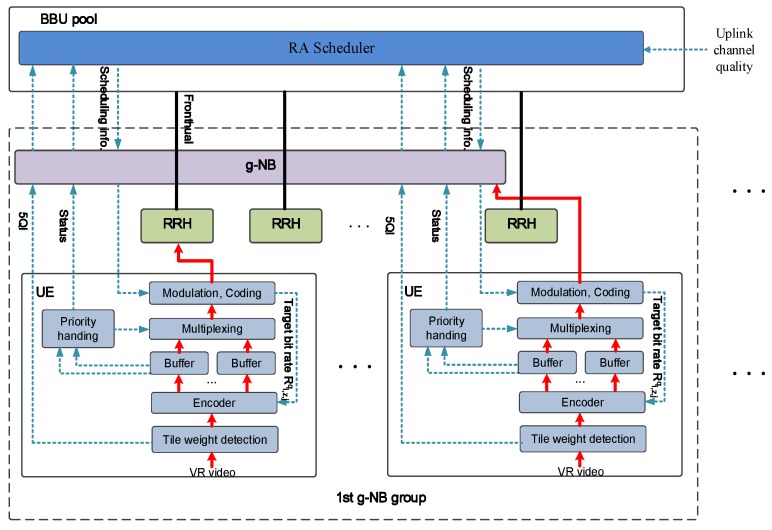
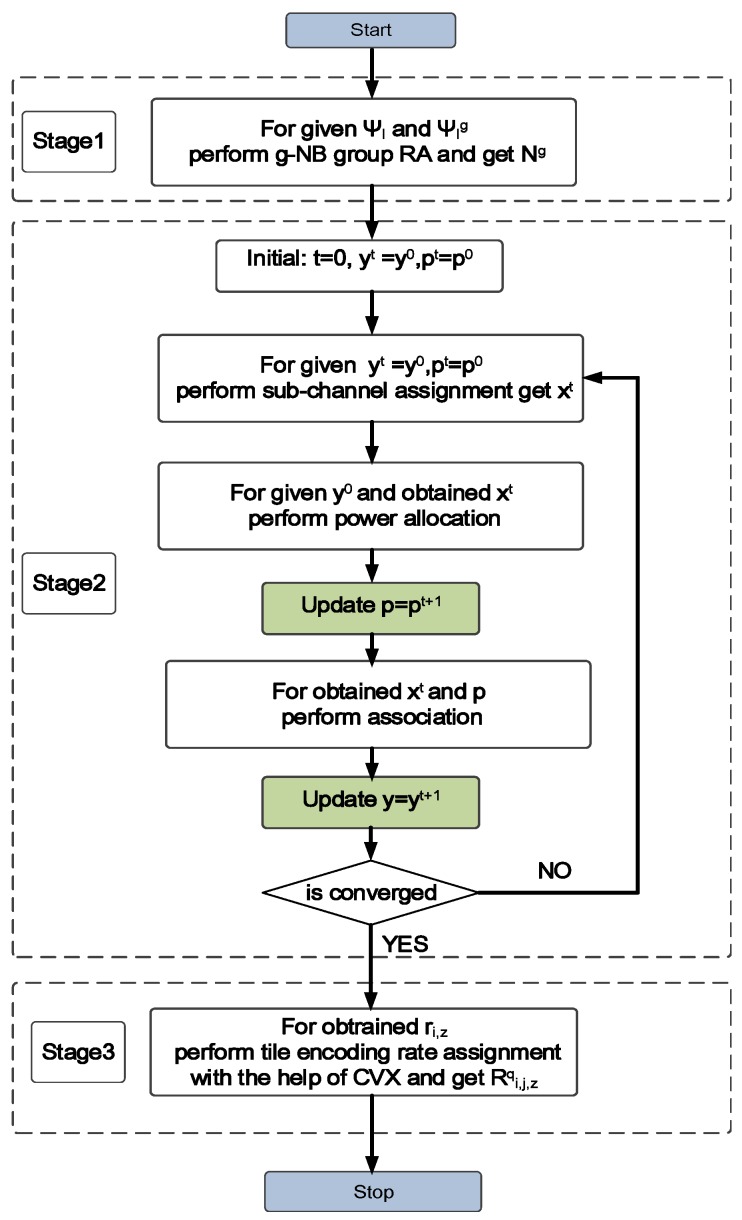
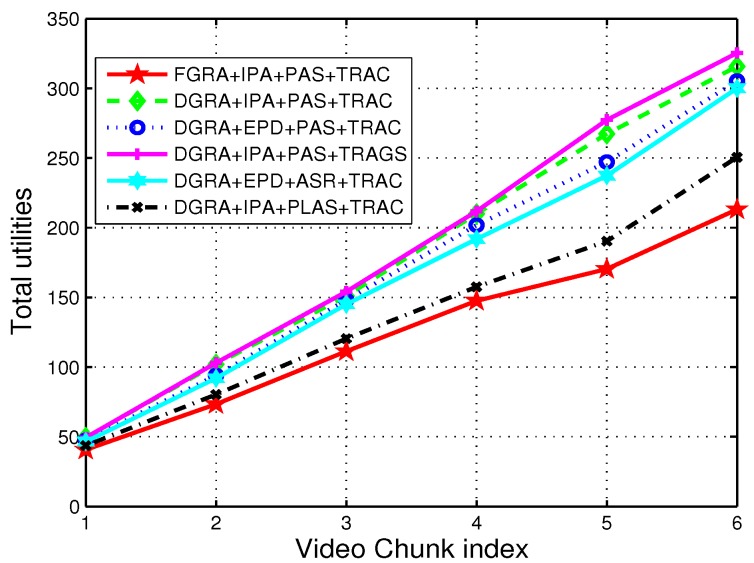
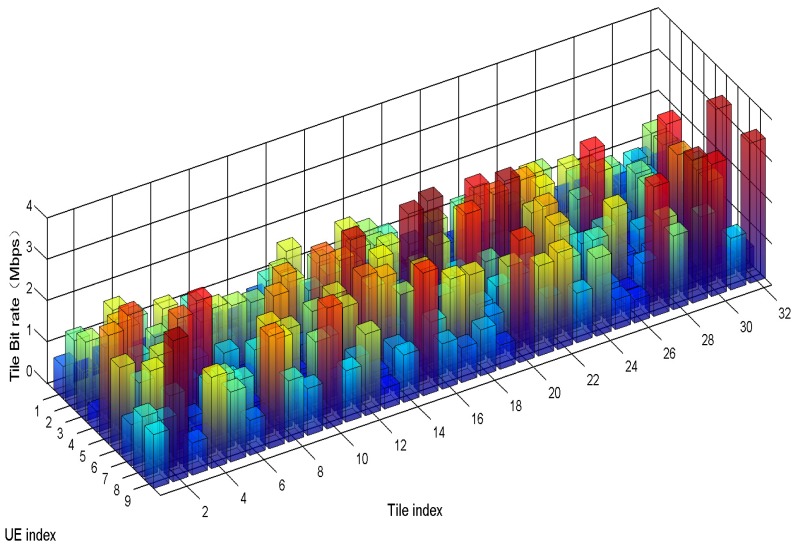
Virtual reality (VR) is emerging as one of key applications in future fifth-generation (5G)networks. Uploading VR video in 5G network is expected to boom in near future, as generalconsumers could generate high-quality VR videos with portable 360-degree cameras and arewilling to share with others. Heterogeneous networks integrating with 5G cloud-radio accessnetworks (H-CRAN) provides high transmission rate for VR video uploading. To address themotion characteristic of UE (User Equipments) and small cell feature of 5G H-CRAN, in this paperwe proposed a content-sensing based resource allocation scheme for delay-sensitive VR videouploading in 5G H-CRAN, in which the source coding rate of uploading VR video is determinedby the centralized RA scheduling. This scheme jointly optimizes g-NB group resource allocation,RHH/g-NB association, sub-channel assignment, power allocation, and tile encoding rate assignmentas formulated in a mixed-integer nonlinear problem (MINLP). To solve the problem, a three stagealgorithm is proposed. Dynamic g-NB group resource allocation is first performed according to theUE density of each group. Then, joint RRH/g-NB association, sub-channel allocation and powerallocation is performed by an iterative process. Finally, encoding tile rate is assigned to optimizethe target objective by adopting convex optimization toolbox. The simulation results show that ourproposed algorithm ensures the total utility of system under the constraint of maximum transmissiondelay and power, which also with low complexity and faster convergence.
虚拟现实(VR)是未来第五代(5G)网络的关键应用之一。预计在不久的将来,5G 网络中的 VR 视频上传将会蓬勃发展,因为普通消费者可以使用便携式 360 度摄像头生成高质量的 VR 视频,并愿意与他人分享。与 5G 云无线电接入网络(H-CRAN)集成的异构网络为 VR 视频上传提供了高传输速率。针对 UE(用户设备)的移动性特征和 5G H-CRAN 的小小区特征,本文提出了一种基于内容感知的资源分配方案,用于 5G H-CRAN 中延迟敏感的 VR 视频上传,其中上传 VR 视频的源编码率由集中式 RA 调度确定。该方案联合优化 g-NB 组资源分配、RRH/g-NB 关联、子信道分配、功率分配和瓦片编码率分配,形成混合整数非线性问题(MINLP)。为了解决该问题,提出了一种三阶段算法。首先根据每组 UE 的密度执行动态 g-NB 组资源分配。然后,通过迭代过程执行联合 RRH/g-NB 关联、子信道分配和功率分配。最后,通过采用凸优化工具箱分配编码瓦片率来优化目标目标。仿真结果表明,所提出的算法在满足最大传输延迟和功率约束的情况下保证了系统的总效用,并且具有低复杂度和更快的收敛速度。