Medical Department, Divisions of Hepatology, Gastroenterology, Oncology, Hematologyand Diabetes, Ruppiner Kliniken, Brandenburg Medical School, 16816 Neuruppin, Germany.
Charité-Universitätsmedizin Berlin, corporate member of Freie Universität Berlin, Humboldt-Universität zu Berlin, Medical Department, Division of Hepatology and Gastroenterology (including Metabolic Diseases), Campus Virchow Klinikum, 13353 Berlin, Germany.
Nutrients. 2019 Feb 9;11(2):363. doi: 10.3390/nu11020363.
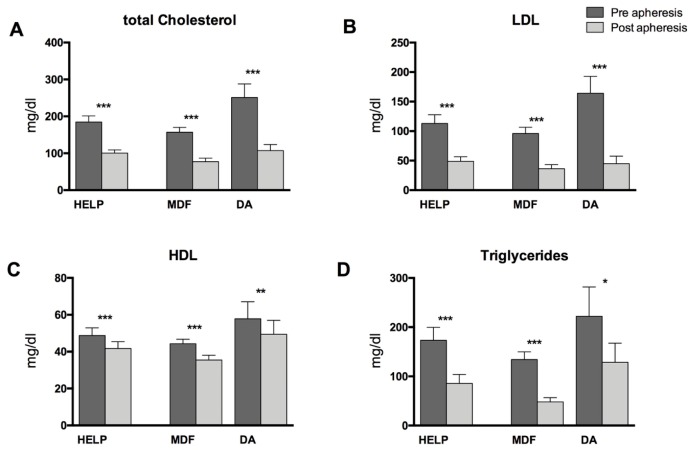
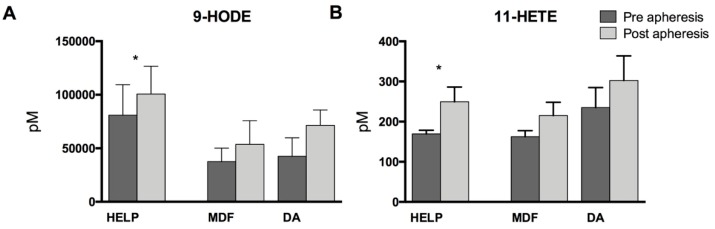
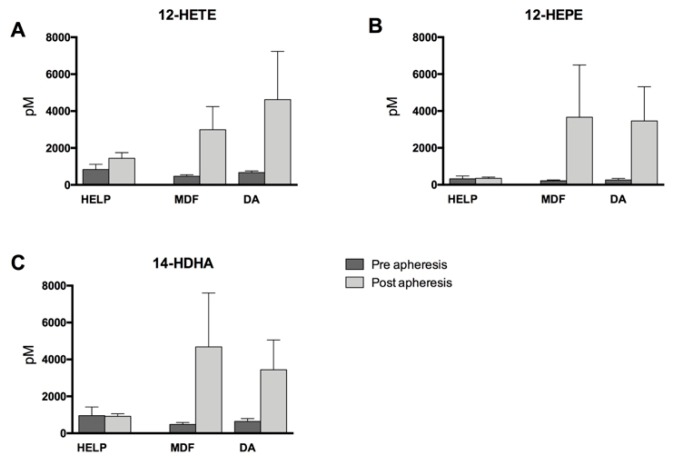
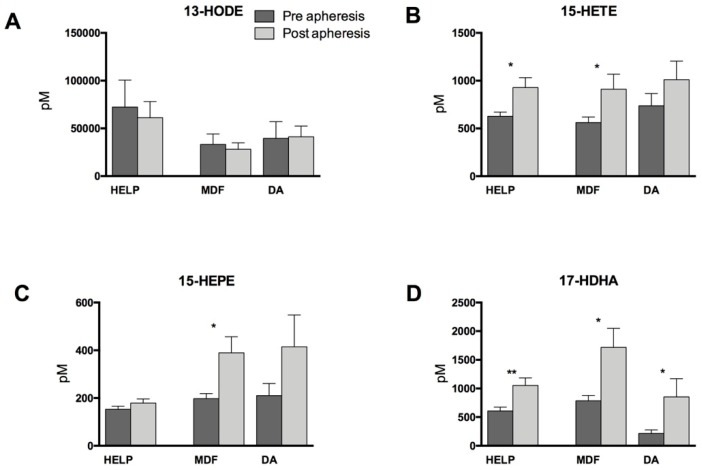
Lipoprotein apheresis reliably reduces low-density lipoprotein (LDL) cholesterol in patients with atherosclerotic disease and therapy-refractory hypercholesterolemia or elevated lipoprotein (a) (Lp(a)). Besides lowering lipoproteins and triglycerides, apheresis also decreases levels of essential omega-6 and omega-3 polyunsaturated fatty acids (6 and 3 PUFAs) in blood plasma. In contrast, heparin-induced extracorporeal low-density lipoprotein precipitation (HELP) lipid apheresis might increase the formation of potentially pro-inflammatory and pro-thrombotic lipid mediators derived from 6 and 3 PUFAs. The study presented here analyzed lipid mediator profiles in the plasma of patients with hyperlipidemia treated by one of three different apheresis methods, either HELP, direct absorption (DA), or membrane filtration (MDF), in a direct pre- and post-apheresis comparison. Using gas chromatography and liquid chromatography tandem mass spectrometry (LC-MS/MS) we were able to analyze fatty acid composition and the formation of lipid mediators called oxylipins. Our data illustrate-particularly in HELP-treated patients-significant decreases of essential omega-6 and omega-3 polyunsaturated fatty acids in blood plasma but significant increases of PUFA-derived lipoxygenase-, as well as cyclooxygenase- and cytochrome P450-derived lipid mediators. Given that -3 PUFAs in particular are presumed to be cardioprotective and -3 PUFA-derived lipid mediators might limit inflammatory reactions, these data indicate that -3 PUFA supplementation in the context of lipid apheresis treatment might have additional benefits through apheresis-triggered protective -3 PUFA-derived lipid mediators.
脂蛋白吸附术能可靠降低动脉粥样硬化疾病患者的低密度脂蛋白(LDL)胆固醇和治疗抵抗性高胆固醇血症或脂蛋白(a)(Lp(a))升高。除了降低脂蛋白和甘油三酯外,吸附术还降低了血浆中必需的ω-6 和 ω-3 多不饱和脂肪酸(6 和 3 PUFAs)的水平。相比之下,肝素诱导的体外低密度脂蛋白沉淀(HELP)脂质吸附术可能会增加源自 6 和 3 PUFAs 的潜在促炎和促血栓形成的脂质介质的形成。本研究分析了三种不同吸附方法之一(HELP、直接吸收(DA)或膜过滤(MDF))治疗的高脂血症患者血浆中的脂质介质谱,并进行了直接的治疗前后比较。我们使用气相色谱和液相色谱串联质谱(LC-MS/MS)分析了脂肪酸组成和称为氧化脂类的脂质介质的形成。我们的数据表明——尤其是在 HELP 治疗的患者中——血浆中必需的ω-6 和 ω-3 多不饱和脂肪酸显著减少,但 PUFA 衍生的脂氧合酶、环氧化酶和细胞色素 P450 衍生的脂质介质显著增加。鉴于 -3 PUFAs 特别被认为具有心脏保护作用,并且 -3 PUFA 衍生的脂质介质可能限制炎症反应,这些数据表明在脂质吸附治疗的背景下补充 -3 PUFAs 通过吸附术触发的保护性 -3 PUFAs 衍生的脂质介质可能会带来额外的益处。