Sinz Susanne, Marquardt Svenja, Soliva Carla R, Braun Ueli, Liesegang Annette, Kreuzer Michael
Institute of Agricultural Sciences, ETH Zurich, Zurich 8092, Switzerland.
Department of Farm Animals, University of Zurich, Zurich 8057, Switzerland.
Asian-Australas J Anim Sci. 2019 Jul;32(7):966-976. doi: 10.5713/ajas.18.0665. Epub 2019 Jan 2.
The methane mitigating potential of various plant-based polyphenol sources is known, but effects of combinations have rarely been tested. The aim of the present study was to determine whether binary and 3-way combinations of such phenol sources affect ruminal fermentation less, similar or more intensively than separate applications.
The extracts used were from Acacia mearnsii bark (acacia), Vitis vinifera (grape) seed, Camellia sinensis leaves (green tea), Uncaria gambir leaves (gambier), Vaccinium macrocarpon berries (cranberry), Fagopyrum esculentum seed (buckwheat), and Ginkgo biloba leaves (ginkgo). All extracts were tested using the Hohenheim gas test. This was done alone at 5% of dry matter (DM). Acacia was also combined with all other single extracts at 5% of DM each, and with two other phenol sources (all possible combinations) at 2.5%+2.5% of DM.
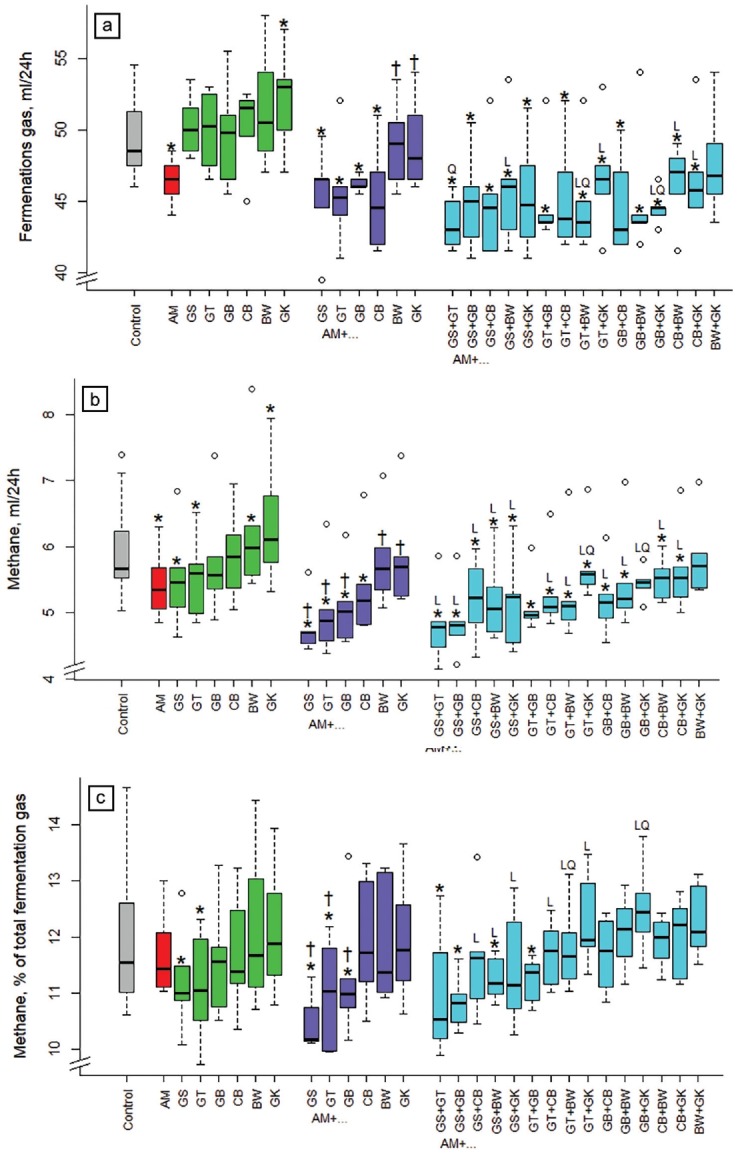
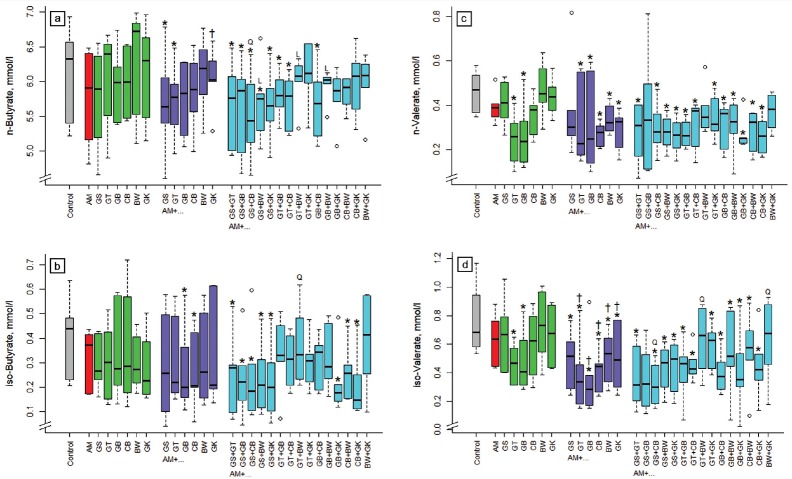
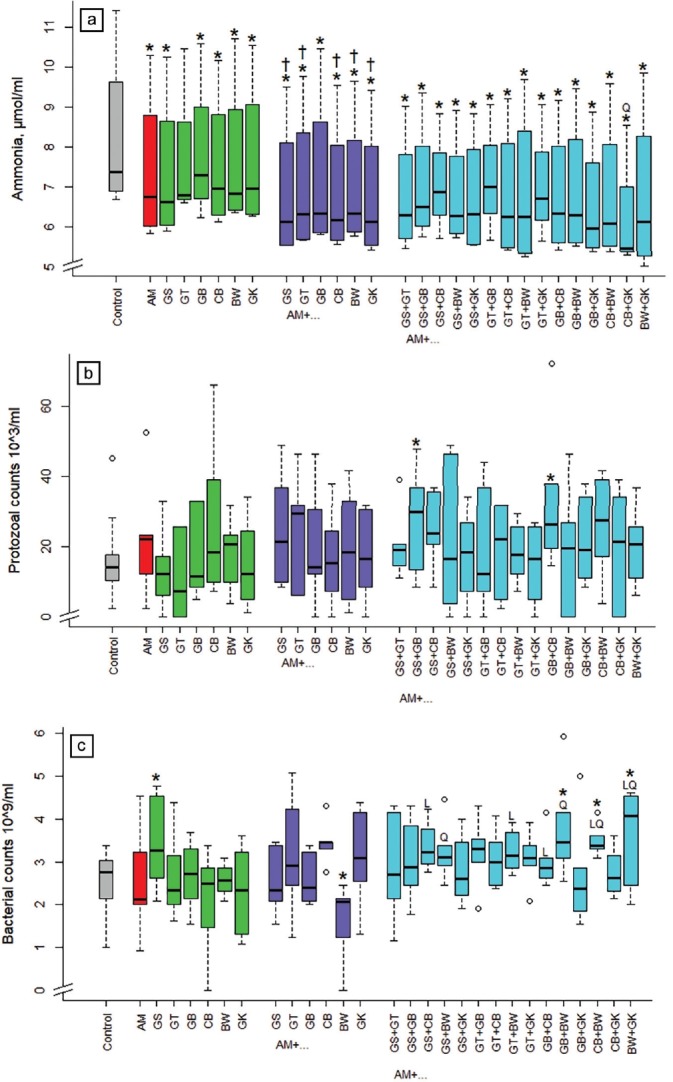
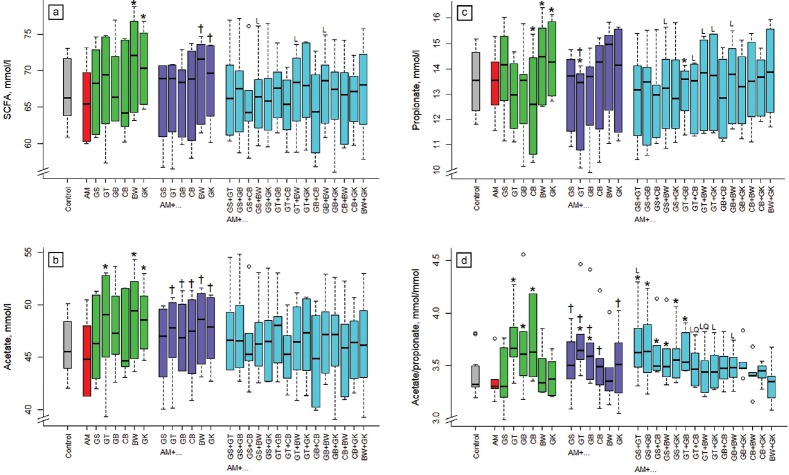
Methane formation was reduced by 7% to 9% by acacia, grape seed and green tea and, in addition, by most extract combinations with acacia. Grape seed and green tea alone and in combination with acacia also reduced methane proportion of total gas to the same degree. The extracts of buckwheat and gingko were poor in phenols and promoted ruminal fermentation. All treatments except green tea alone lowered ammonia concentration by up to 23%, and the binary combinations were more effective as acacia alone. With three extracts, linear effects were found with total gas and methane formation, while with ammonia and other traits linear effects were rare.
The study identified methane and ammonia mitigating potential of various phenolic plant extracts and showed a number of additive and some non-linear effects of combinations of extracts. Further studies, especially in live animals, should concentrate on combinations of extracts from grape seed, green tea leaves Land acacia bark and determine the ideal dosages of such combinations for the purpose of methane mitigation.
各种植物多酚源减少甲烷排放的潜力已为人所知,但对其组合效应的测试却很少。本研究的目的是确定此类酚源的二元组合和三元组合对瘤胃发酵的影响是否比单独使用时更小、相似或更强烈。
所用提取物来自黑荆树皮(金合欢)、葡萄(葡萄)籽、茶树叶子(绿茶)、钩藤叶子(钩藤)、大果越橘浆果(蔓越莓)、荞麦种子(荞麦)和银杏叶(银杏)。所有提取物均采用霍恩海姆气体试验进行测试。单独使用时为干物质(DM)的5%。金合欢还与所有其他单一提取物以DM的5%进行组合,并与其他两种酚源(所有可能的组合)以DM的2.5% + 2.5%进行组合。
金合欢、葡萄籽和绿茶以及大多数与金合欢的提取物组合使甲烷生成减少了7%至9%。单独的葡萄籽和绿茶以及与金合欢组合时,也将甲烷在总气体中的比例降低到相同程度。荞麦和银杏的提取物酚类含量低,促进瘤胃发酵。除单独的绿茶外,所有处理使氨浓度降低了23%,二元组合比单独的金合欢更有效。对于三种提取物,总气体和甲烷生成呈现线性效应,而对于氨和其他特性,线性效应很少见。
该研究确定了各种酚类植物提取物减少甲烷和氨排放的潜力,并显示了提取物组合的一些加性效应和非线性效应。进一步的研究,尤其是在活体动物中的研究,应集中于葡萄籽、绿茶叶和金合欢树皮提取物的组合,并确定此类组合减少甲烷排放的理想剂量。