Centre for Research on Filariasis and other Tropical Diseases, PO Box 5797, Yaounde, Cameroon.
Parasitology and Ecology Laboratory, Department of Animal Biology and Physiology, Faculty of Science, University of Yaoundé 1, Yaoundé, Cameroon.
BMC Infect Dis. 2019 Feb 13;19(1):146. doi: 10.1186/s12879-019-3776-y.
Loiasis is a vector-borne parasitic disease due to Loa loa and transmitted to humans by tabanids of the genus Chrysops. Loiasis has been historically considered as the second or third most common reason for medical consultation after malaria, and a recent study has reported an excess mortality associated with the infection. However, the clinical impact of this filarial disease is yet to be elucidated, and it is still considered a benign disease eliciting very little attention. As a consequence of post-treatment severe adverse events occurring in individuals harboring very high Loa microfilarial loads, ivermectin is not recommended in onchocerciasis hypo-endemic areas that are co-endemic for loiasis. Without treatment, it is likely that the transmission of the disease and the morbidity associated with the infection will increase over time. This study aimed at investigating the long-term trends in prevalence and intensity of Loa loa infection in an area where no mass anti-filarial treatment has ever been distributed.
A cross-sectional survey was conducted in three communities of the Mbalmayo health district (Central Cameroon). All volunteers, males and females aged five years and above, underwent daytime calibrated thick blood smears (CTBS) to search for L. loa microfilariae (mf). A structured questionnaire was administered to assess the history of both loiasis related clinical signs and migration of enrollees.
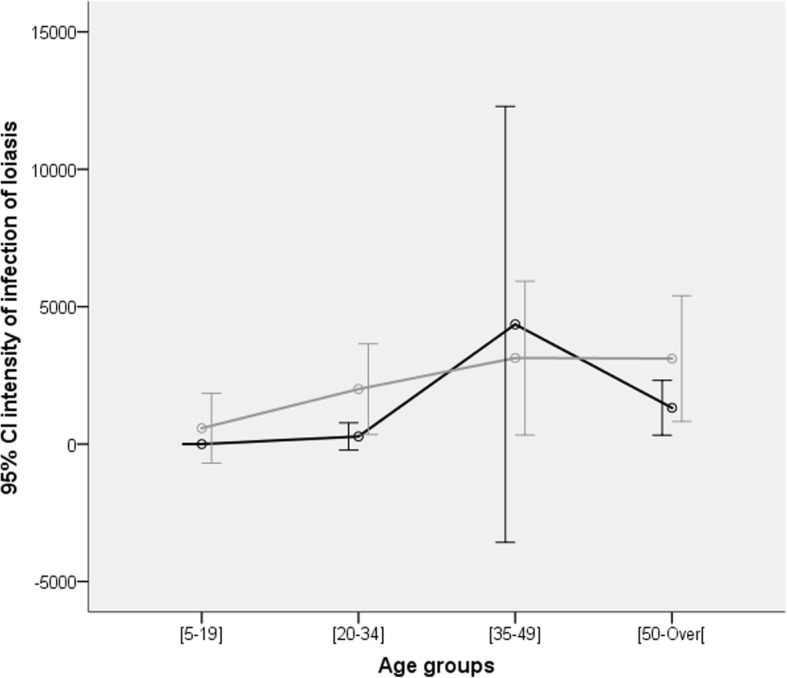
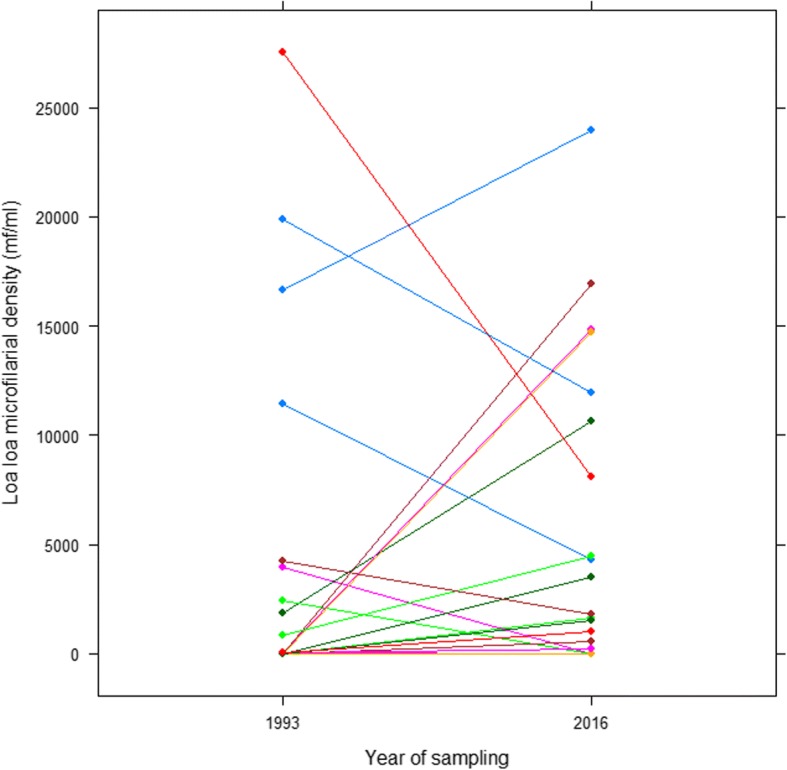
The prevalence of loiasis was 27.3% (95% CI: 22.3-32.9) in the three surveyed communities, with a mean mf density of 1922.7 (sd: 6623.2) mf/mL. Loa loa infection rate was higher amongst females than in males (p = 0.0001) and was positively associated with age of (OR = 1.018; p = 0.007). The intensity of infection was higher among males than in females (p < 0.0001), and displayed a convex in form trends with age groups. The follow up over 23 years revealed that both the rate and intensity of infection were similar to baseline.
The prevalence and intensity of Loa loa infection 23 years on is stable over time, indicating that this filarial disease might be noncumulative as regarded till now.
罗阿丝虫病是一种由罗阿丝虫引起的寄生虫病,通过 Chrysops 属的虻传播给人类。历史上,罗阿丝虫病一直被认为是仅次于疟疾的第二或第三大常见就医原因,最近的一项研究报告称,这种感染与死亡率过高有关。然而,这种丝虫病的临床影响尚未阐明,它仍然被认为是一种良性疾病,很少引起关注。由于在携带高负荷罗阿微丝蚴的个体中发生治疗后严重不良反应,伊维菌素在同时流行罗阿丝虫病和盘尾丝虫病的低度流行区不推荐使用。如果不治疗,随着时间的推移,疾病的传播和与感染相关的发病率很可能会增加。本研究旨在调查在从未进行大规模抗丝虫病治疗的地区,罗阿丝虫感染的流行率和强度的长期趋势。
在喀麦隆中部姆巴尔马约区的三个社区进行了横断面调查。所有年龄在五岁及以上的男性和女性志愿者均接受日间校准厚血涂片(CTBS)以查找罗阿丝虫微丝蚴(mf)。还对参与者进行了一项结构化问卷,以评估与罗阿丝虫病相关的临床体征和移民史。
在三个调查社区中,罗阿丝虫病的流行率为 27.3%(95%CI:22.3-32.9),平均 mf 密度为 1922.7(sd:6623.2)mf/mL。女性中的罗阿丝虫感染率高于男性(p<0.0001),且与年龄呈正相关(OR=1.018;p=0.007)。感染强度在男性中高于女性(p<0.0001),并随年龄组呈凸形趋势。23 年的随访结果表明,感染率和感染强度均与基线相似。
23 年后,罗阿丝虫感染的流行率和强度保持稳定,表明到目前为止,这种丝虫病可能是非累积性的。