Key Laboratory of Regenerative Biology Guangdong Provincial Key Laboratory of Stem Cell and Regenerative Medicine Guangzhou Institutes of Biomedicine and Health Chinese Academy of Sciences Guangzhou China.
University of Chinese Academy of Sciences Beijing China.
FEBS Open Bio. 2019 Jan 18;9(2):206-225. doi: 10.1002/2211-5463.12570. eCollection 2019 Feb.
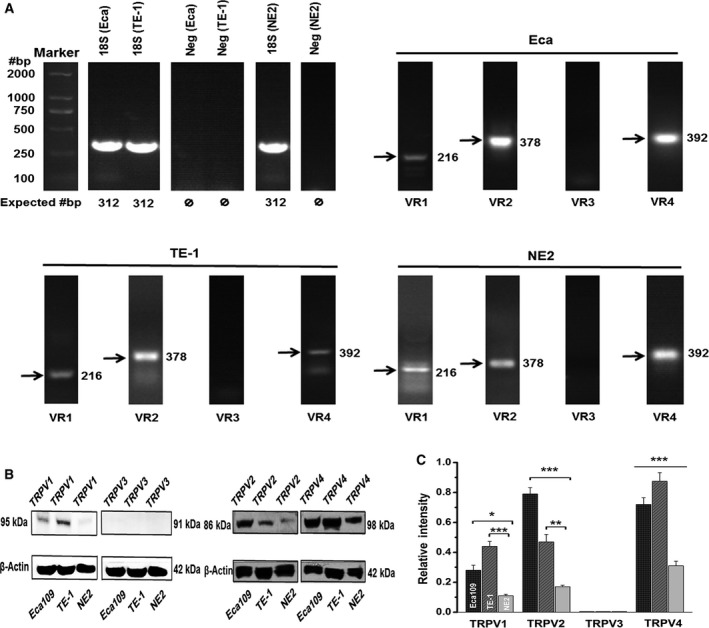
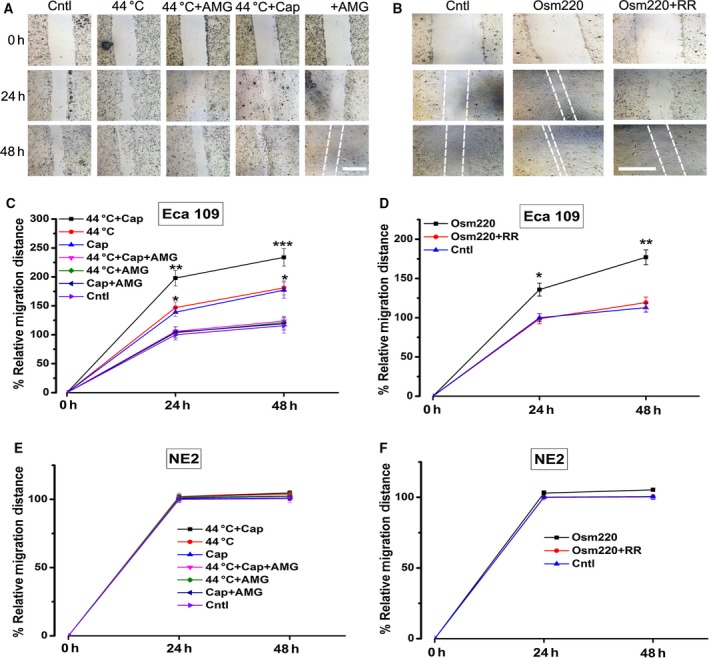
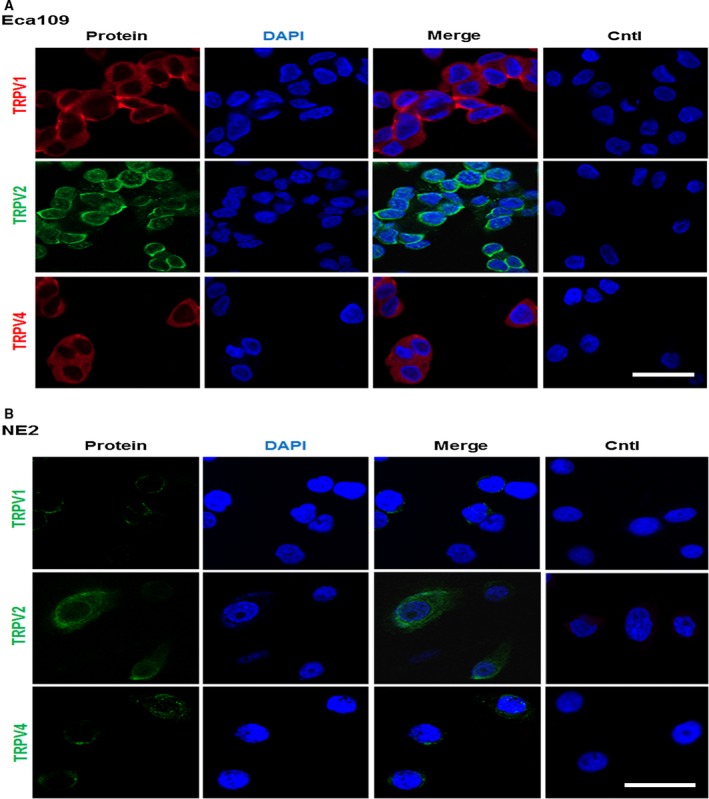
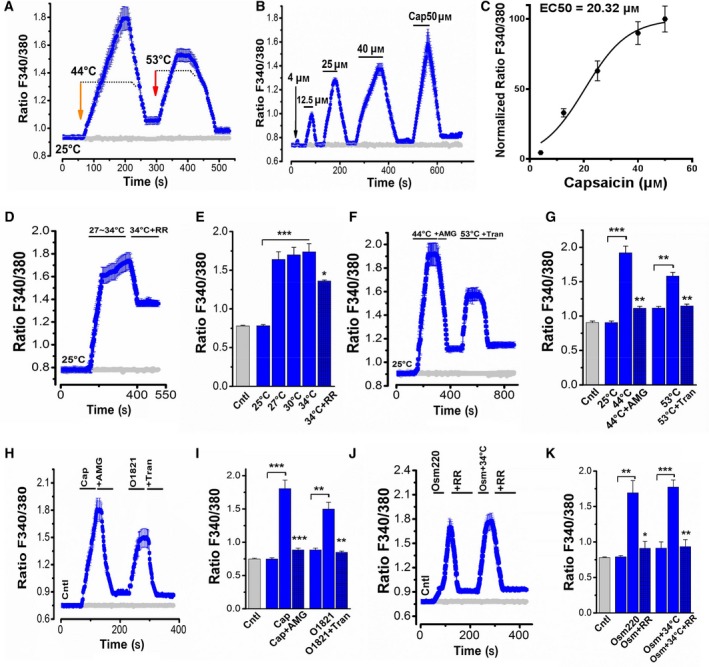
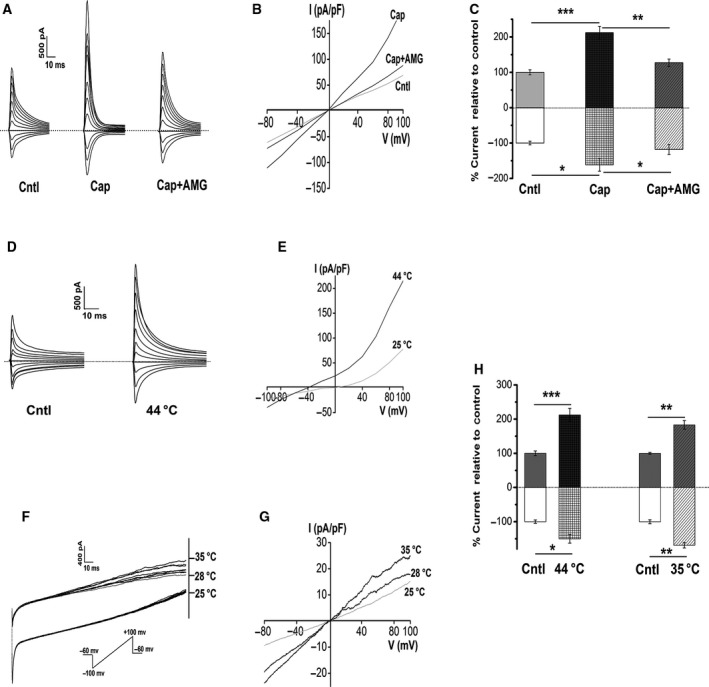
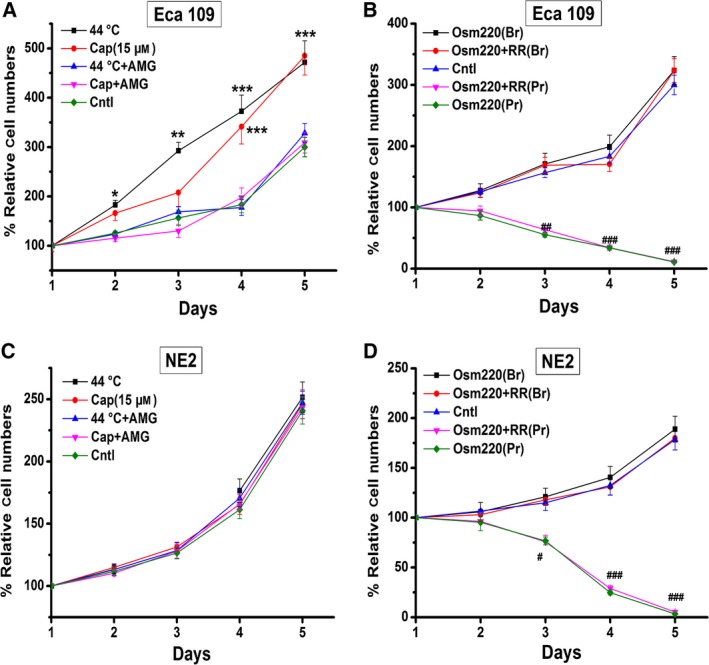
Some members of the transient receptor potential vanilloid (TRPV) subfamily of cation channels are thermosensitive. Earlier studies have revealed the distribution and functions of these thermo-TRPVs (TRPV1-4) in various organs, but their expression and function in the human esophagus are not fully understood. Here, we probed for the expression of the thermo-TRPVs in one nontumor human esophageal squamous cell line and two esophageal squamous cell carcinoma (ESCC) cell lines. TRPV1, TRPV2, and TRPV4 proteins were found to be upregulated in ESCC cells, while TRPV3 was not detectable in any of these cell lines. Subsequently, channel function was evaluated via monitoring of Ca transients by Ca imaging and nonselective cation channel currents were recorded by whole-cell patch clamp. We found that TRPV4 was activated by heat at 28 °C-35 °C, whereas TRPV1 and TRPV2 were activated by higher, noxious temperatures (44 °C and 53 °C, respectively). Furthermore, TRPV1 was activated by capsaicin (EC = 20.32 μm), and this effect was antagonized by AMG9810; TRPV2 was activated by a newly developed cannabinoid compound, O1821, and inhibited by tranilast. In addition, TRPV4 was activated by hypotonic solutions (220 m Osm), and this effect was abolished by ruthenium red. The effects of TRPV1 and TRPV4 on ESCC were also explored. Our data, for the first time, showed that the overactivation of TRPV1 and TRPV4 promoted the proliferation and/or migration of ESCC cells. In summary, TRPV1, TRPV2, and TRPV4 were functionally expressed in human esophageal squamous cells, and thermo-TRPVs might play an important role in the development of ESCC.
一些瞬时受体电位香草素(TRPV)阳离子通道亚家族成员是热敏的。早期研究揭示了这些热 TRPVS(TRPV1-4)在各种器官中的分布和功能,但它们在人食管中的表达和功能尚不完全清楚。在这里,我们研究了热敏 TRPV 在一个非肿瘤人食管鳞状细胞系和两个食管鳞状细胞癌(ESCC)细胞系中的表达。TRPV1、TRPV2 和 TRPV4 蛋白在 ESCC 细胞中上调,而 TRPV3 在这些细胞系中均无法检测到。随后,通过钙成像监测 Ca 瞬变评估通道功能,并通过全细胞膜片钳记录非选择性阳离子通道电流。我们发现 TRPV4 可被 28°C-35°C 的热激活,而 TRPV1 和 TRPV2 可被更高的有害温度(分别为 44°C 和 53°C)激活。此外,TRPV1 被辣椒素(EC 50 = 20.32 μm)激活,该作用被 AMG9810 拮抗;TRPV2 被一种新开发的大麻素化合物 O1821 激活,并被曲尼司特抑制。此外,TRPV4 被低渗溶液(220 m Osm)激活,该作用被钌红消除。还探索了 TRPV1 和 TRPV4 对 ESCC 的影响。我们的数据首次表明,TRPV1 和 TRPV4 的过度激活促进了 ESCC 细胞的增殖和/或迁移。总之,TRPV1、TRPV2 和 TRPV4 在人食管鳞状细胞中功能性表达,热 TRPVS 可能在 ESCC 的发展中起重要作用。