Turk J Med Sci. 2019 Feb 11;49(1):147-152. doi: 10.3906/sag-1805-220.
BACKGROUND/AIM: Ig level assessment is frequently used in the diagnosis and follow-up of immunodeficiency, as well as in studies investigating the prevalence of low serum Ig level in specific diseases.
Patients who underwent Ig testing in the inpatient and outpatient clinics of our hospital in the years 2010–2016 were included. The Ig levels of the patients were assessed separately according to two reference systems commonly used in Turkey and another reference system used in the USA.
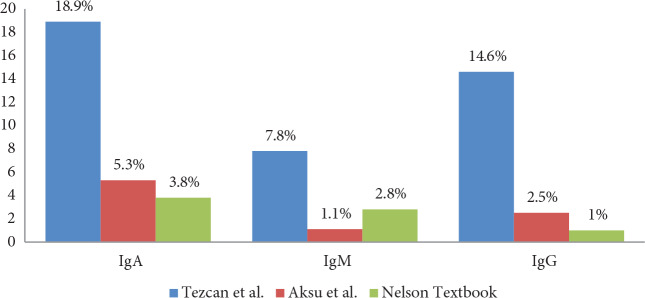
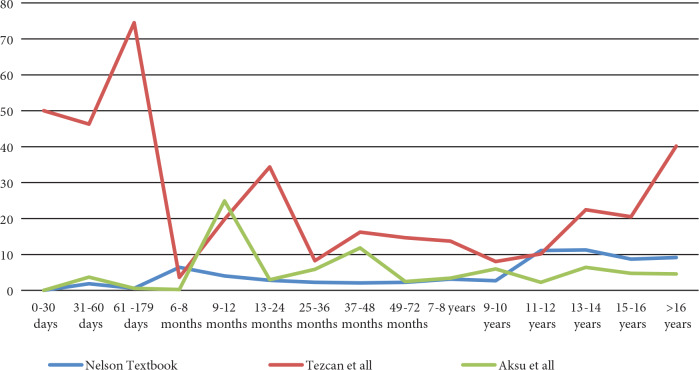
A total of 20,138 patients (57.6% male) were included in the study. The median age of the patients was 55.7 months (interquartile range: 23.1–96.7). According to the reference intervals determined by Tezcan et al., 30.6% of the patients were deficient in one or more Ig values. This rate was 4 times higher than those based on the reference intervals determined by Aksu et al. (7.7%) and those in the Nelson Textbook of Pediatrics (6.8%). We also determined that the frequency of low Ig levels with three reference systems
In this study, we found that the rates of low Ig level in a group of pediatric patients differed significantly when evaluated using three different reference systems for age-related serum Ig levels
背景/目的:免疫缺陷的诊断和随访以及特定疾病中低血清 Ig 水平患病率的研究中经常进行 Ig 水平评估。
纳入了 2010 年至 2016 年在我院门诊和住院部进行 Ig 检测的患者。根据在土耳其常用的两种参考系统和美国使用的另一种参考系统,分别评估患者的 Ig 水平。
研究共纳入 20138 名患者(57.6%为男性)。患者的中位年龄为 55.7 个月(四分位距:23.1-96.7)。根据 Tezcan 等人确定的参考区间,30.6%的患者存在一种或多种 Ig 值缺乏。这一比例是基于 Aksu 等人确定的参考区间(7.7%)和《尼尔森儿科学》(6.8%)的 4 倍。我们还确定了三种参考系统的低 Ig 水平的频率
在这项研究中,我们发现使用三种不同的血清 Ig 水平年龄相关参考系统评估一组儿科患者时,低 Ig 水平的发生率存在显著差异。