Robbins College of Health and Human Sciences, Baylor University, One Bear Place #97343, Waco, TX, 76798-7343, USA.
Texas A&M School of Public Health, College Station, College Station, TX, USA.
BMC Public Health. 2019 Feb 14;19(1):191. doi: 10.1186/s12889-019-6521-y.
Shared genetic and environmental factors suggest that family relationships are important predictors of obesity-related behaviors, yet little is known about how siblings influence physical activity and sedentary behaviors. This study examined physical activity and sedentary behavior between sibling dyads across summer and fall time points and determined if birth order and gender modify the relationship between sibling behaviors.
Mexican-heritage families residing in colonias along the United States-Mexico border were recruited using promotoras de salud to participate in summer and school year surveys. Eighty-seven sibling dyads had complete data for the physical activity sub-study: 21 older brother-younger brother, 21 older brother-younger sister, 23 older sister-younger brother, and 22 older sister-younger sister dyads. Physical activity and sedentary behavior were measured using a validated 7-day recall instrument to create summary measures of weekly active, moderate-to-vigorous physical activity (MVPA) metabolic equivalents (MET), sitting, and screen time minutes. We used linear regression analyses to examine changes over time and the association between older and younger sibling behavior.
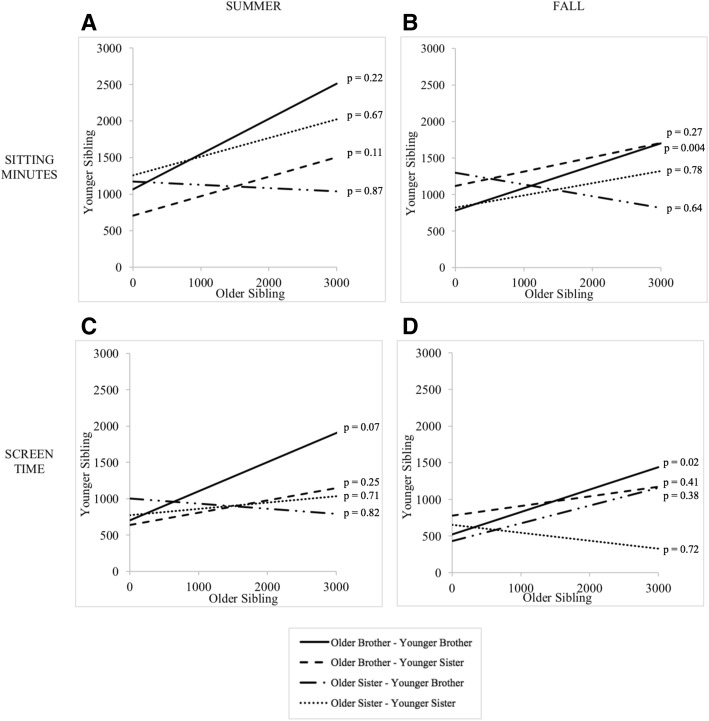
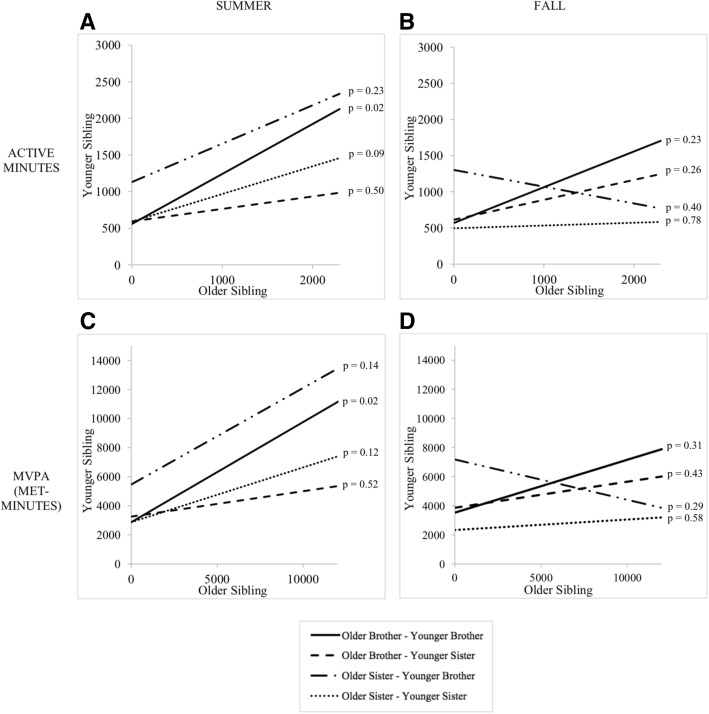
During summer, older siblings (mean age = 11.2 years) reported 1069 active minutes and 1244 sitting minutes per week; younger siblings (mean age = 8.3 years) reported 1201 active minutes and 1368 sitting minutes per week. Younger brothers reported fewer active minutes (mean = - 459.6; p = 0.01) and fewer MVPA MET-minutes (mean = - 2261.7; p = 0.02) of physical activity during the fall. Within all 87 dyads, older sibling physical activity was significantly associated with younger sibling active minutes (B = 0.45;p = 0.004) and MET-minutes (B = 0.45;p = 0.003) during summer but not fall; older sibling sedentary behavior was significantly associated with younger sibling sitting (B = 0.23;p = 0.01) and screen time minutes (B = 0.23;p = 0.004) during fall but not summer. After stratifying by gender dyad groups, younger brother behavior was strongly associated with older brother behavior at both time points.
Younger siblings appear to emulate the physical activity behaviors of their older siblings during non-school summer months and sedentary behaviors of older siblings during school-time fall months, especially older brother-younger brother dyads. Family-based interventions to increase physical activity and decrease sedentary behavior are growing in popularity, but more work is needed to understand the role of sibling influences.
共享的遗传和环境因素表明,家庭关系是肥胖相关行为的重要预测因素,但关于兄弟姐妹如何影响体力活动和久坐行为知之甚少。本研究在夏季和秋季时间点检查了兄弟姐妹之间的体力活动和久坐行为,并确定了出生顺序和性别是否会改变兄弟姐妹行为之间的关系。
使用健康促进者招募居住在美国-墨西哥边境的殖民区的墨西哥裔家庭,以参加夏季和学年调查。87 对兄弟姐妹对完成了体力活动子研究的完整数据:21 对哥哥-弟弟,21 对哥哥-妹妹,23 对姐姐-弟弟和 22 对姐姐-妹妹。使用经过验证的 7 天回忆仪器测量体力活动和久坐行为,以创建每周活跃、中等到剧烈体力活动(MVPA)代谢当量(MET)、坐着和屏幕时间分钟的综合测量值。我们使用线性回归分析来检查随时间的变化以及兄弟姐妹之间行为的关联。
在夏季,年龄较大的兄弟姐妹(平均年龄为 11.2 岁)每周报告 1069 分钟的活跃时间和 1244 分钟的静坐时间;年龄较小的兄弟姐妹(平均年龄为 8.3 岁)每周报告 1201 分钟的活跃时间和 1368 分钟的静坐时间。弟弟在秋季的体力活动中报告的活跃分钟数(平均为-459.6;p=0.01)和更少的 MVPA MET 分钟数(平均为-2261.7;p=0.02)较少。在所有 87 对双胞胎中,年龄较大的兄弟姐妹的体力活动与年龄较小的兄弟姐妹的活跃分钟数(B=0.45;p=0.004)和 MET 分钟数(B=0.45;p=0.003)在夏季有显著关联,但在秋季没有;年龄较大的兄弟姐妹的久坐行为与年龄较小的兄弟姐妹的坐姿(B=0.23;p=0.01)和屏幕时间分钟数(B=0.23;p=0.004)在秋季有显著关联,但在夏季没有。按性别双胞胎组分层后,弟弟的行为在两个时间点都与哥哥的行为密切相关。
在非上学的夏季月份,弟弟似乎模仿哥哥的体力活动行为,而在上学的秋季月份,弟弟模仿哥哥的久坐行为,尤其是哥哥-弟弟双胞胎。以家庭为基础的增加体力活动和减少久坐行为的干预措施越来越受欢迎,但需要更多的工作来了解兄弟姐妹影响的作用。