Zychowicz Anna, Pisarska Magdalena, Łaskawska Anna, Czyż Monika, Witowski Jan, Kisielewski Michał, Kulawik Jan, Budzyński Andrzej, Pędziwiatr Michał
2 Department of General Surgery, Jagiellonian University Medical College, Krakow, Poland.
Centre for Research, Training and Innovation in Surgery (CERTAIN Surgery), Krakow, Poland.
Wideochir Inne Tech Maloinwazyjne. 2019 Jan;14(1):27-37. doi: 10.5114/wiitm.2018.77261. Epub 2018 Jul 24.
The enhanced recovery after surgery (ERAS) protocol relies on patients' compliance and their awareness of its principles. Patients' views on ERAS implementation have never been evaluated in Poland before.
To analyse patients' opinions about this protocol.
One hundred forty consecutive patients undergoing elective laparoscopic procedures in which ERAS was implemented were asked to join the study. Out of them, 120 fulfilled the trial criteria and were surveyed once before and twice after surgery. A 22-question survey about the patient's perception of ERAS principles was presented upon admission and on the day of discharge. A telephone follow-up was performed 2 weeks after discharge.
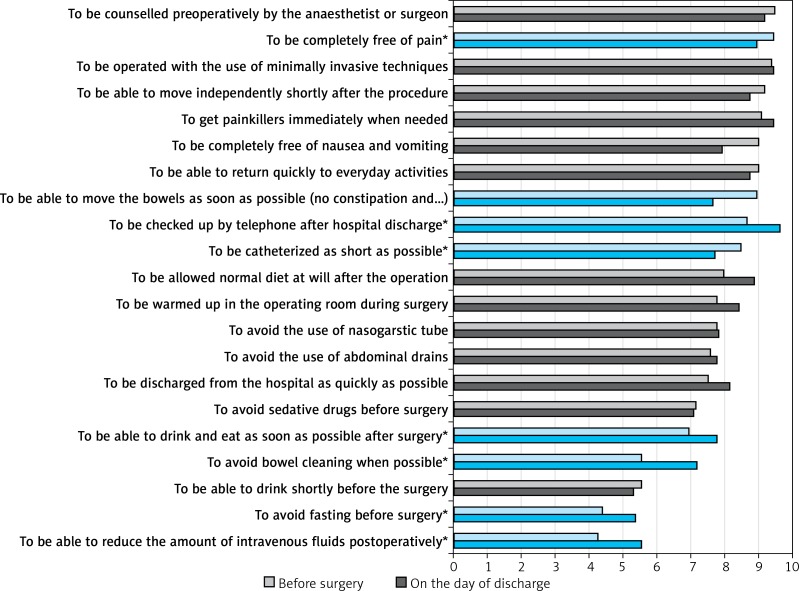
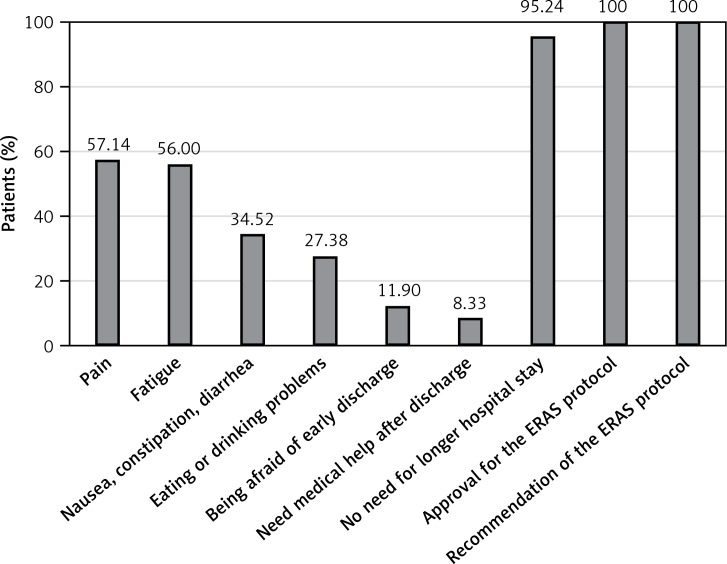
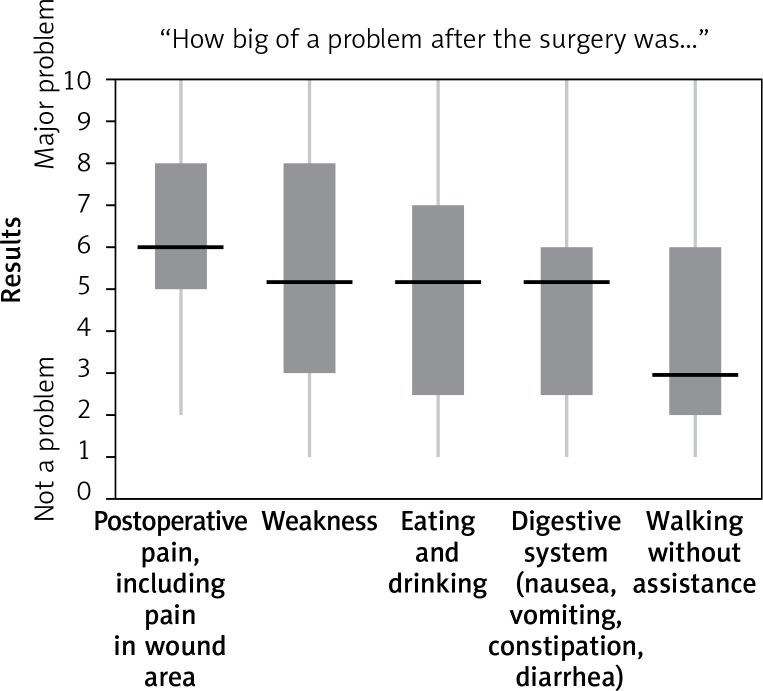
Patients reported the need for being counselled by the anaesthetist/surgeon as the most important element of the protocol. Items such as being free of pain, being free of gastrointestinal symptoms, and being free of catheter were rated more highly preoperatively than on the day of discharge, whereas telephone check-up call, being able to drink and eat early after surgery, avoiding bowel preparation, avoiding preoperative fasting and reducing postoperative intravenous fluids were rated more highly on the day of discharge. Pain was still present in over half of patients two weeks after discharge. Only 4.76% of patients admitted in the telephone survey that they were afraid of early discharge. Shortening of the length of hospital stay thanks to ERAS was widely appreciated among all patients who did not find it necessary to spend a longer time in the hospital.
Polish patients approve the ERAS protocol as modern perioperative care. Patients emphasize the need for preoperative counselling and painless recovery.
术后加速康复(ERAS)方案依赖于患者的依从性及其对该方案原则的认知。此前波兰从未评估过患者对ERAS实施情况的看法。
分析患者对该方案的意见。
连续140例接受择期腹腔镜手术且实施了ERAS的患者被邀请参加研究。其中120例符合试验标准,在手术前接受一次调查,术后接受两次调查。入院时和出院当天进行了一项关于患者对ERAS原则认知的22个问题的调查。出院后2周进行电话随访。
患者报告称,麻醉师/外科医生的咨询是该方案最重要的要素。诸如无疼痛、无胃肠道症状、无导管等项目在术前的评分高于出院当天,而电话随访、术后能尽早饮食、避免肠道准备、避免术前禁食以及减少术后静脉输液在出院当天的评分更高。出院两周后仍有超过一半的患者存在疼痛。在电话调查中,只有4.76%的患者表示担心过早出院。所有患者都普遍赞赏因ERAS而缩短了住院时间,他们认为没有必要在医院里呆更长时间。
波兰患者认可ERAS方案作为现代围手术期护理。患者强调术前咨询和无痛康复的必要性。