Centre for Microbiology Research, Kenya Medical Research Institute, Nairobi.
Bloomberg School of Public Health, Johns Hopkins University, Baltimore, Maryland.
Clin Infect Dis. 2019 Feb 15;68(Suppl 1):S10-S15. doi: 10.1093/cid/ciy898.
Salmonella infections cause a disproportionately high number of deaths in Africa, especially among poor urban populations. The increasing level of multidrug-resistant (MDR) infections is a major cause of concern in these settings where alternative effective treatment is unavailable. Other options for management of these infections must be sought. The knowledge of hotspots in endemic settings can help to prioritize management and control measures in Kenya and the region.
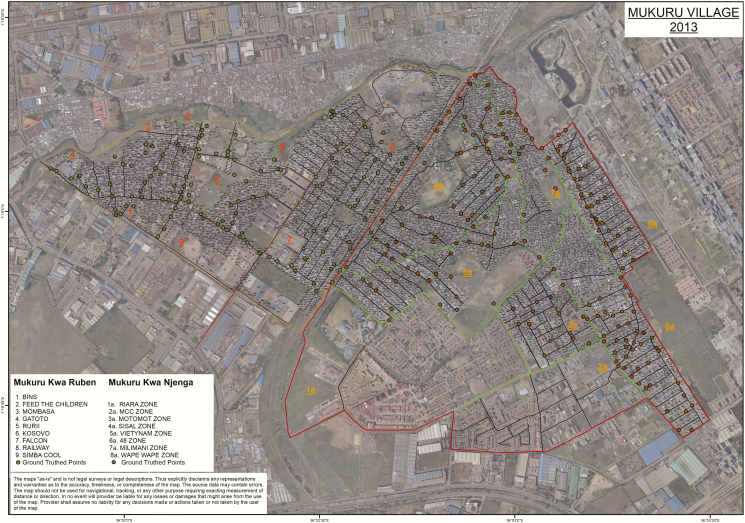
Using blood cultures, we investigated children presenting with fever of unknown origin for Salmonella infections. We performed antimicrobial susceptibility testing and whole genome sequencing to further characterize Salmonella isolates. Using Global Positioning System technologies, we mapped Salmonella isolates to households of patients in the study site and determined risk factors associated with high concentration of cases in particular sites.
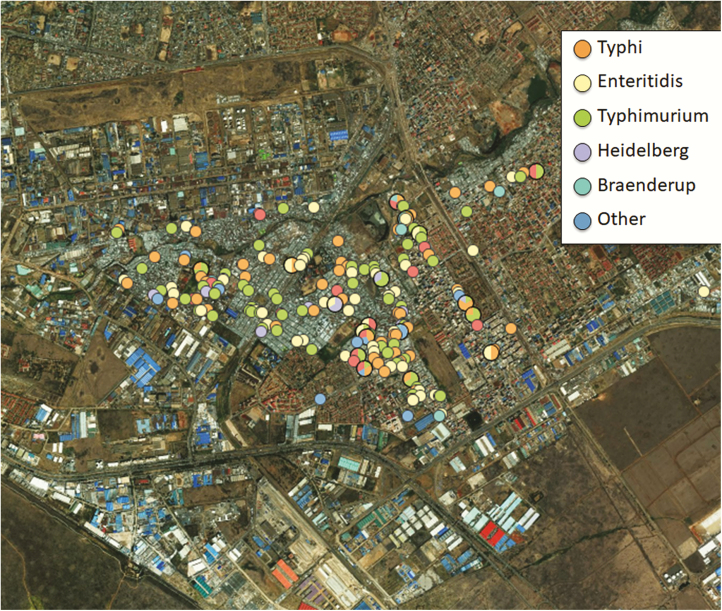
A total of 281 Salmonella species (149 from blood and 132 from fecal samples) from febrile children <5 years of age were studied. These consisted of 85 Salmonella Typhimurium, 58 Salmonella Enteritidis, 32 other nontyphoidal Salmonella (NTS) serotypes, and 126 Salmonella Typhi. The prevalence of MDR invasive NTS (iNTS) was 77.2%, with 15% resistant to ceftriaxone, a drug that is last-line treatment for iNTS and other severe gram-negative infections in Kenya. Invasive NTS and S. Typhi together mapped around common water vending points and close to sewer convergence points in the highly populated village.
These hotspots could be targeted for management and control strategies, including a combined introduction of typhoid and iNTS vaccines, aimed at reducing transmission in these endemic settings.
沙门氏菌感染在非洲导致的死亡人数不成比例地高,尤其是在贫困的城市人口中。在这些地方,无法获得替代的有效治疗方法,因此越来越多的多药耐药(MDR)感染是一个主要的关注点。必须寻找其他治疗这些感染的方法。了解流行地区的热点可以帮助肯尼亚和该地区优先考虑管理和控制措施。
我们使用血液培养物调查了因不明原因发热就诊的儿童的沙门氏菌感染情况。我们进行了抗生素敏感性测试和全基因组测序,以进一步对沙门氏菌分离株进行特征描述。我们使用全球定位系统技术将沙门氏菌分离株映射到研究地点的患者家庭中,并确定与特定地点高病例浓度相关的危险因素。
我们研究了 281 株来自 5 岁以下发热儿童的沙门氏菌(149 株来自血液样本,132 株来自粪便样本),其中包括 85 株鼠伤寒沙门氏菌、58 株肠炎沙门氏菌、32 株其他非伤寒型沙门氏菌(NTS)血清型和 126 株伤寒沙门氏菌。MDR 侵袭性 NTS(iNTS)的流行率为 77.2%,其中 15%对头孢曲松耐药,头孢曲松是肯尼亚 iNTS 和其他严重革兰氏阴性感染的最后一线治疗药物。侵袭性 NTS 和 S. Typhi 一起出现在人口密集的村庄附近的公共水贩卖点和下水道汇聚点周围。
这些热点可以作为管理和控制策略的目标,包括联合引入伤寒和 iNTS 疫苗,以减少这些流行地区的传播。