Institute of Virology, School of Medicine, Technical University of Munich/Helmholtz Zentrum München, Munich, Germany; Institute of Virology, University Hospital of Essen, University of Duisburg-Essen, Essen, Germany; Department of Internal Medicine II, University Hospital Munich-Grosshadern, Munich, Germany.
Department of Medicine II, University Hospital Freiburg, Faculty of Medicine, University of Freiburg, Freiburg, Germany.
Gastroenterology. 2019 May;156(6):1820-1833. doi: 10.1053/j.gastro.2019.02.003. Epub 2019 Feb 12.
BACKGROUND & AIMS: Hepatitis D virus (HDV) superinfection in patients with hepatitis B virus (HBV) is associated with rapid progression to liver cirrhosis and hepatocellular carcinoma. Treatment options are limited, and no vaccine is available. Although HDV-specific CD8 T cells are thought to control the virus, little is known about which HDV epitopes are targeted by virus-specific CD8 T cells or why these cells ultimately fail to control the infection. We aimed to define how HDV escapes the CD8 T-cell-mediated response.
We collected plasma and DNA samples from 104 patients with chronic HDV and HBV infection at medical centers in Europe and the Middle East, sequenced HDV, typed human leukocyte antigen (HLA) class I alleles from patients, and searched for polymorphisms in HDV RNA associated with specific HLA class I alleles. We predicted epitopes in HDV that would be recognized by CD8 T cells and corresponded with the identified virus polymorphisms in patients with resolved (n = 12) or chronic (n = 13) HDV infection.
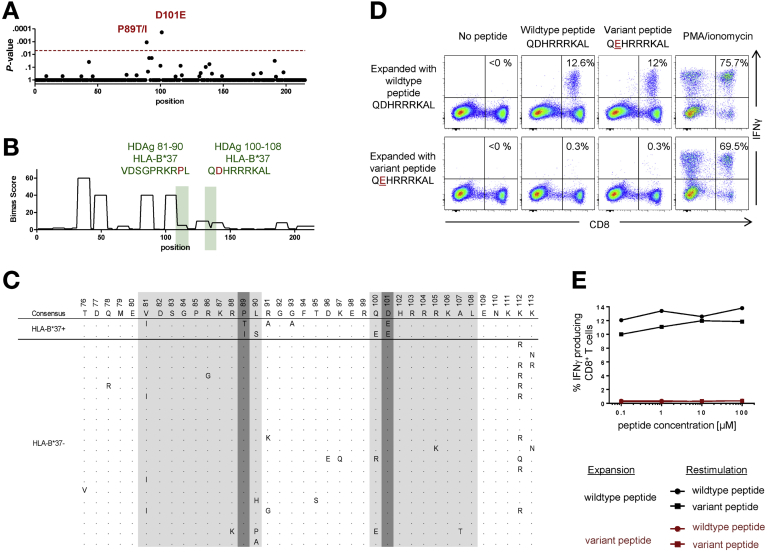
We identified 21 polymorphisms in HDV that were significantly associated with specific HLA class I alleles (P < .005). Five of these polymorphisms were found to correspond to epitopes in HDV that are recognized by CD8 T cells; we confirmed that CD8 T cells in culture targeted these HDV epitopes. HDV variant peptides were only partially cross-recognized by CD8 T cells isolated from patients, indicating that the virus had escaped detection by these cells. These newly identified HDV epitopes were restricted by relatively infrequent HLA class I alleles, and they bound most frequently to HLA-B. In contrast, frequent HLA class I alleles were not associated with HDV sequence polymorphisms.
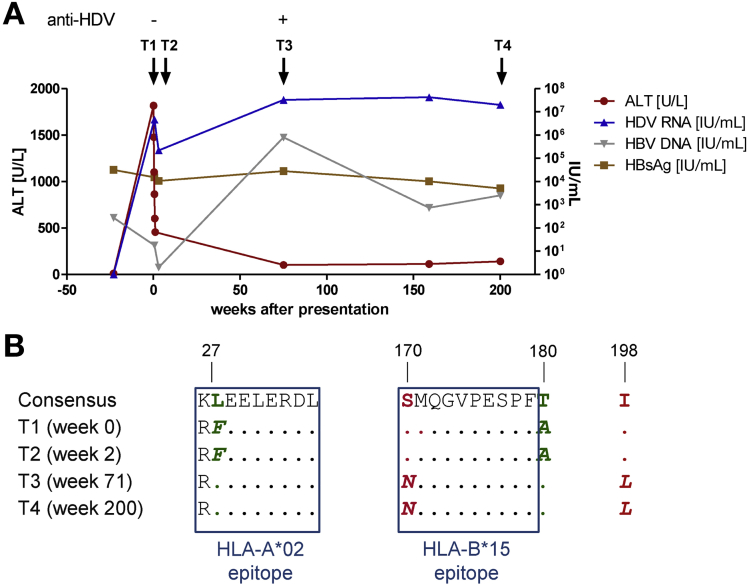
We analyzed sequences of HDV RNA and HLA class I alleles that present epitope peptides to CD8 T cells in patients with persistent HDV infection. We identified polymorphisms in the HDV proteome that associate with HLA class I alleles. Some variant peptides in epitopes from HDV were only partially recognized by CD8 T cells isolated from patients; these could be mutations that allow HDV to escape the immune response, resulting in persistent infection. HDV escape from the immune response was associated with uncommon HLA class I alleles, indicating that HDV evolves, at the population level, to evade recognition by common HLA class I alleles.
乙型肝炎病毒(HBV)合并丁型肝炎病毒(HDV)感染可导致肝纤维化和肝细胞癌的快速进展。目前治疗方法有限,且尚无疫苗可用。虽然认为 HDV 特异性 CD8 T 细胞可控制病毒,但对于哪些 HDV 表位被病毒特异性 CD8 T 细胞靶向以及这些细胞最终为何未能控制感染知之甚少。我们旨在确定 HDV 如何逃避 CD8 T 细胞介导的反应。
我们在欧洲和中东的多个医疗中心收集了 104 例慢性 HDV 和 HBV 感染患者的血浆和 DNA 样本,对 HDV 进行测序,从患者中鉴定人类白细胞抗原(HLA)I 类等位基因,并寻找与特定 HLA I 类等位基因相关的 HDV RNA 多态性。我们预测了在已解决(n=12)或慢性(n=13)HDV 感染患者中,与识别的病毒多态性相对应的、可被 CD8 T 细胞识别的 HDV 表位。
我们发现 21 个 HDV 多态性与特定的 HLA I 类等位基因显著相关(P<0.005)。其中 5 个多态性与 CD8 T 细胞识别的 HDV 表位相对应;我们证实,培养的 CD8 T 细胞靶向这些 HDV 表位。从患者中分离的 CD8 T 细胞仅部分交叉识别 HDV 变异肽,表明这些细胞已逃避了这些病毒的检测。这些新发现的 HDV 表位由相对罕见的 HLA I 类等位基因限制,并且最常与 HLA-B 结合。相比之下,常见的 HLA I 类等位基因与 HDV 序列多态性无关。
我们分析了持续性 HDV 感染患者中 HDV RNA 和 HLA I 类等位基因呈递 CD8 T 细胞表位的序列。我们鉴定了与 HLA I 类等位基因相关的 HDV 蛋白质组多态性。HDV 表位中的一些变异肽仅被从患者中分离的 CD8 T 细胞部分识别;这些可能是允许 HDV 逃避免疫反应的突变,导致持续性感染。HDV 逃避免疫反应与罕见的 HLA I 类等位基因相关,表明 HDV 在群体水平上进化,以逃避常见 HLA I 类等位基因的识别。