Stenman Adam, Zedenius Jan, Juhlin Carl Christofer
Department of Oncology-Pathology, Karolinska Institutet, 171 76 Stockholm, Sweden.
Department of Molecular Medicine and Surgery, Karolinska Institutet, 171 76 Stockholm, Sweden.
Cancers (Basel). 2019 Feb 15;11(2):225. doi: 10.3390/cancers11020225.
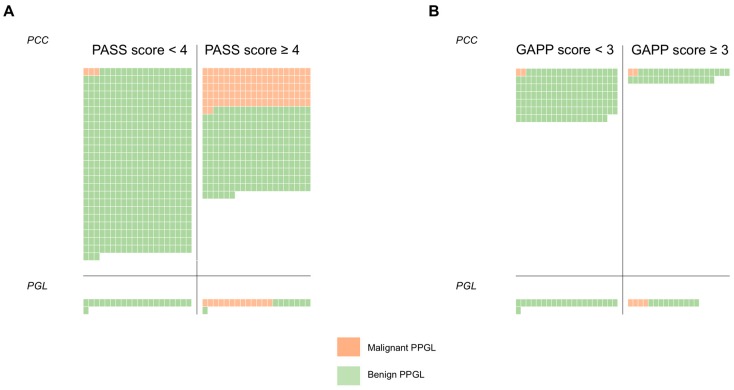
Pheochromocytomas (PCCs) and abdominal paragangliomas (PGLs), collectively abbreviated PPGLs, are neuroendocrine tumors of the adrenal medulla and paraganglia, respectively. These tumors exhibit malignant potential but seldom display evidence of metastatic spread, the latter being the only widely accepted evidence of malignancy. To counter this, pre-defined histological algorithms have been suggested to stratify the risk of malignancy: Pheochromocytoma of the Adrenal Gland Scaled Score (PASS) and the Grading system for Adrenal Pheochromocytoma and Paraganglioma (GAPP). The PASS algorithm was originally intended for PCCs whereas the GAPP model is proposed for stratification of both PCCs and PGLs. In parallel, advances in terms of coupling overtly malignant PPGLs to the underlying molecular genetics have been made, but there is yet no combined risk stratification model based on histology and the overall mutational profile of the tumor. In this review, we systematically meta-analyzed previously reported cohorts using the PASS and GAPP algorithms and acknowledge a "rule-out" way of approaching these stratification models rather than a classical "rule-in" strategy. Moreover, the current genetic panorama regarding possible molecular adjunct markers for PPGL malignancy is reviewed. A combined histological and genetic approach will be needed to fully elucidate the malignant potential of these tumors.
嗜铬细胞瘤(PCCs)和腹部副神经节瘤(PGLs),统称为PPGLs,分别是肾上腺髓质和副神经节的神经内分泌肿瘤。这些肿瘤具有恶性潜能,但很少表现出转移扩散的证据,而转移扩散是唯一被广泛认可的恶性证据。为了解决这个问题,人们提出了预定义的组织学算法来分层恶性风险:肾上腺嗜铬细胞瘤分级评分(PASS)和肾上腺嗜铬细胞瘤及副神经节瘤分级系统(GAPP)。PASS算法最初用于PCCs,而GAPP模型则用于PCCs和PGLs的分层。与此同时,在将明显恶性的PPGLs与潜在分子遗传学联系起来方面已经取得了进展,但尚未有基于组织学和肿瘤整体突变谱的联合风险分层模型。在本综述中,我们使用PASS和GAPP算法对先前报道的队列进行了系统的荟萃分析,并认可采用“排除”方式来应用这些分层模型,而不是传统的“纳入”策略。此外,还综述了关于PPGL恶性可能的分子辅助标志物的当前遗传学全景。需要综合组织学和遗传学方法来充分阐明这些肿瘤的恶性潜能。