Frerichs Inéz, Dargaville Peter A, Rimensberger Peter C
Department of Anaesthesiology and Intensive Care Medicine, University Medical Centre Schleswig-Holstein, Campus Kiel, Arnold-Heller-Str. 3, 24105, Kiel, Germany.
Neonatal and Paediatric Intensive Care Unit, Royal Hobart Hospital, Hobart, Australia.
Intensive Care Med Exp. 2019 Feb 15;7(1):11. doi: 10.1186/s40635-019-0225-6.
The provision of guidance in ventilator therapy by continuous monitoring of regional lung ventilation, aeration and respiratory system mechanics is the main clinical benefit of electrical impedance tomography (EIT). A new application was recently described in critically ill patients undergoing diagnostic bronchoalveolar lavage (BAL) with the intention of using EIT to identify the region where sampling was performed. Increased electrical bioimpedance was reported after fluid instillation. To verify the accuracy of these findings, contradicting the current EIT knowledge, we have systematically analysed chest EIT data acquired under controlled experimental conditions in animals undergoing a large number of BAL procedures.
One hundred thirteen BAL procedures were performed in 13 newborn piglets positioned both supine and prone. EIT data was obtained at 13 images before, during and after each BAL. The data was analysed at three time points: (1) after disconnection from the ventilator before the fluid instillation and by the ends of fluid (2) instillation and (3) recovery by suction and compared with the baseline measurements before the procedure. Functional EIT images were generated, and changes in pixel electrical bioimpedance were calculated relative to baseline. The data was examined in the whole image and in three (ventral, middle, dorsal) regions-of-interest per lung.
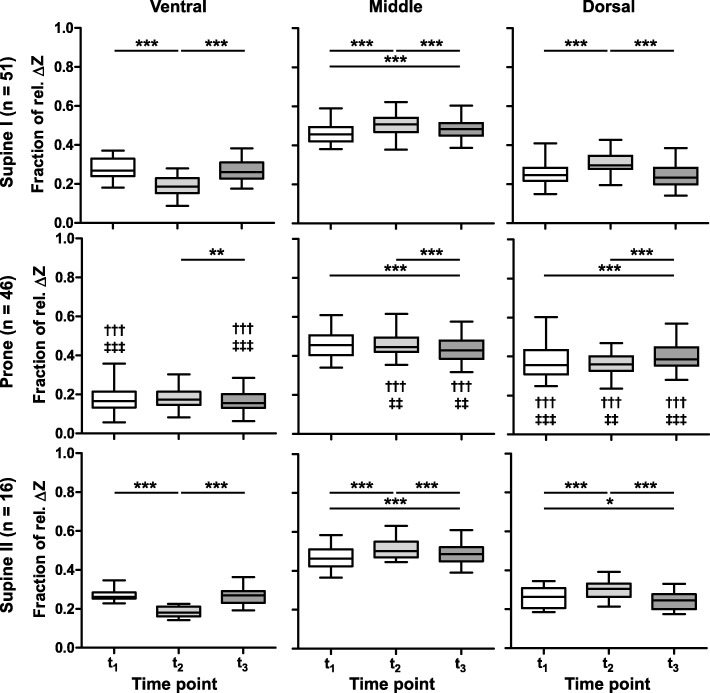
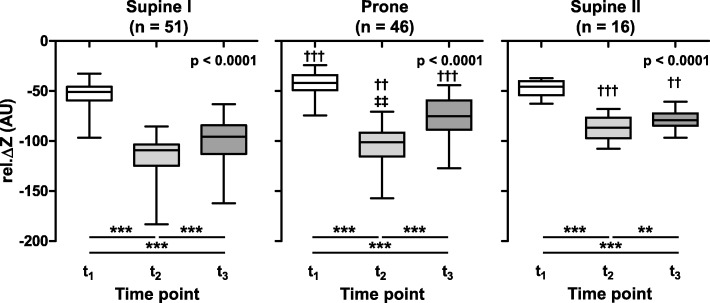
Compared with the baseline phase, chest electrical bioimpedance fell after the disconnection from the ventilator in all animals in both postures during all procedures. The fluid instillation further decreased electrical bioimpedance. During fluid recovery, electrical bioimpedance increased, but not to baseline values. All effects were highly significant (p < 0.001). The fractional changes in individual regions-of-interest were posture-dependent. The regional fall in electrical bioimpedance was smaller in the ventral and larger in the dorsal regions after the fluid instillation than after the initial disconnection to ambient pressure in supine animals (p < 0.001) whereas these changes were of comparable amplitude in prone position.
The results of this study show a regionally dissimilar initial fall in electrical bioimpedance caused by non-uniform aeration loss at the beginning of the BAL procedure. They also confirm a further pronounced fall in bioimpedance during fluid instillation, incomplete recovery after suction and a posture-dependent distribution pattern of these effects.
通过持续监测局部肺通气、气体充盈及呼吸系统力学来为通气治疗提供指导,是电阻抗断层成像(EIT)的主要临床益处。最近有一项新应用被描述,即在接受诊断性支气管肺泡灌洗(BAL)的重症患者中,意图使用EIT来识别进行采样的区域。据报道,液体注入后生物电阻抗增加。为了验证这些与当前EIT知识相矛盾的发现的准确性,我们系统分析了在大量BAL操作的动物中,在受控实验条件下获取的胸部EIT数据。
对13只新生仔猪进行了113次BAL操作,仔猪分别处于仰卧位和俯卧位。在每次BAL操作前、操作期间和操作后获取13幅图像的EIT数据。在三个时间点对数据进行分析:(1)在与呼吸机断开连接后、液体注入前以及液体(2)注入结束时和(3)通过吸引恢复后,并与操作前的基线测量值进行比较。生成功能性EIT图像,并计算相对于基线的像素生物电阻抗变化。在整个图像以及每侧肺的三个(腹侧、中间、背侧)感兴趣区域检查数据。
与基线期相比,在所有操作过程中,两种姿势的所有动物在与呼吸机断开连接后胸部生物电阻抗均下降。液体注入进一步降低了生物电阻抗。在液体恢复过程中,生物电阻抗增加,但未恢复到基线值。所有效应均具有高度显著性(p < 0.001)。各个感兴趣区域的分数变化与姿势有关。仰卧位动物在液体注入后腹侧区域生物电阻抗的下降幅度小于背侧区域,且小于初始与环境压力断开连接后(p < 0.001),而在俯卧位时这些变化幅度相当。
本研究结果表明,在BAL操作开始时,由于通气损失不均匀,生物电阻抗出现区域不同的初始下降。它们还证实了液体注入期间生物电阻抗进一步显著下降、吸引后恢复不完全以及这些效应的姿势依赖性分布模式。