Svob Strac Dubravka, Nedic Erjavec Gordana, Nikolac Perkovic Matea, Nenadic-Sviglin Korona, Konjevod Marcela, Grubor Mirko, Pivac Nela
Laboratory for Molecular Neuropsychiatry, Division of Molecular Medicine, Rudjer Boskovic Institute, Zagreb, Croatia,
Center for Alcoholism and other Addictions, University Psychiatric Hospital Vrapce, Zagreb, Croatia.
Neuropsychiatr Dis Treat. 2019 Jan 24;15:339-347. doi: 10.2147/NDT.S191457. eCollection 2019.
Alcohol dependence displays a wide variety of clinical phenotypes. Various typology classifications of alcoholism include age of onset of alcohol abuse as one of the major phenotypic features. Serotonergic changes have been associated with alcoholism, while serotonin receptors type 1B (5-HT1B) play an important role in regulating serotonergic neurotransmission. The rs13212041 polymorphism modulates the expression of gene coding for 5-HT1B receptor. This study examined the association of platelet serotonin (5-HT) and gene with the onset of alcohol abuse in alcohol-dependent subjects.
Determination of platelet 5-HT concentration and genotyping of rs13212041 gene polymorphism were performed in 613 alcohol-dependent patients, subdivided according to early/late onset (before/after 25 years of age) of alcohol abuse.
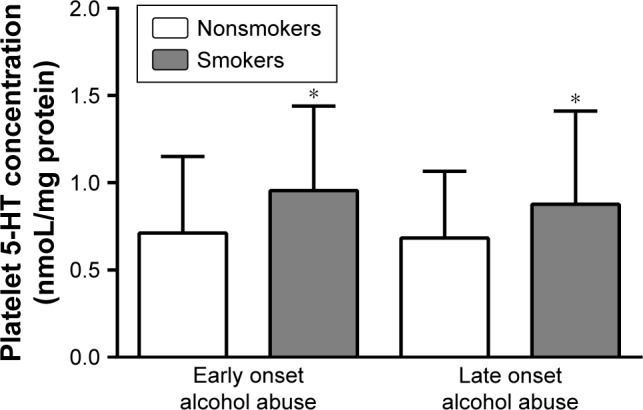
Alcohol-dependent individuals with CC genotype were more frequent in the group with early onset of alcohol abuse compared to carriers of T allele. Besides genotype, age and gender, but not platelet 5-HT, were major variables associated with the onset of alcohol abuse. Platelet 5-HT concentration was not significantly different between patients with early and late onset of alcohol abuse, or patients carrying various genotypes. Although we observed no influence of co-variables such as age, gender, or somatic and psychiatric comorbidities, platelet 5-HT concentration was significantly affected by smoking.
These findings support potential involvement of 5-HT1B receptors in the onset of alcohol abuse and development of alcohol dependence. Additionally, the results of our study emphasize the importance of controlling for smoking status, as one of the significant confounding factors influencing platelet 5-HT concentration.
酒精依赖表现出多种临床表型。酒精中毒的各种类型分类包括酒精滥用的发病年龄作为主要表型特征之一。血清素能变化与酒精中毒有关,而血清素受体1B型(5-HT1B)在调节血清素能神经传递中起重要作用。rs13212041多态性调节编码5-HT1B受体的基因表达。本研究调查了血小板血清素(5-HT)和该基因与酒精依赖者酒精滥用发病的关联。
对613名酒精依赖患者进行血小板5-HT浓度测定和rs13212041基因多态性基因分型,根据酒精滥用的早发/晚发(25岁之前/之后)进行细分。
与T等位基因携带者相比,酒精滥用早发组中CC基因型的酒精依赖个体更为常见。除了基因型、年龄和性别外,与酒精滥用发病相关的主要变量不是血小板5-HT。酒精滥用早发和晚发患者或携带不同基因型的患者之间血小板5-HT浓度无显著差异。尽管我们未观察到年龄、性别或躯体和精神合并症等协变量的影响,但吸烟显著影响血小板5-HT浓度。
这些发现支持5-HT1B受体可能参与酒精滥用的发病和酒精依赖的发展。此外,我们的研究结果强调了控制吸烟状态的重要性,吸烟是影响血小板5-HT浓度的重要混杂因素之一。