Huang Xiaoming, Ludenhoff Jasper M, Dirks Mike, Ouyang Xianhong, Boot Michael D, Hensen Emiel J M
Schuit Institute of Catalysis, Inorganic Materials Chemistry, Eindhoven University of Technology, P.O. Box 513, 5600 MB Eindhoven, The Netherlands.
Combustion Technology, Department of Mechanical Engineering, Eindhoven University of Technology, P.O. Box 513, 5600 MB Eindhoven, The Netherlands.
ACS Catal. 2018 Dec 7;8(12):11184-11190. doi: 10.1021/acscatal.8b03430. Epub 2018 Oct 22.
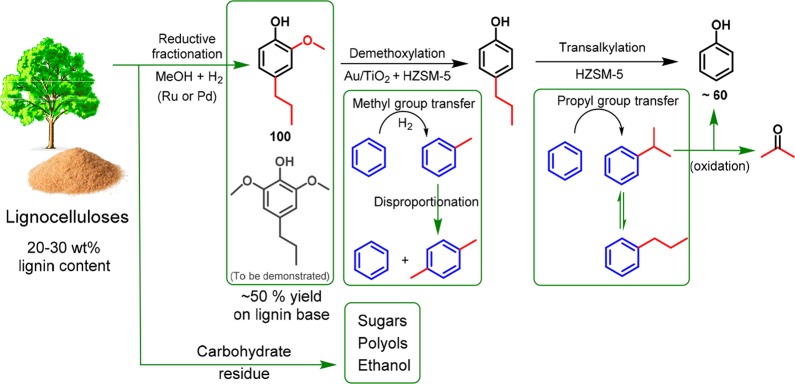
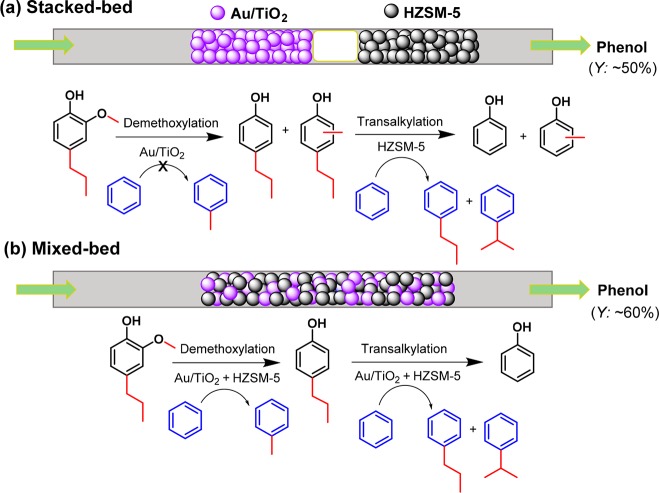
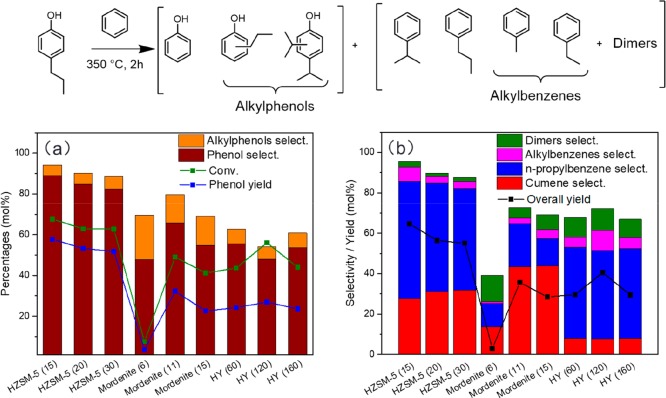
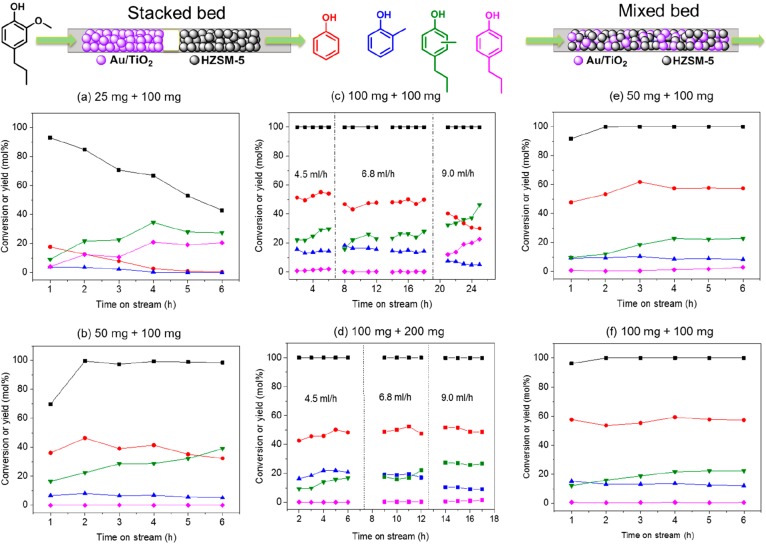
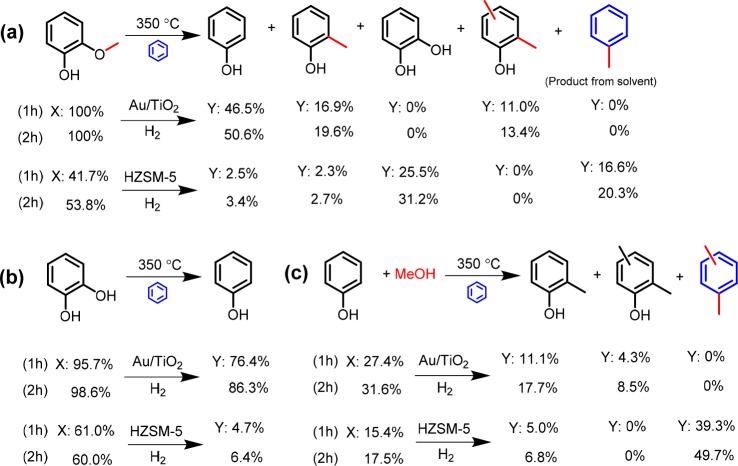
Lignocellulosic biomass is the only renewable source of carbon for the chemical industry. Alkylmethoxyphenols can be obtained in good yield from woody biomass by reductive fractionation, but these compounds are of limited value for large-scale applications. We present a method to convert lignocellulose-derived alkylmethoxyphenols to phenol that can be easily integrated in the petrochemical industry. The underlying chemistry combines demethoxylation catalyzed by a titania-supported gold nanoparticle catalyst and transalkylation of alkyl groups to a low-value benzene-rich stream promoted by HZSM-5 zeolite. In this way, phenol can be obtained in good yield, and benzene can be upgraded to more valuable propylbenzene, cumene, and toluene. We demonstrate that intimate contact between the two catalyst functions is crucial to transferring the methyl groups from the methoxy functionality to benzene instead of phenol. In a mixed-bed configuration, we achieved a yield of 60% phenol and 15% cresol from 4-propylguaiacol in a continuous one-step reaction at 350 °C at a weight hourly space velocity of ∼40 h.
木质纤维素生物质是化学工业唯一的可再生碳源。通过还原分馏可以从木质生物质中高产率地获得烷基甲氧基酚,但这些化合物在大规模应用中的价值有限。我们提出了一种将木质纤维素衍生的烷基甲氧基酚转化为苯酚的方法,该方法可以很容易地整合到石化工业中。其基本化学过程是结合由二氧化钛负载的金纳米颗粒催化剂催化的脱甲氧基反应以及由HZSM-5沸石促进的烷基向低价值富苯物流的烷基转移反应。通过这种方式,可以高产率地获得苯酚,并且苯可以升级为更有价值的丙苯、异丙苯和甲苯。我们证明,两种催化剂功能之间的紧密接触对于将甲基从甲氧基官能团转移到苯而不是苯酚至关重要。在混合床配置中,我们在350°C、重量时空速约为40 h的连续一步反应中,从4-丙基愈创木酚获得了60%的苯酚产率和15%的甲酚产率。