Lawitz Eric, Gane Edward, Cohen Eric, Vierling John, Agarwal Kosh, Hassanein Tarek, Mantry Parvez S, Pockros Paul J, Bennett Michael, Kemmer Nyingi, Morelli Giuseppe, Zha Jiuhong, Wang Deli, Shulman Nancy S, Cohen Daniel E, Reddy K Rajender
The Texas Liver Institute, University of Texas Health, San Antonio, Texas, USA.
Auckland City Hospital, Auckland, New Zealand.
Kidney Int Rep. 2018 Oct 9;4(2):257-266. doi: 10.1016/j.ekir.2018.10.003. eCollection 2019 Feb.
Hepatitis C virus (HCV) infection is common in patients with end-stage renal disease. We investigated the safety and efficacy of ombitasvir (OBV)/paritaprevir (PTV)/ritonavir (r) ± dasabuvir (DSV) ± ribavirin (RBV) in 2 phase 3, open-label, multicenter studies in patients with stage 4 or 5 chronic kidney disease (CKD).
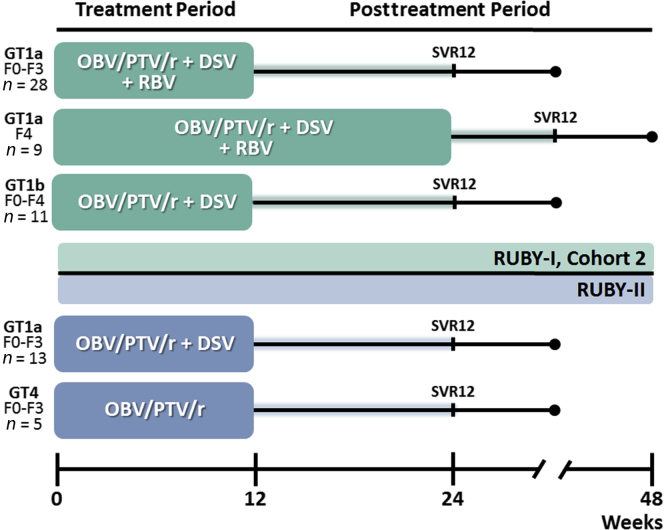
RUBY-I, Cohort 2 enrolled treatment-naïve or -experienced patients with HCV genotype (GT) 1a or 1b infection, with or without cirrhosis. Patients received 12 weeks (24 weeks for GT1a patients with cirrhosis) of OBV/PTV/r + DSV; all GT1a patients received RBV. RUBY-II enrolled treatment-naïve patients with GT1a or GT4 infection without cirrhosis. All patients received 12 weeks of RBV-free treatment: OBV/PTV/r + DSV for GT1a-infected patients; OBV/PTV/r for GT4-infected patients. The primary endpoint was sustained virologic response at posttreatment week 12 (SVR12).
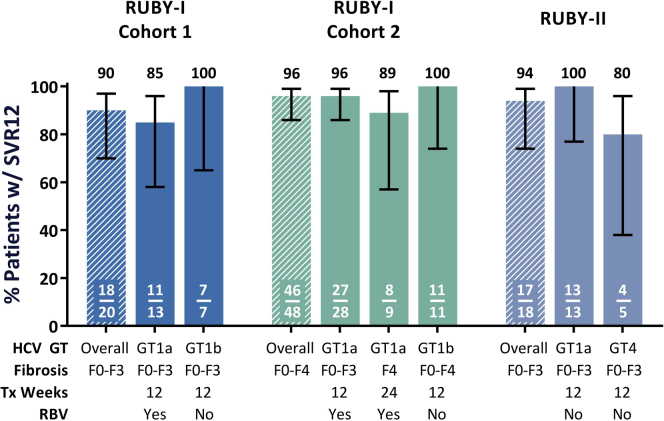
RUBY-I, Cohort 2 and RUBY-II enrolled 66 patients, including 50 (76%) on dialysis; 15 (23%) had compensated cirrhosis. Overall, the SVR12 rate was 95% (63/66); 1 patient had virologic failure. There were 3 discontinuations due to adverse events. Seventy-three percent (27/37) of patients receiving RBV had adverse events leading to RBV dose modification. The RBV-free RUBY-II study had no hemoglobin-associated adverse events.
Treatment with OBV/PTV/r ± DSV ± RBV was well tolerated and patients with HCV GT1 or 4 infection and stage 4 or 5 CKD had high SVR12 rates, including patients with compensated cirrhosis and/or prior treatment experience.
丙型肝炎病毒(HCV)感染在终末期肾病患者中很常见。我们在两项3期开放标签多中心研究中,对ombitasvir(OBV)/paritaprevir(PTV)/ritonavir(r)±dasabuvir(DSV)±ribavirin(RBV)在4或5期慢性肾脏病(CKD)患者中的安全性和疗效进行了研究。
RUBY-I研究的队列2纳入了初治或经治的HCV基因(GT)1a或1b感染患者,有无肝硬化均可。患者接受12周(肝硬化的GT1a患者为24周)的OBV/PTV/r + DSV治疗;所有GT1a患者均接受RBV治疗。RUBY-II研究纳入了无肝硬化的初治GT1a或GT4感染患者。所有患者均接受12周无RBV治疗:GT1a感染患者接受OBV/PTV/r + DSV治疗;GT4感染患者接受OBV/PTV/r治疗。主要终点是治疗后第12周的持续病毒学应答(SVR12)。
RUBY-I研究的队列2和RUBY-II研究共纳入66例患者,其中50例(76%)接受透析;15例(23%)有代偿性肝硬化。总体而言,SVR12率为95%(63/66);1例患者出现病毒学失败。有3例因不良事件停药。接受RBV治疗的患者中有73%(27/37)出现导致RBV剂量调整的不良事件。无RBV的RUBY-II研究未出现与血红蛋白相关的不良事件。
OBV/PTV/r±DSV±RBV治疗耐受性良好,HCV GT1或4感染以及4或5期CKD患者的SVR12率较高,包括有代偿性肝硬化和/或既往治疗经验的患者。