
用于制造隔热刨花板的水葫芦叶柄的微观结构和热物理特性
Microstructural and Thermo-Physical Characterization of a Water Hyacinth Petiole for Thermal Insulation Particle Board Manufacture.
作者信息
Salas-Ruiz Adela, Del Mar Barbero-Barrera María, Ruiz-Téllez Trinidad
机构信息
Department of Construction and Technologies in Architecture, Universidad Politécnica de Madrid, Avd: Juan Herrera 4, 28040 Madrid, Spain.
Botany Area, Faculty of Science, Extremadura University, Avd Portugal 0, 06006 Badajoz, Spain.
出版信息
Materials (Basel). 2019 Feb 13;12(4):560. doi: 10.3390/ma12040560.
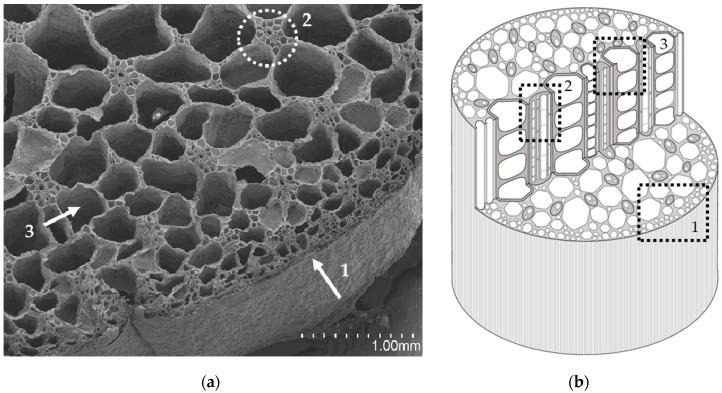
Water Hyacinth () is a dangerous and invasive aquatic species, of which global concern has sharply risen due to its rapid growth. Despite ample research on its possible applications in the construction field, there are no clear references on the optimal use of the plant in finding the most efficient-use building material. In this paper, a microstructural and chemical characterization of the Water Hyacinth petiole was performed, in order to find the most efficient use as a construction material. Subsequently, two types of binder-less insulation panels were developed, with two types of particle size (pulp and staple). A physical, mechanical, and thermal characterization of the boards was performed. These results demonstrated that it is possible to manufacture self-supporting Water Hyacinth petiole panels without an artificial polymer matrix for thermal insulation. The boards showed good thermal conductivity values, ranging from 0.047⁻0.065 W/mK. In addition, clear differences were found in the properties of the boards, depending on the type of Water Hyacinth petiole particle size, due to the differences in the microstructure.
凤眼蓝()是一种危险的入侵性水生植物,由于其快速生长,全球对它的关注度急剧上升。尽管对其在建筑领域的可能应用进行了大量研究,但在寻找最有效利用的建筑材料时,对于该植物的最佳使用方法尚无明确的参考资料。本文对凤眼蓝叶柄进行了微观结构和化学表征,以找到其作为建筑材料的最有效用途。随后,开发了两种无粘结剂保温板,采用了两种粒径类型(纸浆和短纤维)。对板材进行了物理、机械和热性能表征。这些结果表明,无需人工聚合物基体就可以制造出用于隔热的自支撑凤眼蓝叶柄板。这些板材显示出良好的热导率值,范围为0.047⁻0.065W/mK。此外,由于微观结构的差异,根据凤眼蓝叶柄粒径类型的不同,板材的性能存在明显差异。




 Zotero 插件