Department of Cancer Prevention Center, Sun Yat-sen University Cancer Center, Guangzhou, China.
State Key Laboratory of Oncology in South China, Collaborative Innovation Center for Cancer Medicine, Guangdong Key Laboratory of Nasopharyngeal Carcinoma Diagnosis and Therapy, Sun Yat-sen University Cancer Center, Guangzhou, China.
Cancer Med. 2019 Apr;8(4):1835-1844. doi: 10.1002/cam4.2027. Epub 2019 Feb 21.
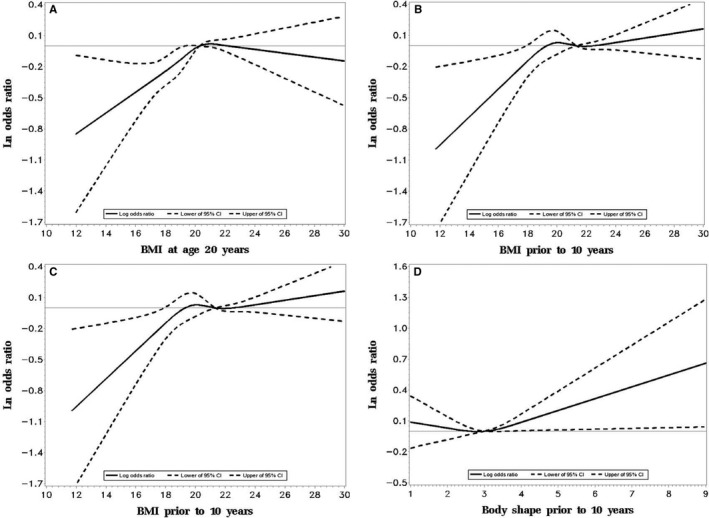
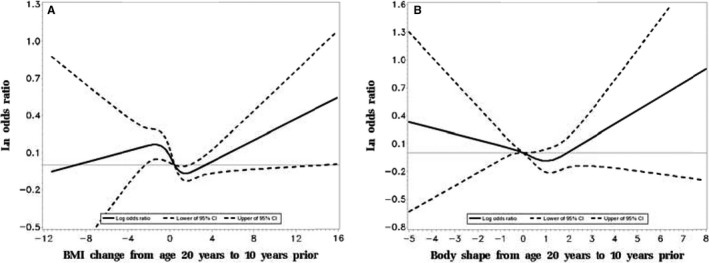
Whether the association between body size or shape and nasopharyngeal carcinoma (NPC) risk exists or varies by age-specific body size indicators is unclear. In a population-based case-control study conducted in Southern China between 2010 and 2014, self-reported height, weight, and body shape at age 20 and 10 years before interview were collected from 2448 histopathologically confirmed NPC cases and 2534 population-based controls. Body mass index (BMI) was categorized according to the World Health Organization guidelines for Asian populations: underweight (<18.5 kg/m ), normal weight (18.5-22.9 kg/m ), overweight (23.0-27.4 kg/m ), and obese (≥27.5 kg/m ). Multivariate odds ratios (ORs) with 95% confidence intervals (CIs) were estimated using logistic regression. Furthermore, restricted cubic spline analysis was employed to examine nonlinear effects of BMI and body shape as continuous covariates. Underweight vs normal weight at age 20 years was associated with a 22% decreased NPC risk (OR, 0.78; 95% CI, 0.67, 0.90), whereas obesity was not significantly associated with NPC risk. Associations with BMI 10 years before the interview were similar. Having the leanest body shape at age 20 years, compared with the mode was not significantly associated with NPC risk (OR, 0.85; 95% CI, 0.62, 1.16), but having a larger body shape was associated with an elevated risk (OR, 1.25; 95% CI, 1.03, 1.52). Increasing BMI revealed positive trends with NPC risk. Despite some indication of significant findings, evidence for a strong association between BMI or body shape and NPC risk is still limited.
体重或体型与鼻咽癌(NPC)风险之间的关联是否存在,或者是否因特定年龄的体重指标而异,目前尚不清楚。在 2010 年至 2014 年期间,在中国南方进行的一项基于人群的病例对照研究中,从 2448 例经组织病理学证实的 NPC 病例和 2534 名基于人群的对照中收集了自我报告的身高、体重和 20 岁及访谈前 10 岁时的体型。体重指数(BMI)根据世界卫生组织针对亚洲人群的指南进行分类:体重不足(<18.5kg/m )、正常体重(18.5-22.9kg/m )、超重(23.0-27.4kg/m )和肥胖(≥27.5kg/m )。使用逻辑回归估计多变量优势比(OR)和 95%置信区间(CI)。此外,还采用受限立方样条分析来检查 BMI 和体型作为连续协变量的非线性效应。20 岁时体重不足与 NPC 风险降低 22%(OR,0.78;95%CI,0.67,0.90)相关,而肥胖与 NPC 风险无显著相关性。与访谈前 10 年 BMI 的相关性相似。与体型模式相比,20 岁时体型最瘦与 NPC 风险无显著相关性(OR,0.85;95%CI,0.62,1.16),但体型较大与风险升高相关(OR,1.25;95%CI,1.03,1.52)。BMI 升高与 NPC 风险呈正相关趋势。尽管有一些迹象表明存在显著的相关性,但 BMI 或体型与 NPC 风险之间的强关联证据仍然有限。