Vita-Salute San Raffaele University, Via Olgettina, 60, Segrate, 20132, Milan, Italy.
In Vivo Human Molecular and Structural Neuroimaging Unit, Division of Neuroscience, IRCCS San Raffaele Scientific Institute, Via Olgettina, 60, Segrate, 20132, Milan, Italy.
Alzheimers Res Ther. 2019 Feb 23;11(1):20. doi: 10.1186/s13195-019-0473-4.
[18F]FDG-PET hypometabolism patterns are indicative of different neurodegenerative conditions, even from the earliest disease phase. This makes [18F]FDG-PET a valuable tool in the diagnostic workup of neurodegenerative diseases. The utility of [18F]FDG-PET in dementia with Lewy bodies (DLB) needs further validation by considering large samples of patients and disease comparisons and applying state-of-the-art statistical methods. Here, we aimed to provide an extensive validation of the [18F]FDG-PET metabolic signatures in supporting DLB diagnosis near the first clinical assessment, which is characterized by high diagnostic uncertainty, at the single-subject level.
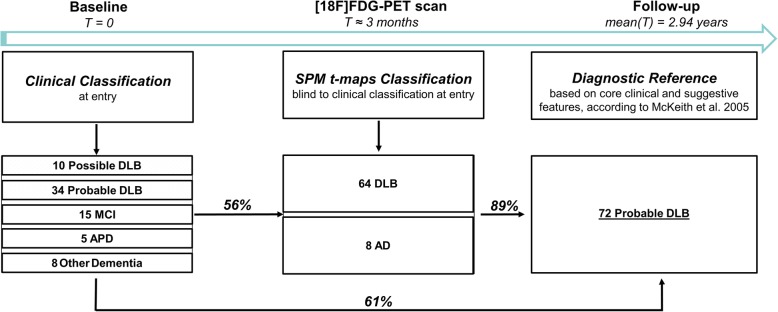
In this retrospective study, we included N = 72 patients with heterogeneous clinical classification at entry (mild cognitive impairment, atypical parkinsonisms, possible DLB, probable DLB, and other dementias) and an established diagnosis of DLB at a later follow-up. We generated patterns of [18F]FDG-PET hypometabolism in single cases by using a validated voxel-wise analysis (p < 0.05, FWE-corrected). The hypometabolism patterns were independently classified by expert raters blinded to any clinical information. The final clinical diagnosis at follow-up (2.94 ± 1.39 [0.34-6.04] years) was considered as the diagnostic reference and compared with clinical classification at entry and with [18F]FDG-PET classification alone. In addition, we calculated the diagnostic accuracy of [18F]FDG-PET maps in the differential diagnosis of DLB with Alzheimer's disease dementia (ADD) (N = 60) and Parkinson's disease (PD) (N = 36).
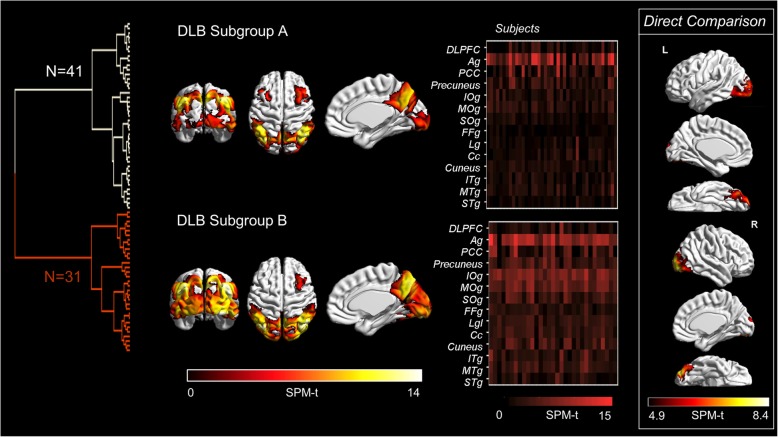
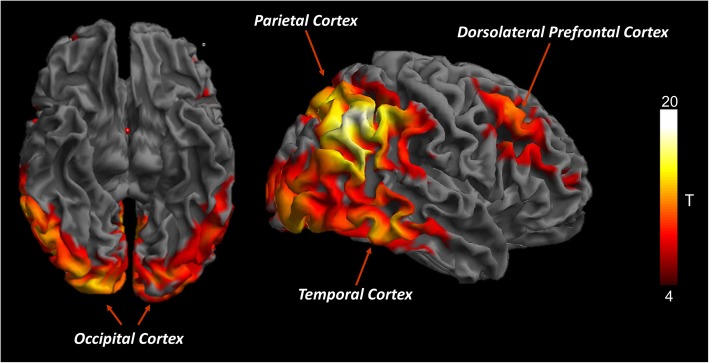
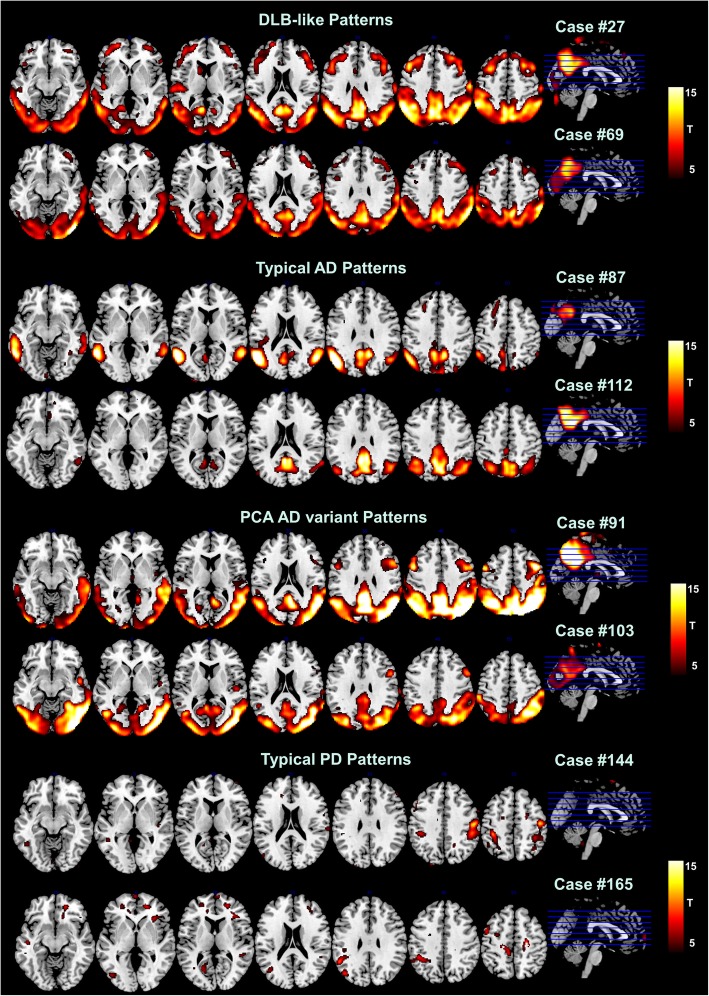
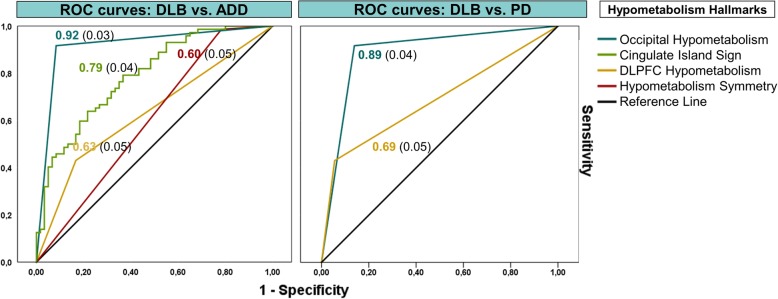
The single-subject [18F]FDG-PET hypometabolism pattern, showing temporo-parietal and occipital involvement, was highly consistent across DLB cases. Clinical classification at entry produced several misclassifications with an agreement of only 61.1% with the diagnostic reference. On the contrary, [18F]FDG-PET hypometabolism maps alone accurately predicted diagnosis of DLB at follow-up (88.9%). The high power of the [18F]FDG-PET hypometabolism signature in predicting the final clinical diagnosis allowed a ≈ 50% increase in accuracy compared to the first clinical assessment alone. Finally, [18F]FDG-PET hypometabolism maps yielded extremely high discriminative power, distinguishing DLB from ADD and PD conditions with an accuracy of > 90%.
The present validation of the diagnostic and prognostic accuracy of the disease-specific brain metabolic signature in DLB at the single-subject level argues for the consideration of [18F]FDG-PET in the early phase of the DLB diagnostic flowchart. The assessment of the [18F]FDG-PET hypometabolism pattern at entry may shorten the diagnostic time, resulting in benefits for treatment options and management of patients.
[18F]FDG-PET 代谢低下模式表明存在不同的神经退行性疾病,甚至在疾病的早期阶段也是如此。这使得[18F]FDG-PET 成为神经退行性疾病诊断的重要工具。需要通过考虑大量患者和疾病比较,并应用最先进的统计方法,进一步验证[18F]FDG-PET 在路易体痴呆(DLB)中的效用。在这里,我们旨在在单个患者水平上,在首次临床评估时,对[18F]FDG-PET 代谢特征支持 DLB 诊断的广泛验证,该评估具有高度诊断不确定性。
在这项回顾性研究中,我们纳入了 72 名患者,他们在进入时具有不同的临床分类(轻度认知障碍、非典型帕金森病、可能的 DLB、可能的 DLB 和其他痴呆症),并且在随后的随访中具有明确的 DLB 诊断。我们使用经过验证的体素分析生成了单个病例的[18F]FDG-PET 代谢低下模式(p<0.05,FWE 校正)。代谢低下模式由专家评审员独立分类,他们对任何临床信息均不知情。在随访时的最终临床诊断(2.94±1.39[0.34-6.04]年)被视为诊断参考,并与进入时的临床分类和单独的[18F]FDG-PET 分类进行比较。此外,我们计算了[18F]FDG-PET 图谱在 DLB 与阿尔茨海默病痴呆(ADD)(N=60)和帕金森病(PD)(N=36)的鉴别诊断中的诊断准确性。
单个患者的[18F]FDG-PET 代谢低下模式显示颞顶叶和枕叶受累,在 DLB 病例中高度一致。进入时的临床分类存在一些错误分类,与诊断参考的一致性仅为 61.1%。相反,单独的[18F]FDG-PET 代谢低下图谱准确预测了随访时的 DLB 诊断(88.9%)。[18F]FDG-PET 代谢低下特征在预测最终临床诊断方面的高功效,使得与单独进行首次临床评估相比,准确性提高了约 50%。最后,[18F]FDG-PET 代谢低下图谱在区分 DLB 与 ADD 和 PD 方面具有极高的鉴别能力,准确率超过 90%。
本研究在单个患者水平上验证了 DLB 疾病特异性脑代谢特征的诊断和预后准确性,这表明在 DLB 诊断流程图的早期阶段应考虑使用[18F]FDG-PET。在进入时评估[18F]FDG-PET 代谢低下模式可能会缩短诊断时间,从而为治疗选择和患者管理带来益处。