Department of Chemistry, University of Guelph, Guelph, ON, Canada.
Curr Med Chem. 2019;26(35):6341-6348. doi: 10.2174/0929867326666190225164527.
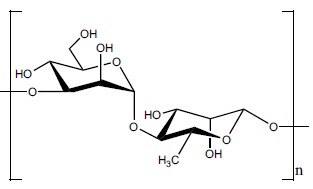
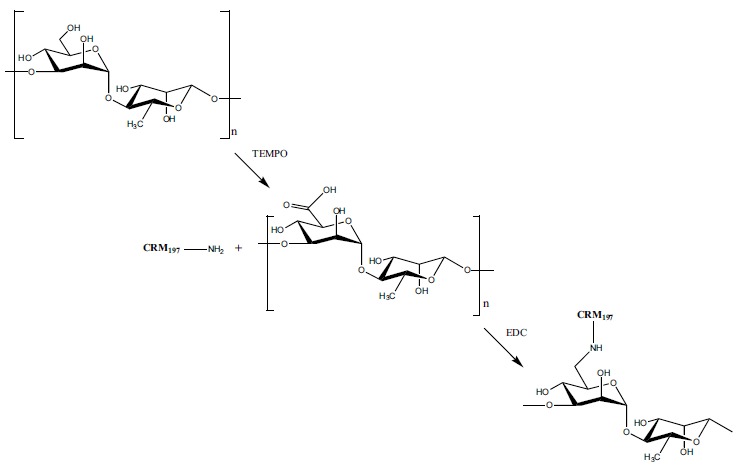
A large number of children in the autism spectrum disorder suffer from gastrointestinal (GI) conditions, such as constipation and diarrhea. Clostridium bolteae is a part of a set of pathogens being regularly detected in the stool samples of hosts affected by GI and autism symptoms. Accompanying studies have pointed out the possibility that such microbes affect behaviour through the production of neurotoxic metabolites in a so-called, gut-brain connection. As an extension of our Clostridium difficile polysaccharide (PS)-based vaccine research, we engaged in the discovery of C. bolteae surface carbohydrates. So far, studies revealed that C. bolteae produces a specific immunogenic PS capsule comprised of disaccharide repeating blocks of mannose (Manp) and rhamnose (Rhap) units: α-D-Manp-(1→[-4)-β-D-Rhap- (1→3)-α-D-Manp-(1→]n. For vaccinology and further immunogenic experiments, a method to produce C. bolteae PS conjugates has been developed, along with the chemical syntheses of the PS non-reducing end linkage, with D-Rha or L-Rha, α-D-Manp-(1→4)-α-D-Rhap- (1→O(CH2)5NH2 and α-D-Manp-(1→4)-α-L-Rhap-(1→O(CH2)5NH2, equipped with an aminopentyl linker at the reducing end for conjugation purposes. The discovery of C. bolteae PS immunogen opens the door to the creation of non-evasive diagnostic tools to evaluate the frequency and role of this microbe in autistic subjects and to a vaccine to reduce colonization levels in the GI tract, thus impeding the concentration of neurotoxins.
大量自闭症谱系障碍儿童患有胃肠道 (GI) 疾病,例如便秘和腹泻。梭状芽胞杆菌是一组经常在受 GI 和自闭症症状影响的宿主粪便样本中检测到的病原体的一部分。伴随的研究指出,这些微生物可能通过在所谓的“肠-脑连接”中产生神经毒性代谢物来影响行为。作为我们艰难梭菌多糖 (PS) 疫苗研究的延伸,我们致力于发现梭状芽胞杆菌表面碳水化合物。到目前为止,研究表明梭状芽胞杆菌产生一种由甘露糖 (Manp) 和鼠李糖 (Rhap) 单元的二糖重复块组成的特定免疫原性 PS 胶囊:α-D-Manp-(1→[-4)-β-D-Rhap- (1→3)-α-D-Manp-(1→]n。为了疫苗学和进一步的免疫实验,已经开发出一种生产梭状芽胞杆菌 PS 缀合物的方法,以及 PS 非还原端键的化学合成,与 D-Rha 或 L-Rha 一起,α-D-Manp-(1→4)-α-D-Rhap- (1→O(CH2)5NH2 和 α-D-Manp-(1→4)-α-L-Rhap-(1→O(CH2)5NH2,在还原端配备氨基戊基接头用于缀合目的。梭状芽胞杆菌 PS 免疫原的发现为创建非侵入性诊断工具打开了大门,可用于评估这种微生物在自闭症患者中的频率和作用,并开发疫苗来降低胃肠道中的定植水平,从而阻止神经毒素的集中。