University of Clermont Auvergne, INRA, UMR 1019 Human Nutrition Unit, Clermont-Ferrand, France.
CHU Clermont-Ferrand, INSERM CIC 1405, University of Clermont Auvergne, Clermont-Ferrand, France.
Front Immunol. 2019 Feb 8;10:65. doi: 10.3389/fimmu.2019.00065. eCollection 2019.
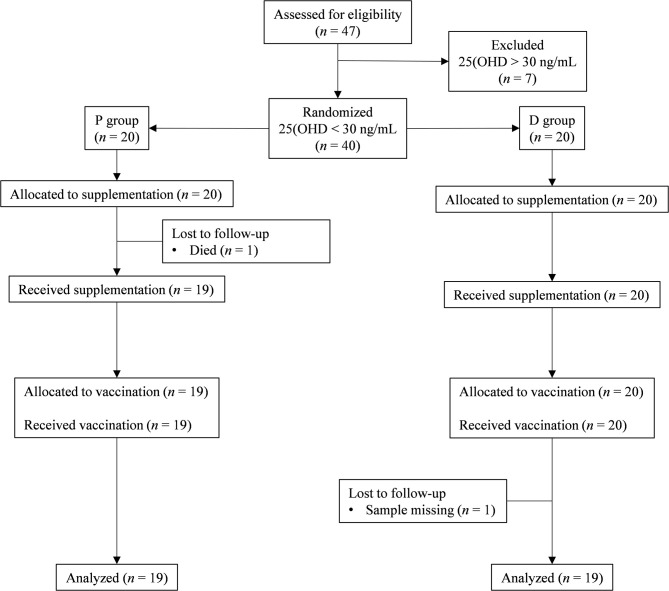
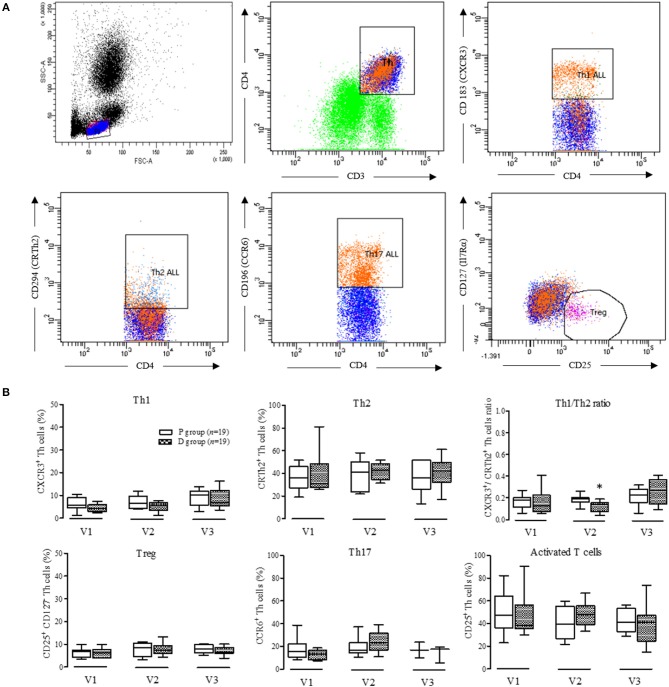
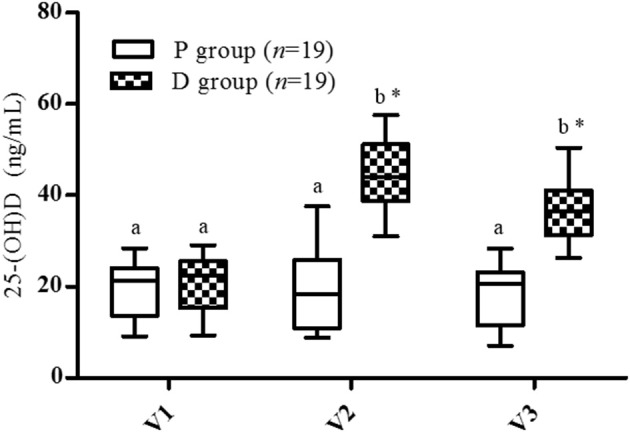
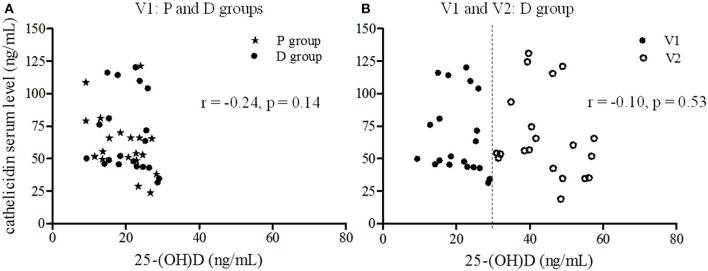
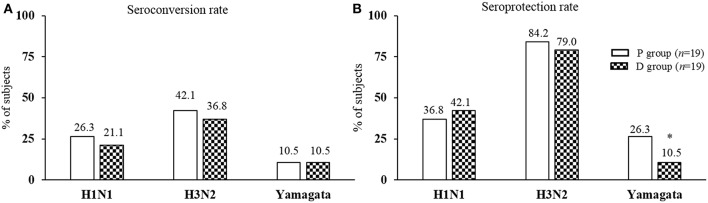
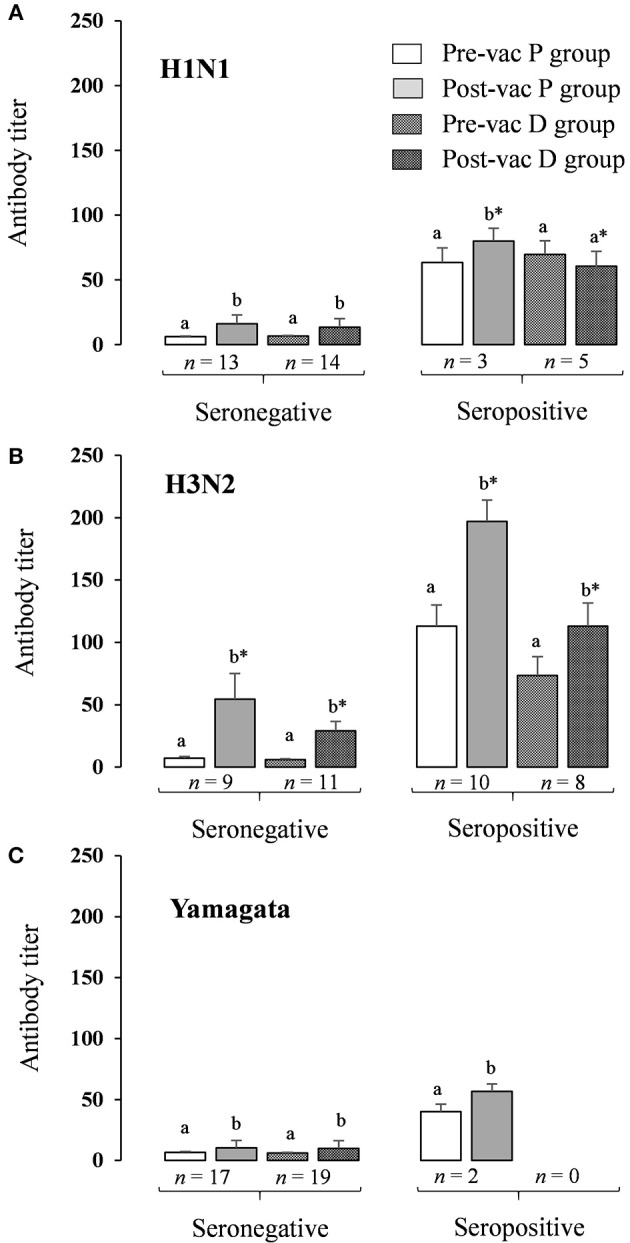
Immunosenescence contributes to reduced vaccine response in elderly persons, and is worsened by deficiencies in nutrients such as Vitamin (Vit-D). The immune system is a well-known target of Vit-D, which can both potentiate the innate immune response and inhibit the adaptive system, and so modulate vaccination response. This randomized placebo-controlled double-blind trial investigated whether Vit-D supplementation in deficient elderly persons could improve influenza seroprotection and immune response. Deficient volunteers (Vit-D serum <30 ng/mL) were assigned (V1) to receive either 100,000 IU/15 days of cholecalciferol (D, = 19), or a placebo (P, = 19), over a 3 month period. Influenza vaccination was performed at the end of this period (V2), and the vaccine response was evaluated 28 days later (V3). At each visit, serum cathelicidin, immune response to vaccination, plasma cytokines, lymphocyte phenotyping, and phagocyte ROS production were assessed. Levels of serum 25-(OH)D increased after supplementation (D group, V1 vs. V2: 20.7 ± 5.7 vs. 44.3 ± 8.6 ng/mL, < 0.001). No difference was observed for serum cathelicidin levels, antibody titers, and ROS production in D vs. P groups at V3. Lower plasma levels of TNFα ( = 0.040) and IL-6 ( = 0.046), and higher ones for TFGβ ( = 0.0028) were observed at V3. The Th1/Th2 ratio was lower in the D group at V2 (D: 0.12 ± 0.05 vs. P: 0.18 ± 0.05, = 0.039). Vit-D supplementation promotes a higher TGFβ plasma level in response to influenza vaccination without improving antibody production. This supplementation seems to direct the lymphocyte polarization toward a tolerogenic immune response. A deeper characterization of metabolic and molecular pathways of these observations will aid in the understanding of Vit-D's effects on cell-mediated immunity in aging. This clinical trial was registered at clinicaltrials.gov as NCT01893385.
免疫衰老导致老年人对疫苗的反应减弱,而营养缺乏(如维生素 D)会使情况恶化。免疫系统是维生素 D 的一个众所周知的靶点,它既能增强先天免疫反应,又能抑制适应性系统,从而调节疫苗反应。这项随机安慰剂对照双盲试验研究了在缺乏维生素 D 的老年人中补充维生素 D 是否能提高流感疫苗的保护作用和免疫反应。缺乏志愿者(维生素 D 血清<30ng/ml)被分配(V1)接受 100,000IU/15 天的胆钙化醇(D,=19)或安慰剂(P,=19),持续 3 个月。在这段时间结束时(V2)进行流感疫苗接种,并在 28 天后(V3)评估疫苗反应。在每次就诊时,评估血清抗菌肽、疫苗免疫反应、血浆细胞因子、淋巴细胞表型和吞噬细胞 ROS 产生。补充后血清 25-(OH)D 水平升高(D 组,V1 与 V2:20.7±5.7 与 44.3±8.6ng/ml,<0.001)。在 V3 时,D 组与 P 组之间的血清抗菌肽水平、抗体滴度和 ROS 产生无差异。在 V3 时观察到较低的 TNFα(=0.040)和 IL-6(=0.046)的血浆水平,以及较高的 TFGβ(=0.0028)。在 V2 时,D 组的 Th1/Th2 比值较低(D:0.12±0.05 与 P:0.18±0.05,=0.039)。维生素 D 补充促进了流感疫苗接种后的 TGFβ 血浆水平升高,而不改善抗体产生。这种补充似乎使淋巴细胞极化向耐受免疫反应。更深入地研究这些观察结果的代谢和分子途径将有助于了解维生素 D 对衰老过程中细胞介导免疫的影响。这项临床试验在 clinicaltrials.gov 上注册为 NCT01893385。