Zhao Xiao, Sun Chaofeng, Cao Miaomiao, Li Hao
Health Science Center, Xi'an Jiaotong University, Xi'an, P.R.China.
Cardiovascular Department, The First Affiliated Hospital, Xi'an Jiaotong University, Xi'an, P.R.China.
Clin Cardiol. 2019 Apr;42(4):452-458. doi: 10.1002/clc.23167. Epub 2019 Mar 18.
Atrial fibrillation (AF) is the most common cardiac arrhythmia, with its incidence making up nearly one-third of all hospital admissions. Atrioventricular block (AVB) is a conduction abnormality along the atrioventricular node or the His-Purkinje system. The relationship between atrioventricular conduction block and AF is controversial.
This study is designed to observe whether there is a correlation between AVB and AF, and which type of AVB has the most obvious correlation with AF.
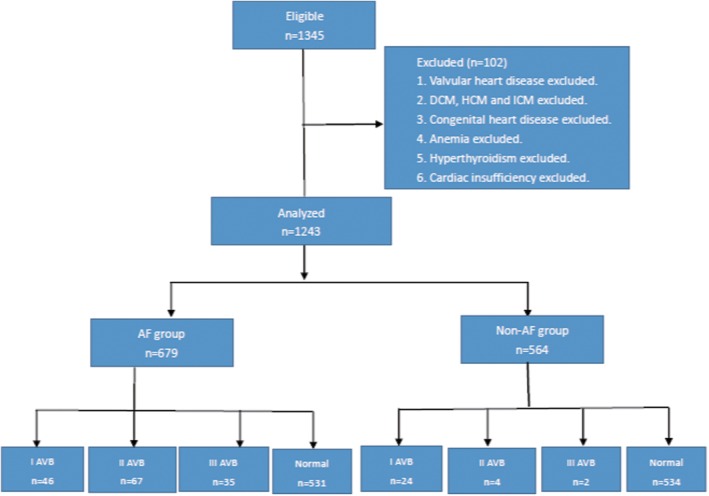
This study retrospectively reviewed 1345 patients. We classified the AVB according to the AVB classification criteria. One hundred and two patients were excluded, and the final total sample size was 1243 patients, including 679 patients in the AF group (378, 55.7% males) and 564 patients in the non-AF group (287, 50.8% males). AF group and non-AF group were compared to observe the relationship between AVB and AF.
The I AVB have a relative statistical risk of 1.927 (95% confidence interval [CI]: 1.160-3.203, P < 0.05) with the occurrence of AF. II AVB occupied the largest proportion, accounting for 67 cases (9.87%), and the statistical risk of II AVB in AF is 16.845 (95% CI: 6.099-46.524, P < 0.000). III AVB has a comparative statistical risk of 17.599 (95% CI: 4.212-73.541, P < 0.000).
The three types of AVB in the AF group were significantly higher than that in the non-AF group. II AVB has the highest incidence rate compared with other types of AVB in the AF group. AVB can be used as a risk factor for AF occurrence.
心房颤动(AF)是最常见的心律失常,其发病率几乎占所有住院患者的三分之一。房室传导阻滞(AVB)是沿房室结或希氏 - 浦肯野系统的传导异常。房室传导阻滞与房颤之间的关系存在争议。
本研究旨在观察AVB与AF之间是否存在相关性,以及哪种类型的AVB与AF的相关性最明显。
本研究回顾性分析了1345例患者。我们根据AVB分类标准对AVB进行分类。排除102例患者,最终总样本量为1243例患者,其中房颤组679例(男性378例,占55.7%),非房颤组564例(男性287例,占50.8%)。比较房颤组和非房颤组,以观察AVB与AF之间的关系。
一度房室传导阻滞(I AVB)发生房颤的相对统计风险为1.927(95%置信区间[CI]:1.160 - 3.203,P < 0.05)。二度房室传导阻滞(II AVB)所占比例最大,为67例(9.87%),房颤患者中II AVB的统计风险为16.845(95% CI:6.099 - 46.524,P < 0.000)。三度房室传导阻滞(III AVB)的比较统计风险为17.599(95% CI:4.212 - 73.541,P < 0.000)。
房颤组的三种类型房室传导阻滞均显著高于非房颤组。与房颤组其他类型的房室传导阻滞相比,II AVB的发病率最高。房室传导阻滞可作为房颤发生的危险因素。