Karolinska Institute, Department of Clinical Sciences, Cardiology Unit, Danderyd University Hospital, Stockholm, Sweden.
Karolinska Institute, Department of Neurobiology, Care Sciences and Society, Stockholm, Sweden.
PLoS One. 2019 Feb 26;14(2):e0212974. doi: 10.1371/journal.pone.0212974. eCollection 2019.
Atrial fibrillation (AF), an important cause of thromboembolic events, is often silent and intermittent, thus presenting a diagnostic challenge. The aim of this study was to assess whether the plasma level of N-terminal pro-brain natriuretic peptide (NT-proBNP) is related to the presence of AF and thereby might be used to facilitate screening programs for AF in primary care.
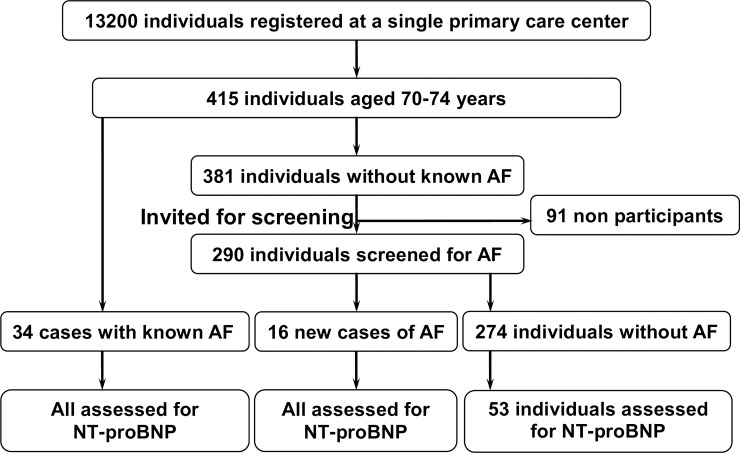
This was a cross sectional screening study. A population of 70-74-year-old individuals registered at a single primary care center in Stockholm were invited to AF screening. Intermittent ECG recording, 30 seconds twice a day using a hand-held device over 2 weeks, was offered to participants without previously known AF. Of the 324 participating persons, 34 patients had already known AF and 16 new cases of AF were detected by screening. Plasma NT-proBNP was measured in patients with previously known AF, newly detected AF, and 53 control participants without AF.
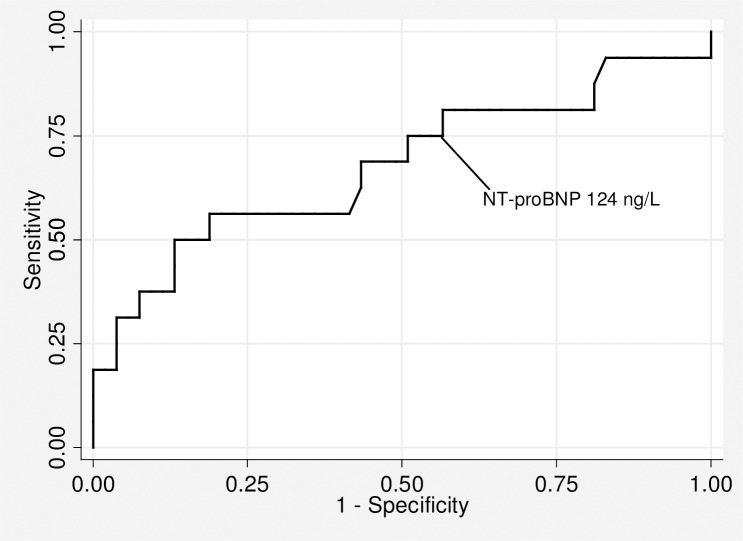
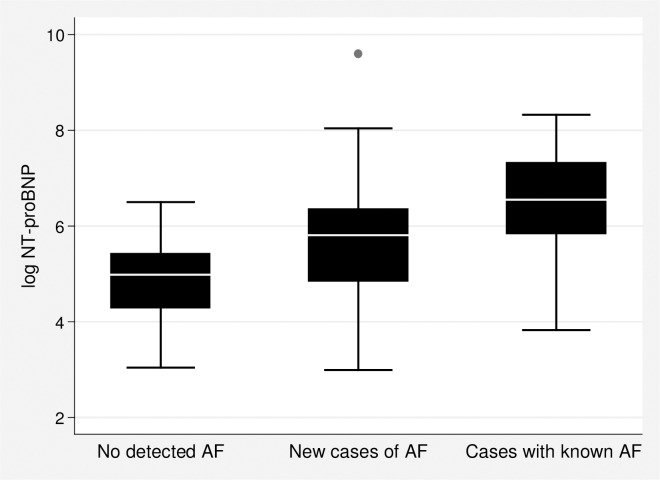
The median NT-proBNP was 697 ng/L in patients with previously known AF, 335 ng/L in new cases of AF, and 146 ng/L in patients without AF. After adjustment for several clinical variables and morbidities, the differences of median NT-proBNP levels were statistically significant between cases of previously known AF and new cases of AF as well as between new cases of AF and those without AF. The area under receiver operating characteristic curve of detection of new AF was 0.68 (95% CI 0.56 to 0.79) yielding a cut-off point of 124 ng/L with 75% sensitivity, 45% specificity, and 86% negative predictive value.
The NT-proBNP plasma levels among patients with known AF are higher than those with newly detected AF, and the latter have higher levels than those without AF. Therefore NT-proBNP might be a useful screening marker for the detection of AF and its persistence.
心房颤动(AF)是血栓栓塞事件的重要原因,常为无症状和间歇性,因此诊断具有挑战性。本研究旨在评估血浆 N 末端脑利钠肽前体(NT-proBNP)水平是否与 AF 有关,从而可能用于促进初级保健中的 AF 筛查计划。
这是一项横断面筛查研究。邀请斯德哥尔摩一家初级保健中心登记的 70-74 岁人群进行 AF 筛查。为无先前已知 AF 的参与者提供使用手持式设备每天两次、每次 30 秒的间歇性心电图记录,持续 2 周。在 324 名参与的人中,34 名患者已有已知的 AF,通过筛查发现了 16 例新的 AF 病例。在先前已知的 AF 患者、新发现的 AF 患者和 53 名无 AF 的对照参与者中测量了血浆 NT-proBNP。
先前已知的 AF 患者的中位 NT-proBNP 为 697ng/L,新发 AF 患者为 335ng/L,无 AF 患者为 146ng/L。在调整了几个临床变量和合并症后,先前已知的 AF 病例和新发 AF 病例以及新发 AF 病例和无 AF 病例的中位 NT-proBNP 水平差异具有统计学意义。检测新发 AF 的受试者工作特征曲线下面积为 0.68(95%CI 0.56-0.79),截断值为 124ng/L,灵敏度为 75%,特异性为 45%,阴性预测值为 86%。
已知 AF 患者的 NT-proBNP 血浆水平高于新发 AF 患者,后者高于无 AF 患者。因此,NT-proBNP 可能是检测 AF 及其持续性的有用筛查标志物。