Lyu Jiao, Zhang Qi, Chen Chunli, Xu Yu, Ji Xunda, Zhao Peiquan
Department of Ophthalmology, Xinhua Hospital, Medical School, Shanghai Jiao Tong University, 1665 Kong Jiang Road, Shanghai, 200092, China.
Department of Ophthalmology, Shengli Oilfield Central Hospital, 31 Jinan Road, Dongying, 257000, Shan Dong Province, China.
BMC Ophthalmol. 2019 Feb 26;19(1):60. doi: 10.1186/s12886-019-1067-4.
Type 1 retinopathy of prematurity (ROP) is occasionally observed in preterm infants after the postmenstrual age (PMA) of 40 weeks; however, evidence-based treatment guidelines are largely lacking. In this study, we report the clinical characteristics of preterm infants with type 1 ROP at PMA of > 40 weeks and compare the treatment outcomes of intravitreal ranibizumab (IVR) and laser therapy.
Twenty-seven eyes of 14 infants, primarily treated for type 1 ROP after 40 weeks PMA by IVR (17 eyes in 9 infants) or by laser photocoagulation (10 eyes in 5 infants) were included in this retrospective analysis. The preoperative fundus characteristics and the structural outcomes and additional treatment after 6 months were analyzed.
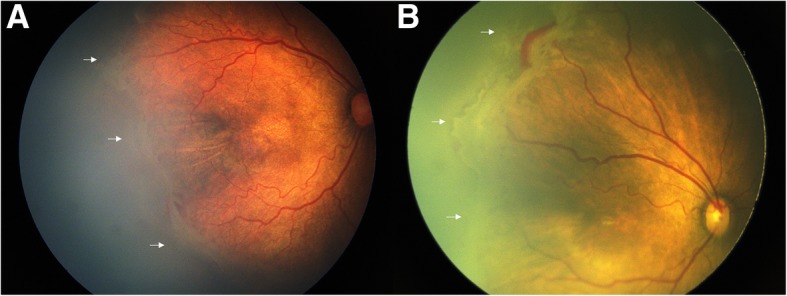
Of the 27 eyes, 20 eyes (74%) had zone II stage 3 plus disease (+) ROP and 7 eyes had zone II stage 2 + ROP. Seventeen (63%) eyes showed thick fibrous ridges. After primary treatment at 40-48 weeks PMA, ROP regression was observed in a similar proportion of eyes in the IVR and laser groups (88% vs. 70%; p = 0.326); complete vascularization was observed in 24% eyes in the IVR group. Compared to laser group, a higher proportion of eyes in IVR group received additional treatment (IVR group 76% vs. laser group 30%; p = 0.040), for unresolved peripheral avascularity in 11 eyes and ROP progression with fibrotic contraction in 2 eyes after primary IVR.
Preterm infants with type 1 ROP at > 40 weeks PMA displayed enhanced fibrotic proliferation. Both primary IVR and laser effectively promote ROP regression. Primary IVR cannot guarantee full retinal vascularization but is associated with a risk of fibrotic contraction.
1型早产儿视网膜病变(ROP)偶尔会在孕龄(PMA)40周后的早产儿中观察到;然而,基于证据的治疗指南在很大程度上并不存在。在本研究中,我们报告了孕龄大于40周的1型ROP早产儿的临床特征,并比较了玻璃体内注射雷珠单抗(IVR)和激光治疗的效果。
本回顾性分析纳入了14例婴儿的27只眼睛,这些婴儿主要在孕龄40周后因1型ROP接受了IVR治疗(9例婴儿的17只眼睛)或激光光凝治疗(5例婴儿的10只眼睛)。分析了术前眼底特征、6个月后的结构结果和额外治疗情况。
在这27只眼睛中,20只眼睛(74%)患有Ⅱ区3期加病变(+)ROP,7只眼睛患有Ⅱ区2期+ROP。17只眼睛(63%)出现了粗大的纤维嵴。在孕龄40 - 48周进行初次治疗后,IVR组和激光组中ROP消退的眼睛比例相似(88%对70%;p = 0.326);IVR组中24%的眼睛观察到完全血管化。与激光组相比,IVR组中有更高比例的眼睛接受了额外治疗(IVR组76%对激光组30%;p = 0.040),原因是初次IVR治疗后11只眼睛的周边无血管区未解决,2只眼睛的ROP进展伴有纤维化收缩。
孕龄大于40周的1型ROP早产儿表现出增强的纤维化增殖。初次IVR和激光均能有效促进ROP消退。初次IVR不能保证视网膜完全血管化,但与纤维化收缩风险相关。