Visscher Christian, Hankel Julia, Nies Andrea, Keller Birgit, Galvez Eric, Strowig Till, Keller Christoph, Breves Gerhard
Institute for Animal Nutrition, University of Veterinary Medicine Hannover, Foundation, Hannover, Germany.
Helmholtz Center for Infection Research, Braunschweig, Germany.
Front Vet Sci. 2019 Feb 12;6:29. doi: 10.3389/fvets.2019.00029. eCollection 2019.
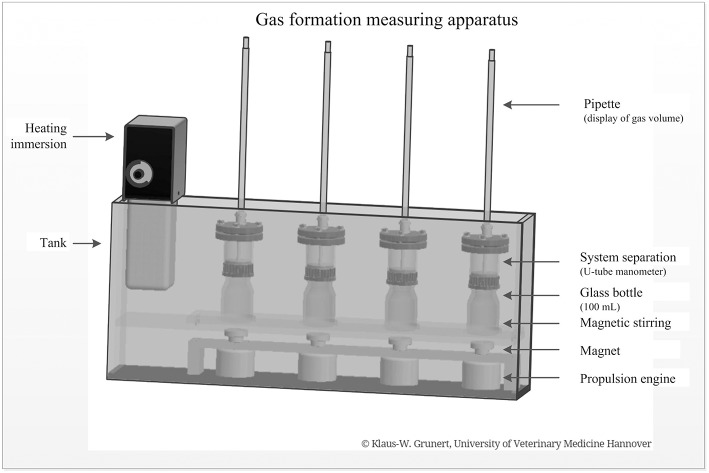
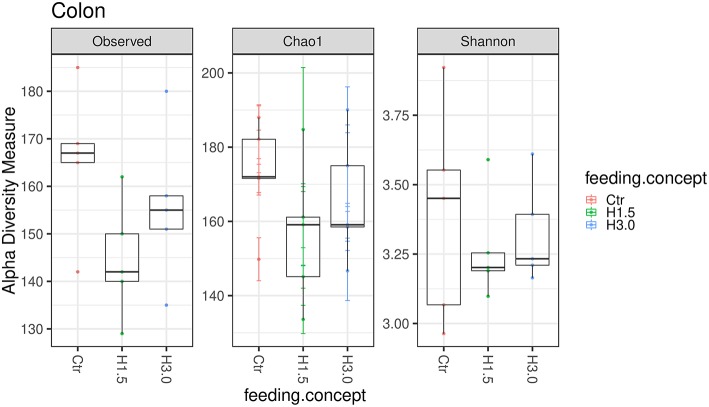
The transition from breast milk to solid feed is a dramatic change in the nutrition of piglets, frequently necessitating antibiotic treatment. In efforts to reduce the use of antibiotics, dietetic concepts based on natural feed additives are becoming more and more important. In the present study, experiments were carried out with 15 rearing piglets (days 28-56) divided into three groups that were offered different diets (Ctr [0% peat]; H1.5 [1.5% peat]; and H3.0 [3.0% peat] based on a commercial weaner recipe; all ~178 g CP, 13.7 MJ ME, 13.3 g Lys, as-fed). The contents of cecal and colon digesta were removed at necropsy. The gas formation (4 h) in colon digesta was measured using batch fermenters. For microbiome studies, 16S rRNA amplification was performed within the hypervariable region V 4 and sequenced with Illumina MiSeq platform. DNA read mapping and statistical analysis were performed using QIIME (version 1.8.0), MicrobiomeAnalyst, RStudio, and SAS Enterprise Guide. The mean body weight of the animals at the end of the trial did not show statistical differences (in kg: Ctr: 26.1 ± 4.85, H1.5: 28.5 ± 3.41, H3.0: 26.2 ± 4.92). The daily weight gains were high for this age (in g/day; Ctr: 607 ± 157; H1.5: 692 ± 101; H3.0: 615 ± 113) and the feed to gain ratio low (in kg/kg; Ctr: 1.538; H1.5: 1.462; H3.0: 1.462). Concentrations of short-chain fatty acids in the cecal content were significantly lower when peat was used (mmol/kg wet weight; Ctr: 173 ± 30.0; H1.5:134 ± 15.0; H3.0:133 ± 17.3). Numerical differences were found in the gas formation (in mL gas per 10 mL batch in 4 h; Ctr: 7.9 ± 2.2; H1.5: 7.4 ± 2.4; H3.0: 6.6 ± 1.1). The microbiome analyses in the cecal content showed significantly higher values for alpha diversity Chao 1 index for samples from the control group. Significant differences were found for bacterial relative abundance for at phylum level and at class level ( < 0.05) in cecal microbiota. Therefore, there was initial evidence that peat influences intestinal microflora causing a shift in the overall concentration of fermentation products in both, the cecal and the colon content.
从母乳过渡到固体饲料对仔猪营养来说是一个巨大变化,常常需要进行抗生素治疗。为减少抗生素使用,基于天然饲料添加剂的饮食理念正变得越来越重要。在本研究中,对15头饲养仔猪(28 - 56日龄)进行了实验,将其分为三组,分别给予不同日粮(对照组[0%泥炭];H1.5组[1.5%泥炭];H3.0组[3.0%泥炭],基于商业断奶仔猪日粮配方;所有日粮粗蛋白含量约178 g、代谢能13.7 MJ、赖氨酸13.3 g,按饲喂状态计)。在尸检时采集盲肠和结肠内容物。使用批次发酵罐测量结肠内容物中的气体生成量(4小时)。对于微生物组研究,在高变区V4内进行16S rRNA扩增,并使用Illumina MiSeq平台进行测序。使用QIIME(1.8.0版本)、MicrobiomeAnalyst、RStudio和SAS Enterprise Guide进行DNA读数比对和统计分析。试验结束时动物的平均体重未显示出统计学差异(单位:kg;对照组:26.1 ± 4.85,H1.5组:28.5 ± 3.41,H3.0组:26.2 ± 4.92)。这个年龄段的日增重较高(单位:g/天;对照组:607 ± 157;H1.5组:692 ± 101;H3.0组:615 ± 【此处原文有误,应为113】),饲料转化率较低(单位:kg/kg;对照组:1.538;H1.5组:1.462;H3.0组:1.462)。当使用泥炭时,盲肠内容物中短链脂肪酸的浓度显著降低(单位:mmol/kg湿重;对照组:173 ± 30.0;H1.5组:134 ± 15.0;H3.0组:133 ± 17.3)。在气体生成量方面发现了数值差异(单位:4小时内每10 mL批次产生的气体毫升数;对照组:7.9 ± 2.2;H1.5组:7.4 ± 2.4;H3.0组:6.6 ± 1.1)。盲肠内容物的微生物组分析显示,对照组样本的α多样性Chao 1指数值显著更高。在盲肠微生物群的门水平和纲水平上发现了细菌相对丰度的显著差异(P < 0.05)。因此,初步有证据表明泥炭会影响肠道微生物群,导致盲肠和结肠内容物中发酵产物的总体浓度发生变化。 【备注:原文中“at phylum level and at class level”中间多了个空格,翻译时已修正,同时补充了日增重数据中原文有误的部分】