Laribi Bahareh, Shekarabi Mehdi, Zarnani Amir Hassan, Ghaffarpour Majid, Marzban Mohsen
Department of Immunology, School of Medicine, Tehran University of Medical Sciences, Tehran, Iran.
Department of Immunology, School of Medicine, Iran University of Medical Sciences, Tehran, Iran.
Med J Islam Repub Iran. 2018 Nov 27;32:118. doi: 10.14196/mjiri.32.118. eCollection 2018.
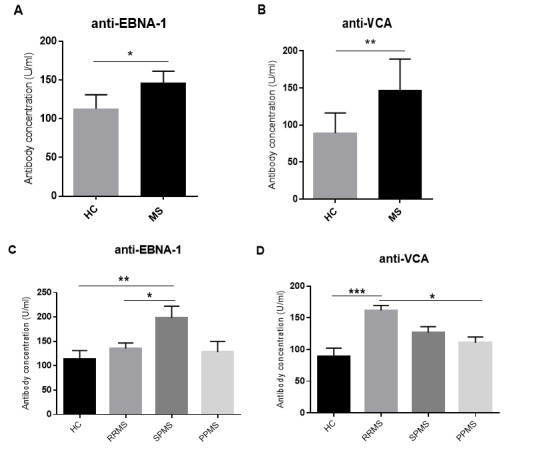
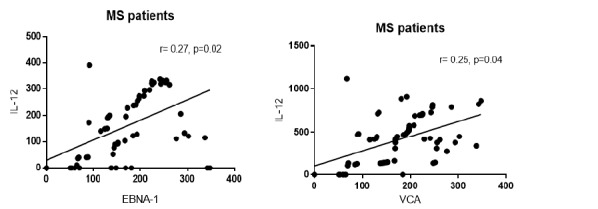
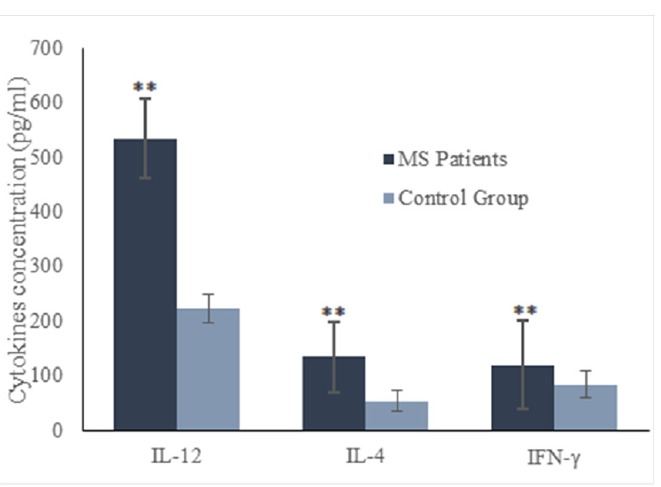
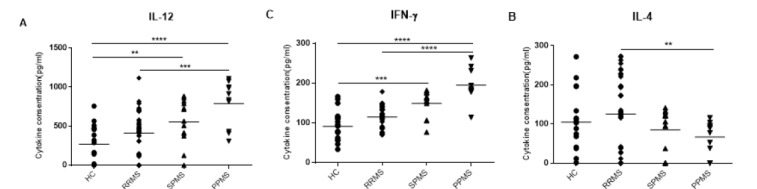
Epidemiological evidence suggests a role of Epstein-Barr virus (EBV) in triggering the pathogenesis of Multiple Sclerosis (MS). The aim of this study was to assess the EBV-specific antibodies in MS patients with various clinical patterns and their association with the production of IFN-γ, IL-12, and IL-4 cytokines compared with healthy individuals. We measured EBNA-1 IgG, VCA IgG, and production of IFN-γ, IL-12 and IL-4 cytokines in patients with different clinical patterns and healthy controls using ELISA method. There was a higher titer of anti-EBV antibodies in MS patients compared to healthy controls. SPMS patients generated higher EBNA-1 levels than those with RRMS and PPMS patients whereas; the level of VCA IgG was higher in the RRMS patients than PPMS. In PPMS patients, a significant increase was found in IFN-γ and IL-12 cytokines compared to other subtypes, whereas IL-4 cytokine had a decreased level compared to RRMS patients. Higher anti-EBV antibodies are associated with increased IL-12 cytokine in RRMS patients. However, no significant correlation was found between these antibodies and other secreted cytokines. EBV infection is one of the strong risk factors for MS. Acting on these factors could be useful to decrease the incidence and disease exacerbation of MS. Study of the antibody levels to EBV virus could be useful for evaluating MS risk score in each clinical subtypes.
流行病学证据表明,爱泼斯坦-巴尔病毒(EBV)在引发多发性硬化症(MS)的发病机制中起作用。本研究的目的是评估具有不同临床模式的MS患者中EBV特异性抗体,以及与健康个体相比,这些抗体与干扰素-γ(IFN-γ)、白细胞介素-12(IL-12)和白细胞介素-4(IL-4)细胞因子产生之间的关联。我们使用酶联免疫吸附测定(ELISA)方法,测量了不同临床模式的患者和健康对照者中EBNA-1 IgG、VCA IgG以及IFN-γ、IL-12和IL-4细胞因子的产生情况。与健康对照者相比,MS患者中抗EBV抗体的滴度更高。继发进展型多发性硬化症(SPMS)患者产生的EBNA-1水平高于复发缓解型多发性硬化症(RRMS)患者和原发进展型多发性硬化症(PPMS)患者;而RRMS患者的VCA IgG水平高于PPMS患者。与其他亚型相比,PPMS患者中IFN-γ和IL-12细胞因子显著增加,而与RRMS患者相比,IL-4细胞因子水平降低。RRMS患者中较高的抗EBV抗体与IL-12细胞因子增加有关。然而,未发现这些抗体与其他分泌的细胞因子之间存在显著相关性。EBV感染是MS的重要危险因素之一。针对这些因素采取行动可能有助于降低MS的发病率和疾病恶化程度。研究针对EBV病毒的抗体水平可能有助于评估每种临床亚型的MS风险评分。