Xu Min, Hu Lan, Huang Heyu, Wang Liping, Tan Jintong, Zhang Yongjun, Chen Chao, Zhang Xi, Huang Lisu
Department of Neonatology, Xinhua Hospital, Shanghai Jiaotong University School of Medicine, Shanghai, China.
Department of Neonatology, Children Hospital of Fudan University, Shanghai, China.
Front Pediatr. 2019 Feb 13;7:31. doi: 10.3389/fped.2019.00031. eCollection 2019.
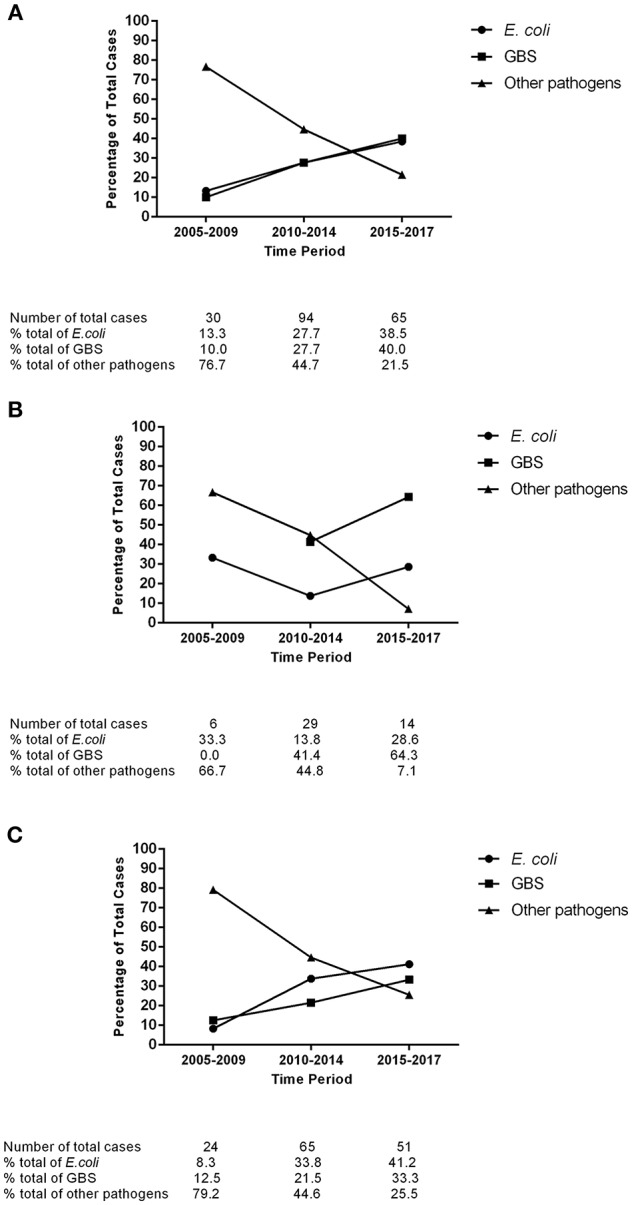
Neonatal bacterial meningitis is a severe infectious disease with a high risk of neurodevelopmental sequelae. The causative pathogens may be related to specific clinical features of the disease. Therefore, this study aimed at determining the pathogen-specific and clinical features of bacterial meningitis in full-term neonates. We enrolled neonates from the Shanghai Neonate Meningitis Cohort (2005-2017), which is a multicenter retrospective cohort that recruits almost all full-term neonates in Shanghai who underwent lumbar puncture. Patient history and clinical examination results were extracted from the computer-documented information systems of four hospitals. The trends of pathogen distribution were analyzed and differences in the clinical manifestations, treatment, and clinical outcomes at discharge were compared according to the causative pathogen. Logistic regression was used to evaluate the pathogen-specific risk of neurological complications. In total, 518 cases of neonatal meningitis, including 189 proven cases, were included. (GBS) and () were the leading pathogens in proven cases of early-onset and late-onset neonatal meningitis, respectively. The proportion of early-onset and late-onset GBS and late-onset meningitis cases increased gradually. GBS meningitis had the highest risk of neurological complications, whereas the overall incidence of hydrocephalus and brain abscess in was higher than that in GBS. Rates of neonatal GBS and meningitis were high in 2005-2017 in Shanghai, and the risk of neurological complications was also high. Therefore, active prevention, rational use of antibiotics, and continuous monitoring of GBS and in neonates should be initiated in Shanghai.
新生儿细菌性脑膜炎是一种严重的传染病,具有较高的神经发育后遗症风险。致病病原体可能与该疾病的特定临床特征有关。因此,本研究旨在确定足月儿细菌性脑膜炎的病原体特异性及临床特征。我们纳入了上海新生儿脑膜炎队列(2005 - 2017年)中的新生儿,这是一个多中心回顾性队列,招募了上海几乎所有接受腰椎穿刺的足月儿。从四家医院的计算机记录信息系统中提取患者病史和临床检查结果。分析病原体分布趋势,并根据致病病原体比较临床表现、治疗及出院时临床结局的差异。采用逻辑回归评估病原体特异性神经并发症风险。总共纳入了518例新生儿脑膜炎病例,其中包括189例确诊病例。早发型和晚发型新生儿脑膜炎确诊病例中的主要病原体分别为B族链球菌(GBS)和[此处原文缺失病原体名称]。早发型和晚发型GBS及晚发型[此处原文缺失病原体名称]脑膜炎病例的比例逐渐增加。GBS脑膜炎的神经并发症风险最高,而[此处原文缺失病原体名称]脑膜炎中脑积水和脑脓肿的总体发生率高于GBS脑膜炎。2005 - 2017年上海新生儿GBS和[此处原文缺失病原体名称]脑膜炎的发病率较高,神经并发症风险也较高。因此,上海应开展积极预防、合理使用抗生素以及对新生儿GBS和[此处原文缺失病原体名称]进行持续监测。