Stanford University, Department of Neurology and Neurological Sciences, 300 Pasteur Dr. Room H3144, MC 5235, Stanford, CA 94305, United States of America.
Stanford University, Department of Neurology and Neurological Sciences, 300 Pasteur Dr. Room H3144, MC 5235, Stanford, CA 94305, United States of America; Mount Sinai Beth Israel, Department of Neurology, 10 Union Square East, New York, NY 10003, United States of America.
Neurobiol Dis. 2019 Jul;127:278-286. doi: 10.1016/j.nbd.2019.02.023. Epub 2019 Feb 28.
Low concentrations of cerebrospinal fluid (CSF) amyloid-beta (Aβ-42) are associated with increased risk of cognitive decline in Parkinson's disease (PD). We sought to determine whether APOE genotype modifies the rate of cognitive decline in PD patients with low CSF Aβ-42 compared to patients with normal levels.
The Parkinson's Progression Markers Initiative is a longitudinal, ongoing study of de novo PD participants, which includes APOE genotyping, CSF Aβ-42 determinations, and neuropsychological assessments. We used linear mixed effects models in three PD groups (PD participants with low CSF Aβ at baseline, PD participants with normal CSF Aβ, and both groups combined). Having at least one copy of the APOE ɛ4 allele, time, and the interaction of APOE ɛ4 and time were predictor variables for cognitive change, adjusting for age, gender and education.
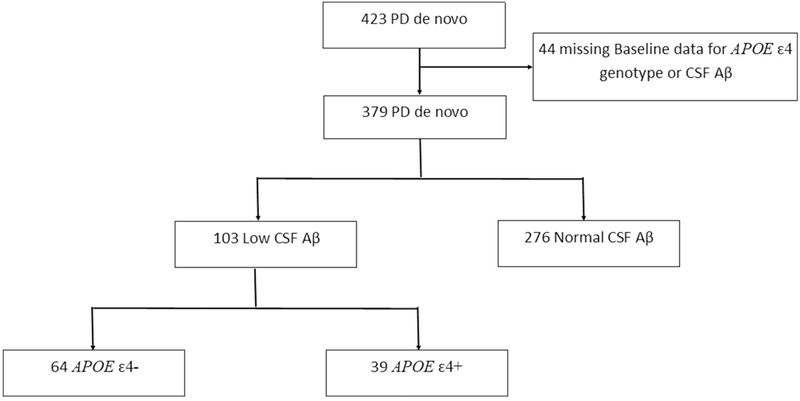
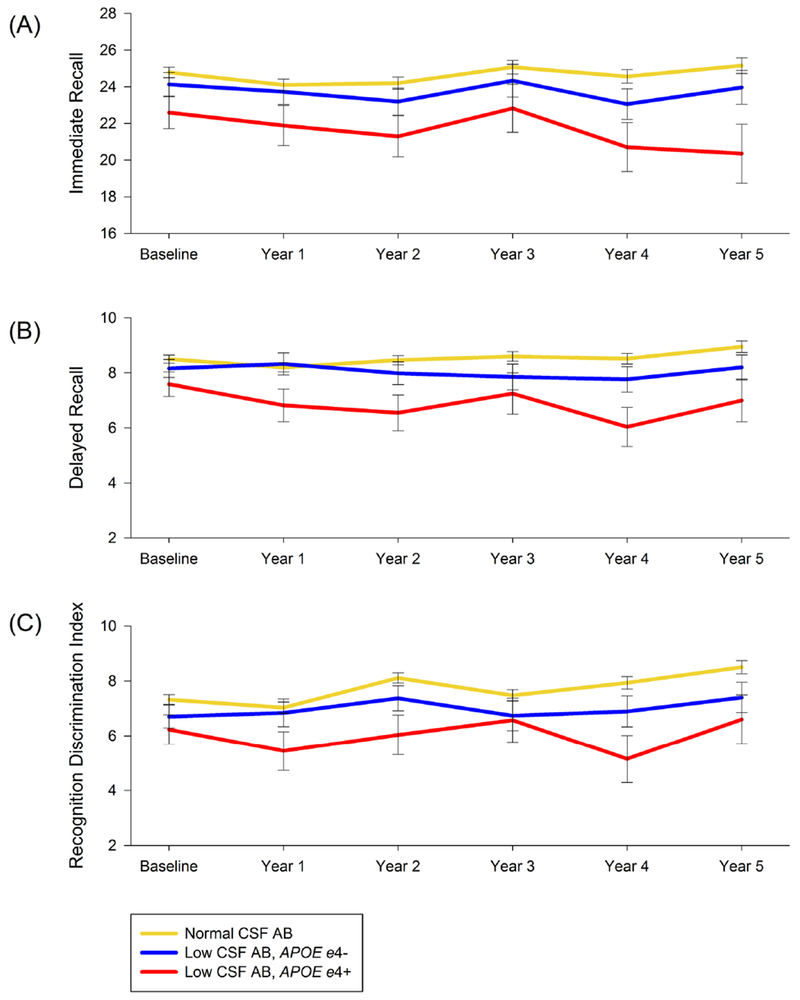
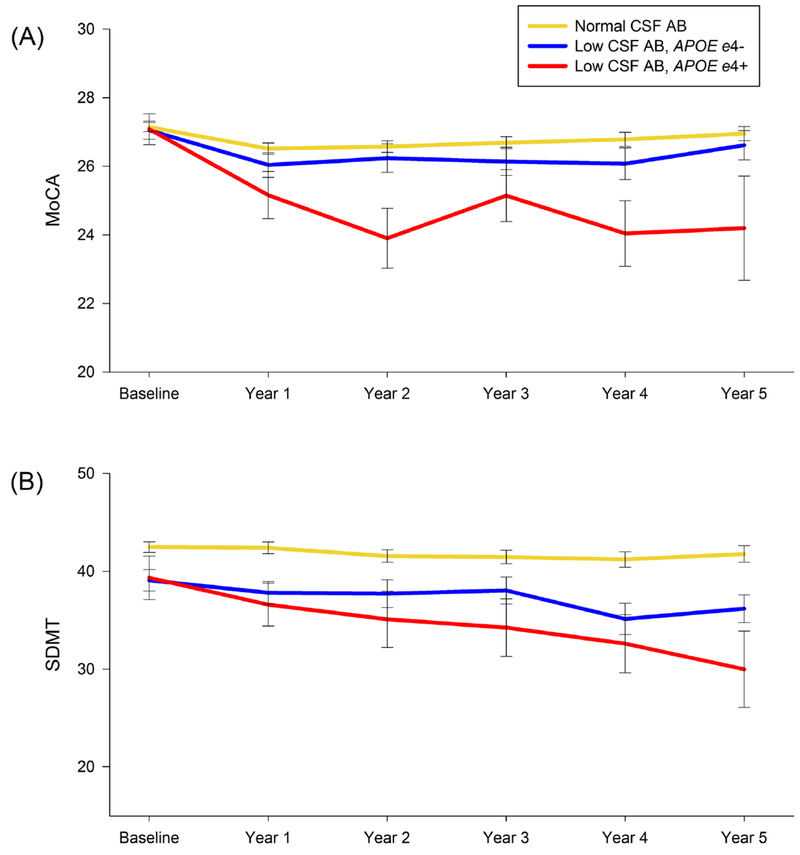
423 de novo PD participants were followed up to 5 years with annual cognitive assessments. 103 participants had low baseline CSF Aβ-42 (39 APOE ε4+, 64 APOE ε4-). Compared to participants with normal CSF Aβ-42, those with low CSF Aβ-42 declined faster on most cognitive tests. Within the low CSF Aβ-42 group, APOE ε4+ participants had faster rates of decline on the Montreal Cognitive Assessment (primary outcome; 0.57 points annual decline, p = .005; 5-year standardized change of 1.2) and the Symbol Digit Modalities Test (1.4 points annual decline, p = .002; 5-year standardized change of 0.72).
PD patients with low CSF Aβ-42 and APOE ε4+ showed a higher rate of cognitive decline early in the disease. Tests of global cognition (Montreal Cognitive Assessment) and processing speed (Symbol Digit Modalities Test) were the most sensitive to early cognitive decline. Results suggest that CSF Aβ-42 and APOE ε4 might interact to promote early cognitive changes in PD patients.
脑脊液(CSF)中淀粉样蛋白-β(Aβ-42)浓度较低与帕金森病(PD)认知能力下降的风险增加有关。我们旨在确定 APOE 基因型是否会改变与 CSF Aβ-42 水平正常的 PD 患者相比,CSF Aβ-42 水平较低的 PD 患者的认知下降速度。
帕金森病进展标志物倡议是一项针对新发 PD 参与者的纵向、正在进行的研究,包括 APOE 基因分型、CSF Aβ-42 测定和神经心理学评估。我们使用线性混合效应模型对三个 PD 组(基线时 CSF Aβ 较低的 PD 参与者、CSF Aβ 正常的 PD 参与者和两组合并)进行分析。具有至少一个 APOE ɛ4 等位基因、时间以及 APOE ɛ4 与时间的相互作用是认知变化的预测变量,调整了年龄、性别和教育因素。
423 名新发 PD 参与者接受了每年一次的认知评估,随访时间长达 5 年。103 名参与者基线时 CSF Aβ-42 较低(39 名 APOE ε4+,64 名 APOE ε4-)。与 CSF Aβ-42 正常的参与者相比,CSF Aβ-42 较低的参与者在大多数认知测试中下降速度更快。在 CSF Aβ-42 较低的组内,APOE ε4+参与者在蒙特利尔认知评估(主要结局;每年下降 0.57 分,p=0.005;5 年标准化变化为 1.2)和符号数字模态测试(每年下降 1.4 分,p=0.002;5 年标准化变化为 0.72)上的下降速度更快。
CSF Aβ-42 水平较低且 APOE ε4+的 PD 患者在疾病早期认知下降速度更快。对整体认知(蒙特利尔认知评估)和处理速度(符号数字模态测试)的测试对早期认知下降最为敏感。结果表明,CSF Aβ-42 和 APOE ε4 可能相互作用,促进 PD 患者的早期认知变化。