Smith John-Rudolph H, Houck Darby A, Hart Jessica A, Vidal Armando F, Frank Rachel M, Bravman Jonathan T, McCarty Eric C
Department of Orthopedics, University of Colorado School of Medicine, Aurora, Colorado, USA.
Orthop J Sports Med. 2019 Feb 22;7(2):2325967119826094. doi: 10.1177/2325967119826094. eCollection 2019 Feb.
Recent studies have described surgical techniques to increase the hamstring graft diameter for anterior cruciate ligament reconstruction (ACLR), particularly for 5-strand hamstring (5HS) autografts.
To review the literature examining the biomechanical and clinical outcomes of 5HS autografts for ACLR.
Systematic review; Level of evidence, 3.
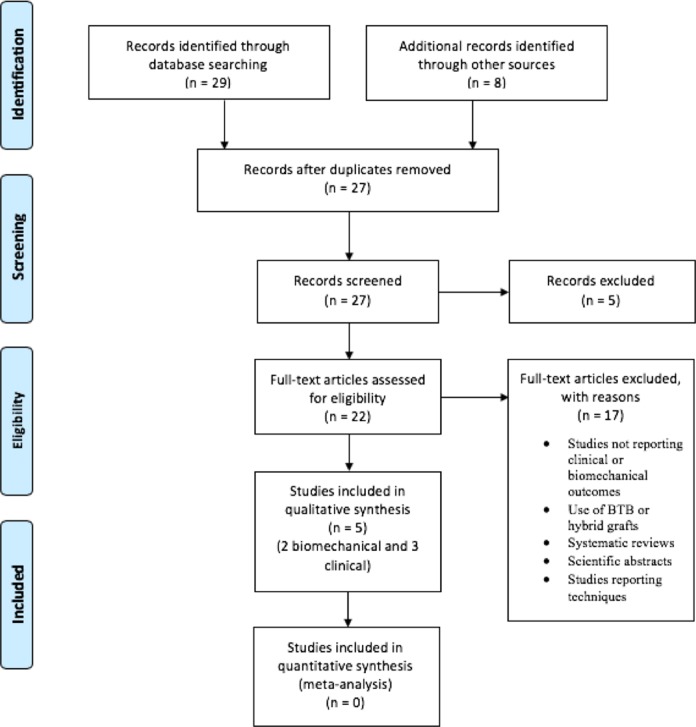
A systematic review using PRISMA (Preferred Reporting Items for Systematic Meta-Analyses) guidelines was performed by searching PubMed, Embase, and the Cochrane Library for studies reporting the biomechanical and clinical outcomes of 5HS autografts. All English-language literature published from 2012 to 2018 that reported the biomechanical properties of 5HS grafts and/or clinical outcomes after ACLR with 5HS autografts with a minimum 1-year follow-up was reviewed by 2 independent reviewers. Graft diameter, stiffness, displacement, strength, failure rates, anteroposterior knee laxity, and patient-reported outcome scores were collected. The study methodology was evaluated using the modified Coleman Methodology Score.
Two biomechanical and 3 clinical studies (1 with level 2 evidence, 2 with level 3 evidence) were included. The biomechanical studies compared the results of fourteen 4-strand hamstring (4HS) and fourteen 5HS graft specimens for ACLR (ovine grafts, n = 12; cadaveric grafts, n = 16) and found no significant differences in ultimate load, stiffness, displacement, and stress relaxation ( > .05), likely attributed to insufficient incorporation of the fifth strand. The mean 5HS cadaveric graft diameter (8.2 mm) was significantly greater than that of 4HS grafts (6.8 mm) ( .002), whereas the mean ovine graft diameters were not significantly different (4HS, 5.2 mm; 5HS, 5.3 mm) ( > .05). Two clinical studies compared the outcomes after ACLR of 53 patients with a 4HS autograft versus 62 patients with a 5HS autograft, while 1 clinical study reported the outcomes of 25 patients after ACLR with a 5HS autograft (mean age, 28.7 years; mean follow-up, 24.8 months). The overall mean diameter for 4HS and 5HS autografts was 8.4 and 9.1 mm, respectively. There was no significant difference in failure rates between 4HS and 5HS autografts ( = .82). None of the comparative studies reported significant differences in any clinical outcomes ( > .05 for all).
The available literature on traditional 4HS and 5HS autografts for ACLR is limited. Of the available data, clinical and biomechanical studies suggest no difference in outcomes after ACLR with either graft construct. Additional research is needed to determine whether creating a 5HS graft is beneficial.
近期研究描述了增加用于前交叉韧带重建(ACLR)的腘绳肌移植物直径的手术技术,特别是对于五股腘绳肌(5HS)自体移植物。
回顾研究5HS自体移植物用于ACLR的生物力学和临床结果的文献。
系统评价;证据等级,3级。
按照PRISMA(系统评价和Meta分析的首选报告项目)指南进行系统评价,通过检索PubMed、Embase和Cochrane图书馆查找报告5HS自体移植物生物力学和临床结果的研究。2名独立审阅者对2012年至2018年发表的所有英文文献进行了综述,这些文献报告了5HS移植物的生物力学特性和/或ACLR使用5HS自体移植物且至少随访1年的临床结果。收集移植物直径、刚度、位移、强度、失败率、膝关节前后向松弛度以及患者报告的结局评分。使用改良的科尔曼方法评分对研究方法进行评估。
纳入了2项生物力学研究和3项临床研究(1项为2级证据,2项为3级证据)。生物力学研究比较了用于ACLR的14个四股腘绳肌(4HS)和14个5HS移植物标本的结果(羊移植物,n = 12;尸体移植物,n = 16),发现极限载荷、刚度、位移和应力松弛方面无显著差异(P >.05),这可能归因于第五股的整合不足。5HS尸体移植物的平均直径(8.2 mm)显著大于4HS移植物(6.8 mm)(P =.002),而羊移植物的平均直径无显著差异(4HS,5.2 mm;5HS,5.3 mm)(P >.05)。2项临床研究比较了53例接受4HS自体移植物和62例接受5HS自体移植物的患者ACLR后的结果,而1项临床研究报告了25例接受5HS自体移植物的患者ACLR后的结果(平均年龄,28.7岁;平均随访,24.8个月)。4HS和5HS自体移植物的总体平均直径分别为8.4和9.1 mm。4HS和5HS自体移植物的失败率无显著差异(P =.82)。所有比较研究均未报告任何临床结果存在显著差异(所有P >.05)。
关于传统4HS和5HS自体移植物用于ACLR的现有文献有限。在现有数据中,临床和生物力学研究表明两种移植物结构在ACLR后的结果无差异。需要进一步研究以确定创建5HS移植物是否有益。